
Blackjack Basic Strategy Chart (4–8 Decks)
Basic strategy is the set of decisions that gives the highest expected return for every combination of your hand and the dealer’s upcard, using only the cards you can see. It was derived by computer simulation and is fixed for a given rule set. Played without errors in a 3:2, S17 multi-deck game, it brings the house edge down to roughly 0.4%–0.5%. Guessing or “never bust” play typically costs 2% or more.
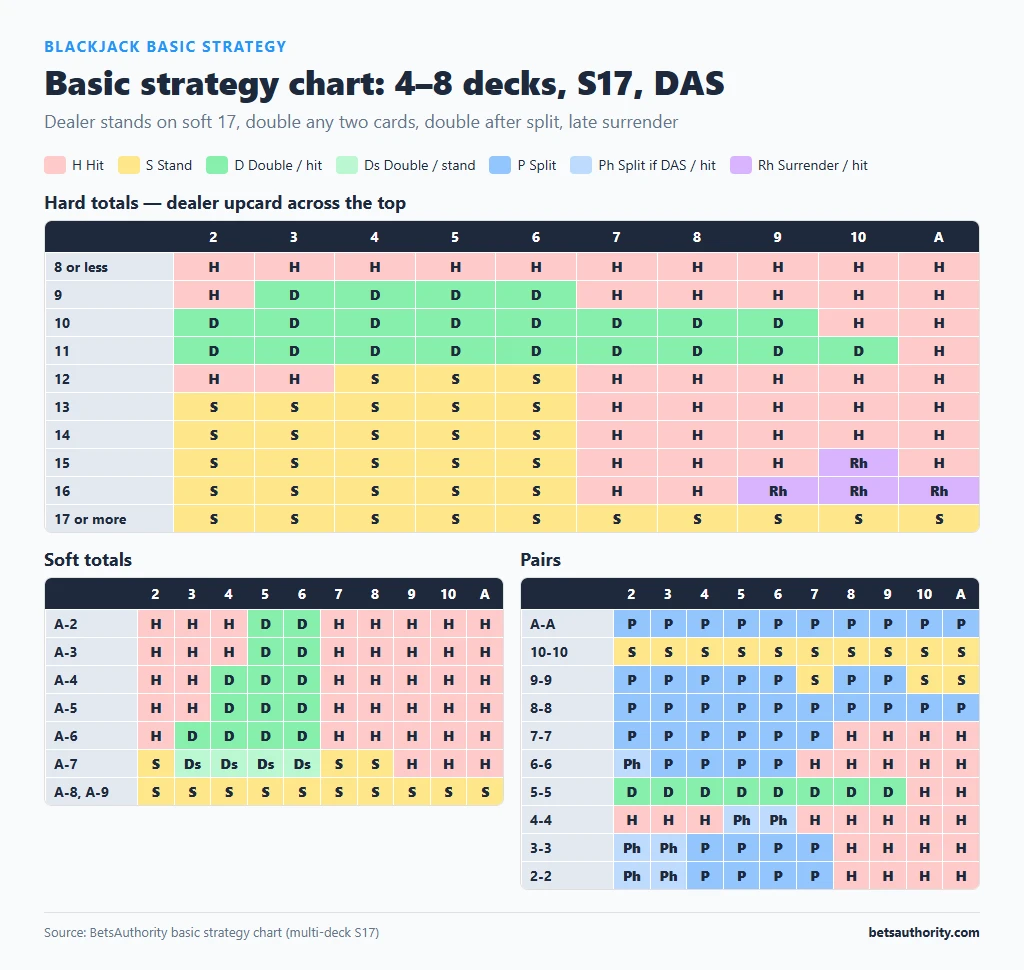
The charts below are for 4 to 8 decks, dealer stands on soft 17 (S17), double on any two cards, double after split allowed, late surrender allowed. This matches most live dealer tables and many RNG games. Changes for H17 tables follow the charts. The rules themselves are on our blackjack rules page, and the full game overview is in the blackjack guide.
Chart Key
| Code | Action |
|---|---|
| H | Hit |
| S | Stand |
| D | Double if allowed, otherwise hit |
| Ds | Double if allowed, otherwise stand |
| P | Split |
| Ph | Split if double after split is allowed, otherwise hit |
| Rh | Surrender if allowed, otherwise hit |
Hard Totals
| Your hand | 2 | 3 | 4 | 5 | 6 | 7 | 8 | 9 | 10 | A |
|---|---|---|---|---|---|---|---|---|---|---|
| 8 or less | H | H | H | H | H | H | H | H | H | H |
| 9 | H | D | D | D | D | H | H | H | H | H |
| 10 | D | D | D | D | D | D | D | D | H | H |
| 11 | D | D | D | D | D | D | D | D | D | H |
| 12 | H | H | S | S | S | H | H | H | H | H |
| 13 | S | S | S | S | S | H | H | H | H | H |
| 14 | S | S | S | S | S | H | H | H | H | H |
| 15 | S | S | S | S | S | H | H | H | Rh | H |
| 16 | S | S | S | S | S | H | H | Rh | Rh | Rh |
| 17 or more | S | S | S | S | S | S | S | S | S | S |
Two patterns cover most of the table. Against a dealer 2 to 6 the dealer busts often (35%–42% of the time), so you stand on 13 to 16 and let the dealer take the risk. Against 7 to Ace the dealer busts far less (12%–26%), so a total of 12 to 16 must be improved. The bust figures by upcard are on the dealer rules page.
Soft Totals
| Your hand | 2 | 3 | 4 | 5 | 6 | 7 | 8 | 9 | 10 | A |
|---|---|---|---|---|---|---|---|---|---|---|
| A-2 (soft 13) | H | H | H | D | D | H | H | H | H | H |
| A-3 (soft 14) | H | H | H | D | D | H | H | H | H | H |
| A-4 (soft 15) | H | H | D | D | D | H | H | H | H | H |
| A-5 (soft 16) | H | H | D | D | D | H | H | H | H | H |
| A-6 (soft 17) | H | D | D | D | D | H | H | H | H | H |
| A-7 (soft 18) | S | Ds | Ds | Ds | Ds | S | S | H | H | H |
| A-8, A-9 | S | S | S | S | S | S | S | S | S | S |
Soft hands cannot bust on the next card, which is why they are doubled more aggressively than hard hands. Soft 18 against 9, 10 or Ace is the most commonly misplayed hand: it is a hit. The reasoning is on our soft hands page.
Pairs
| Your pair | 2 | 3 | 4 | 5 | 6 | 7 | 8 | 9 | 10 | A |
|---|---|---|---|---|---|---|---|---|---|---|
| A-A | P | P | P | P | P | P | P | P | P | P |
| 10-10 | S | S | S | S | S | S | S | S | S | S |
| 9-9 | P | P | P | P | P | S | P | P | S | S |
| 8-8 | P | P | P | P | P | P | P | P | P | P |
| 7-7 | P | P | P | P | P | P | H | H | H | H |
| 6-6 | Ph | P | P | P | P | H | H | H | H | H |
| 5-5 | D | D | D | D | D | D | D | D | H | H |
| 4-4 | H | H | H | Ph | Ph | H | H | H | H | H |
| 3-3 | Ph | Ph | P | P | P | P | H | H | H | H |
| 2-2 | Ph | Ph | P | P | P | P | H | H | H | H |
If a pair is not split, play it as the hard total (5-5 is a hard 10, 10-10 is a hard 20). Why 8s are always split and 10s never are is explained on the splitting pairs page.
Changes When the Dealer Hits Soft 17 (H17)
| Hand | vs | S17 play | H17 play |
|---|---|---|---|
| 11 | A | Hit | Double |
| A-7 (soft 18) | 2 | Stand | Double, otherwise stand |
| A-8 (soft 19) | 6 | Stand | Double, otherwise stand |
| 15 | A | Hit | Surrender, otherwise hit |
| 17 | A | Stand | Surrender, otherwise stand |
| 8-8 | A | Split | Surrender, otherwise split |
Changes for Other Rules
- No double after split: split 2-2 and 3-3 only against 4 to 7, split 6-6 only against 3 to 6, never split 4-4 (play as hard 8), and play the “Ph” cells as hits.
- No surrender: play every “Rh” cell as a hit.
- European no hole card (all bets lost to dealer blackjack): hit 11 against 10 and Ace, and against a 10 or Ace hit 8-8 rather than split, and do not split A-A against an Ace. Our European vs American page covers this format.
- Single and double deck: several cells differ (for example 11 vs Ace is a double, 9 vs 2 is a double in single deck). Use a deck-specific chart for those games.
How Much Does Each Mistake Cost?
Basic strategy errors are not equally expensive. The costliest common ones, in expected loss per A$100 staked on the hand where the error is made, are rough but useful guides:
| Mistake | Why it costs |
|---|---|
| Taking insurance without counting | Insurance returns about -7.4% per unit in a 6-deck game |
| Standing on 12–16 against 7 to Ace | Dealer makes 17+ on about 74%–88% of hands from those upcards |
| Not doubling 11 against 2 to 10 | Loses the largest edge situation the player gets |
| Not splitting 8-8 | 16 is the weakest total; two hands starting on 8 lose less |
| Splitting 10-10 | Breaks up a 20, which loses only to a dealer 21 (under 12% of non-blackjack dealer hands against any upcard) |
| Hitting soft 18 vs 2, 7, 8 | Soft 18 already beats or ties most dealer outcomes there |
Insurance maths is on our insurance page, and other frequent errors are listed in common blackjack mistakes.
Five Worked Examples
- You hold 7-5 (hard 12), dealer shows 3. Chart: H. A dealer 3 busts about 37% of the time, which is not enough to justify standing on the weakest stiff total. Only the 9s, 10s and face cards (5 of 13 ranks) can bust you on the next card.
- You hold A-7, dealer shows 9. Chart: H. A dealer 9 finishes on 19, 20 or 21 about 53% of the time, so 18 is an underdog and improving it is worth the small risk of dropping to a hard total.
- You hold 9-9, dealer shows 7. Chart: S. Your 18 already beats the most likely dealer result of 17 (about 37% of dealer 7 outcomes).
- You hold 10-6, dealer shows 10, surrender available. Chart: Rh. Surrender loses exactly 50% of the stake; playing the hand on loses more than that on average.
- You hold 6-5, dealer shows 10. Chart: D. In a peek game the dealer has already confirmed no blackjack, and an 11 is favoured to finish on 21 or 20 often enough that the doubled stake pays.
Using the Chart Online
- Open the game info and confirm decks, S17 or H17, doubling, double after split and surrender.
- Keep the matching chart open beside the game. Online RNG games and live tables both allow this.
- Play the free or demo version until decisions are automatic — see demo play.
- Set a session stake. At A$10 per hand and an assumed 60 hands per hour, a 0.5% edge is an average cost of about A$3 per hour; the swings from hand to hand are far larger. Our bankroll management guide covers sizing.
Basic strategy does not create a player edge. Only card counting in a dealt shoe can do that, and online RNG games reshuffle each round — see card counting.
Frequently Asked Questions
No. It minimises the house edge to roughly 0.4%–0.5% in a standard 3:2, S17 multi-deck game. The casino still keeps an advantage over the long run and short sessions vary widely.
Yes. Online RNG and live dealer blackjack let you keep a chart open. Land-based casinos usually allow printed cards at the table as well.
Simulations show hitting 12 loses slightly less than standing against 2 and 3, because those upcards bust only about 35%–37% of the time. Against 4 to 6, standing is better.
Slightly. With H17 you double 11 against an Ace, double soft 18 against 2 and soft 19 against 6, and surrender 15, 17 and 8-8 against an Ace where surrender is offered.
A few cells change between single deck, double deck and 4–8 decks. The chart on this page is for 4–8 decks, which covers most live and RNG tables.
18+ only. For free, confidential support call Gambling Help Online on 1800 858 858.