
Soft Hands in Blackjack: How to Play Soft 13 to Soft 20
A soft hand is any hand containing an Ace that is currently counted as 11. A-6 is soft 17; A-2-4 is also soft 17. The defining property is that the next card cannot bust the hand: if the total would go over 21, the Ace simply drops to 1 and the hand becomes hard. That safety changes the correct strategy, and soft hands are where many players lose the most value through misplays. This page is part of our blackjack guide.
Soft vs Hard: Quick Examples
| Cards | Total | Type |
|---|---|---|
| A-6 | 17 | Soft (Ace = 11) |
| A-6-5 | 12 | Hard (Ace = 1, since 22 would bust) |
| A-A | 12 | Soft 12 (one Ace = 11) — but treated as a pair and split |
| A-2-A | 14 | Soft 14 |
| A-9 | 20 | Soft 20 |
| A-5-10 | 16 | Hard 16 |
Live and RNG games usually show soft totals as two numbers, such as “7/17”. The higher number is the soft total.
Soft Hand Strategy Chart (4–8 Decks, S17)
D = double if allowed, otherwise hit. Ds = double if allowed, otherwise stand.
| Hand | 2 | 3 | 4 | 5 | 6 | 7 | 8 | 9 | 10 | A |
|---|---|---|---|---|---|---|---|---|---|---|
| Soft 13 (A-2) | H | H | H | D | D | H | H | H | H | H |
| Soft 14 (A-3) | H | H | H | D | D | H | H | H | H | H |
| Soft 15 (A-4) | H | H | D | D | D | H | H | H | H | H |
| Soft 16 (A-5) | H | H | D | D | D | H | H | H | H | H |
| Soft 17 (A-6) | H | D | D | D | D | H | H | H | H | H |
| Soft 18 (A-7) | S | Ds | Ds | Ds | Ds | S | S | H | H | H |
| Soft 19 (A-8) | S | S | S | S | S | S | S | S | S | S |
| Soft 20 (A-9) | S | S | S | S | S | S | S | S | S | S |
In H17 games: A-7 against 2 becomes Ds and A-8 against 6 becomes Ds. A soft hand of three or more cards is played the same way, but if doubling is no longer allowed, “D” becomes hit and “Ds” becomes stand.
Soft 17: Never Stand
A soft 17 is never a standing hand for the player. A standing 17 wins only when the dealer busts, pushes against a dealer 17 and loses to every dealer 18–21. Since the next card cannot bust a soft 17, you hit (or double against 3 to 6). Over the long run, standing on soft 17 is clearly worse than hitting against every upcard.
Soft 18: The Most Misplayed Hand
Most players stand on any 18. With A-7 the correct play depends on the upcard:
- Against 2, 7, 8: stand. 18 already beats or ties the dealer’s most frequent results (from a 7, the most likely dealer total is 17, about 37% of outcomes; from an 8, it is 18, about 36%).
- Against 3 to 6: double, or stand if doubling is not allowed. The dealer busts 37%–42% of the time from these cards, and a soft 18 rarely gets worse with one more card.
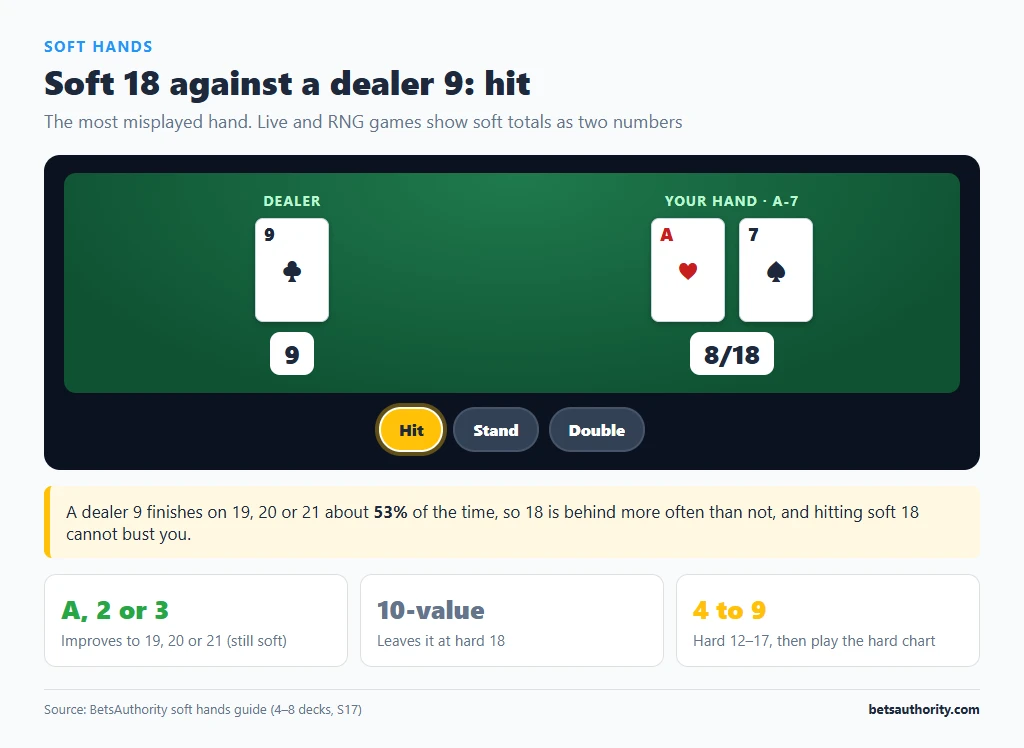
- Against 9, 10 and Ace: hit. A dealer 9 finishes on 19, 20 or 21 about 53% of the time; a dealer 10 after the peek finishes on 19–21 about 53% too. An 18 is behind more often than not, and hitting soft 18 cannot bust you.
What happens when you hit A-7: any A, 2 or 3 improves the hand to 19, 20 or 21 (still soft). A 10-value card leaves it at hard 18. Cards 4–9 turn it into hard 12–17, which is then played by the hard chart.
Soft 19 and Soft 20
Stand on soft 19 and soft 20 in multi-deck S17 games. The one exception is A-8 against a 6 in H17 games, which is a double. Soft 20 is never doubled in standard play.
The Dealer’s Soft 17 Rule
The dealer’s rule on soft 17 is printed on the table: “Dealer stands on all 17s” (S17) or “Dealer hits soft 17” (H17). H17 adds about 0.22% to the house edge, because the dealer improves soft 17 more often than busting from it. From a dealer 6 upcard, S17 dealers finish on exactly 17 about 16.5% of the time; H17 dealers about 11.5%, with more of those hands turned into 18–21 and slightly more busts. The full dealer table is on our dealer rules page.
Why Soft Doubles Pay
Doubling A-2 against a 5 looks reckless, but it uses two facts: the hand cannot bust with one card, and a dealer 5 busts about 42% of the time. Doubling against weak upcards puts twice the money into a position where the dealer often loses regardless of your total. Against a 2 or 3 the dealer busts less, so the lower soft totals are hits there.
Common Soft-Hand Errors
- Standing on soft 17 (“17 is a made hand”).
- Standing on soft 18 against 9, 10 or Ace.
- Not doubling A-2 to A-7 against 5 and 6.
- Treating A-A as soft 12 instead of splitting it (see splitting pairs).
- Doubling soft 19 or soft 20 in S17 games.
These are among the errors listed in common blackjack mistakes. The full strategy for hard totals and pairs is on our basic strategy chart; doubling decisions are explained on the doubling down page.
Practice
The fastest way to learn soft hands is repetition in demo mode with the chart open. Most RNG blackjack games offer free play; our demo play guide explains how to find it.
Frequently Asked Questions
A hand with an Ace counted as 11, such as A-6 (soft 17). It cannot bust with one more card because the Ace can revert to 1.
Against a dealer 9, 10 or Ace, yes. Stand against 2, 7 and 8, and double against 3 to 6 where allowed.
No. Hit, or double against 3 to 6. Soft 17 cannot bust on the next card and wins rarely as a standing hand.
The dealer must take another card with A-6 or another soft 17. It adds about 0.22% to the house edge compared with a dealer who stands.
Technically it is soft 12, but you should always split Aces rather than play it as a total.
18+ only. For support, contact Gambling Help Online on 1800 858 858.