
The Interactive Gambling Act 2001 Explained

The Interactive Gambling Act 2001 (Cth), usually shortened to the IGA, is the Commonwealth law that decides which gambling services can be offered online or by phone to people in Australia. ACMA describes it as setting “the rules for companies that offer or advertise gambling services”. It covers gambling through websites, apps and telephone.
This page explains the Act’s key terms, what it prohibits, how it is enforced, and how it has been amended up to the reform bill passed in August 2026. For a shorter yes/no answer, see is online gambling legal in Australia.
Key Terms in the Act
| Term | Meaning in practice |
|---|---|
| Interactive gambling service | A gambling service provided over the internet, a phone line or another broadcast or data service, for a fee, where chance is involved |
| Prohibited interactive gambling service | Services that cannot be offered online to people in Australia at all, such as online casino games, online pokies and online in-play betting on sport |
| Regulated interactive gambling service | Wagering services (for example sports and racing betting) that may be offered only by a provider holding an Australian state or territory licence |
| Australian-customer link | The test for whether a service is provided to customers physically present in Australia; it applies even when the operator is based overseas |
| Excluded services | Categories the Act carves out, such as licensed pre-match wagering and official lotteries |
What the Act Prohibits
According to ACMA, banned services include:
- online casinos, including pokies and table games;
- in-play sports betting online (phone in-play betting is permitted);
- sports betting services that do not hold an Australian licence;
- betting on the outcome of a lottery.
The Act also prohibits advertising these services in Australia, prohibits licensed wagering providers from offering or facilitating credit, and underpins BetStop, the National Self-Exclusion Register.
Who Can Be Penalised
The prohibitions are directed at providers, their directors and principals, and advertisers. Providing a prohibited service to customers with an Australian-customer link is both an offence and a civil penalty provision, and each day of contravention is treated as a separate contravention. People who are “knowingly concerned” in a contravention, such as affiliates and promoters, can also be pursued.
The Act does not contain a provision that penalises a person for using a prohibited service. ACMA’s consumer warning focuses on financial risk: users of illegal services are not protected by Australian law if a provider withholds winnings.
Enforcement Tools
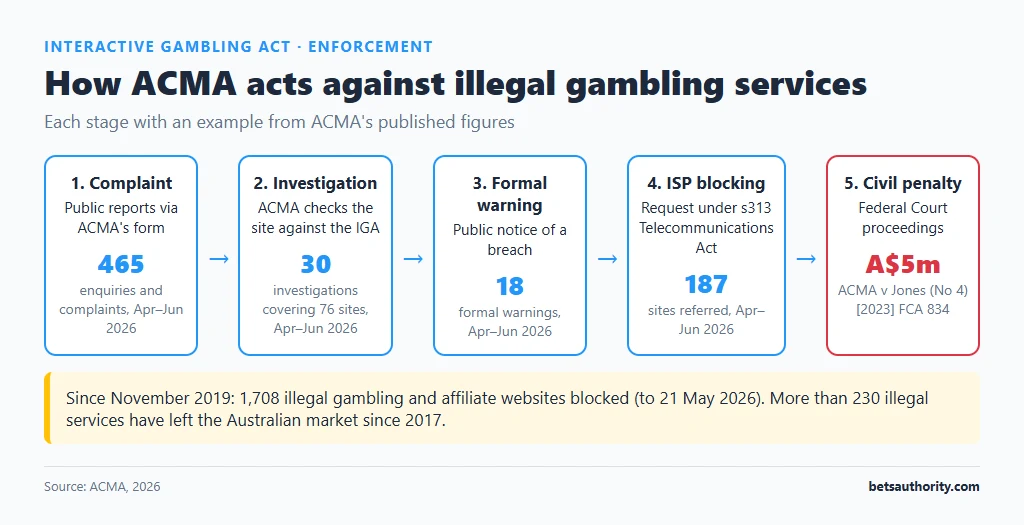
| Tool | What it does | Example |
|---|---|---|
| Formal warning | Public notice that the ACMA found a breach | 18 formal warnings issued in April–June 2026 |
| Website blocking | ACMA asks internet service providers to block a domain under s313 of the Telecommunications Act 1997 | 1,708 sites blocked between November 2019 and 21 May 2026 |
| Family-friendly filters | Blocked URLs are passed to accredited filter providers | 187 URLs reported in April–June 2026 |
| Infringement notice | A fixed penalty paid instead of court action | Picklebet paid A$19,800 for a BetStop breach (October 2026) |
| Court-enforceable undertaking and remedial direction | Requires a provider to fix its systems, often with an independent audit | Tabcorp paid A$112,680 and entered an undertaking over BetStop breaches (January 2026) |
| Civil penalty proceedings | ACMA asks the Federal Court to impose penalties | Federal Court penalty of A$5 million in ACMA v Jones (No 4) [2023] FCA 834 |
| Border Force referral | Directors and principals of offending companies can be referred to the Australian Border Force | Power added by the 2017 amendments |
Amendments Since 2001
| Year | Amendment | Effect |
|---|---|---|
| 2017 | Interactive Gambling Amendment Act 2017 | Made it explicit that unlicensed wagering is illegal, created the licensed-provider register, added civil penalties and director referrals; followed the 2016 Review of Illegal Offshore Wagering |
| 2018 | Interactive Gambling Amendment (Lottery Betting) Act | Banned betting on the outcome of lotteries |
| 2019 | Amendment enabling a national self-exclusion register | Legal basis for BetStop, which launched on 21 August 2023 |
| 2023 | Credit ban legislation | From 11 June 2024, licensed online and phone wagering providers cannot accept credit cards, credit-linked wallets or digital currency |
| 2026 | Interactive Gambling Amendment (Gambling Reform) Bill 2026, passed 19 August 2026 | Advertising restrictions, an opt-out register for gambling ads, limits on inducements, a ban on activity-based commissions to staff or affiliates, takedown powers against illegal services; most measures commence 1 January 2027 |
ACMA states that since the 2017 reforms more than 230 illegal services have withdrawn from the Australian market.
How the IGA Fits With State Law
The IGA governs online and phone delivery. Licensing of bookmakers, lotteries, casinos and venue pokies is done by each state and territory. The National Consumer Protection Framework for Online Wagering adds 10 minimum protections for licensed wagering customers, including deposit limits, monthly activity statements and identity verification before the first bet. These protections do not reach offshore casinos, which is one reason the offshore casinos page treats licence checks and complaint routes separately.
What the IGA Means for You as a Player
- If you use a licensed Australian betting app, the IGA and the National Framework give you tools such as BetStop, deposit limits and ACMA complaints.
- If you use an offshore casino, the IGA does not penalise you, but none of those protections apply. Disputes go to the overseas licensing body, as explained in how to file a complaint.
- Domains of offshore casinos can be blocked by your ISP without notice. See how ACMA blocking works.
Read the Act itself at legislation.gov.au and ACMA’s summary at acma.gov.au.
This guide is part of our online gambling in Australia section, which covers the law, licences, complaints and player protections.
Keep reading
All in Online Gambling in Australia- Tobique Gaming Licence Explained for AustraliansWhat the Tobique Gaming Commission is, how its colour-coded seal works, where to complain and what…Read guide
- VPNs and Online CasinosUsing a VPN at an online casino can lead to closed accounts and voided winnings. What…Read guide
- Anjouan Gaming Licence Explained for AustraliansWho issues Anjouan gaming licences, what the licence covers, how to check a seal and where…Read guide
Frequently Asked Questions
It sets which gambling services can be provided online or by phone to people in Australia. It bans online casinos, online in-play sports betting, unlicensed wagering and betting on lottery outcomes, and it bans advertising those services.
No offence in the Act applies to the customer. The prohibitions and penalties apply to providers, their directors, and people who advertise or promote illegal services.
The Australian Communications and Media Authority (ACMA). It investigates complaints, issues warnings and infringement notices, asks internet providers to block websites and takes civil penalty cases to the Federal Court.
It made unlicensed online wagering clearly illegal, introduced a public register of licensed wagering providers, added civil penalties and allowed ACMA to refer directors of offending companies to the Australian Border Force.
The Gambling Reform Bill passed on 19 August 2026. ACMA says most of the reforms commence on 1 January 2027.
Gambling is for adults 18+ only. Free, confidential support is available 24/7 from Gambling Help Online on 1800 858 858.