
When to Split Pairs in Blackjack
Splitting turns one pair into two separate hands, each carrying a stake equal to the original bet. It is the one decision in blackjack where you can put more money on the table after seeing the cards, so the right splits gain value and the wrong ones double your exposure on a bad hand. This page gives the split chart for multi-deck games, the reasoning for each pair, and the table rules that change it. It is part of our blackjack guide.
Split Rules You Need to Know
| Rule | Common online setting | Why it matters |
|---|---|---|
| Which pairs can be split | Any two cards of the same rank; many games also allow any two 10-value cards (K-Q) | Some tables require identical ranks |
| Maximum hands | 2 at many live tables (no resplit); up to 4 at many RNG games | Resplitting helps the player by about 0.10% |
| Split Aces | One card each, no further action | Drawing to split Aces would be worth about 0.19% |
| Resplit Aces | Usually not allowed | Allowing it is worth about 0.08% |
| Double after split (DAS) | Usually allowed | Without it the house edge rises about 0.14% |
| 21 after splitting Aces | Counts as 21, not blackjack; pays 1:1 | A split A-10 does not get 3:2 |
Check the help screen for these before applying a chart.
Pair Splitting Chart (4–8 Decks, S17, DAS)
P = split, Ph = split only if double after split is allowed (otherwise hit), H = hit, S = stand, D = double.
| Pair | 2 | 3 | 4 | 5 | 6 | 7 | 8 | 9 | 10 | A |
|---|---|---|---|---|---|---|---|---|---|---|
| A-A | P | P | P | P | P | P | P | P | P | P |
| 10-10 | S | S | S | S | S | S | S | S | S | S |
| 9-9 | P | P | P | P | P | S | P | P | S | S |
| 8-8 | P | P | P | P | P | P | P | P | P | P |
| 7-7 | P | P | P | P | P | P | H | H | H | H |
| 6-6 | Ph | P | P | P | P | H | H | H | H | H |
| 5-5 | D | D | D | D | D | D | D | D | H | H |
| 4-4 | H | H | H | Ph | Ph | H | H | H | H | H |
| 3-3 | Ph | Ph | P | P | P | P | H | H | H | H |
| 2-2 | Ph | Ph | P | P | P | P | H | H | H | H |
The full chart, including hard and soft totals, is on our basic strategy page.
Always Split Aces
A-A played as one hand is a soft 12, a mediocre total. Split, each Ace starts a new hand, and 4 of the 13 ranks (all 10-value cards) give 21 immediately. Even with only one card per Ace, two hands starting from 11 are far stronger than a single soft 12. This holds against every upcard, including a dealer Ace.
Always Split 8s
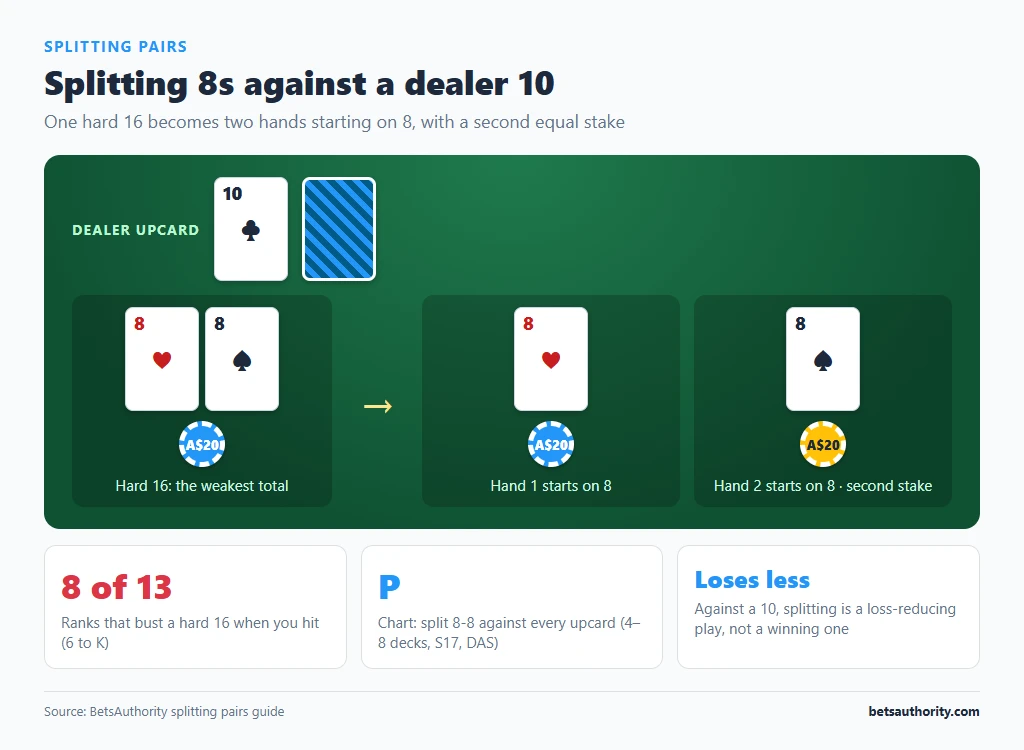
8-8 is hard 16, the worst total in blackjack: standing loses to any dealer 17–21, and hitting busts on 6, 7, 8, 9, 10, J, Q, K (8 of 13 ranks). Two hands starting from 8 still lose money against a dealer 9, 10 or Ace, but they lose less than one 16. Splitting 8s against a 10 is a loss-reducing play, not a winning one.
Exception: in strict no-hole-card games where a dealer blackjack takes split stakes, hit 8-8 against a 10 or Ace rather than risk two bets. In H17 games with late surrender, 8-8 against an Ace is a surrender.
Never Split 10s or 5s
10-10 is a 20. Against any upcard, 20 loses only to a dealer 21, which happens on under 12% of non-blackjack dealer hands for every upcard (about 6%–7.4% against a 7, 8 or 9 up). Splitting two 10s gives up a near-certain win for two hands that each start on 10. Even against a dealer 6, which busts about 42% of the time, standing is the higher-value play for a basic-strategy player.
5-5 is a 10. As a single hand it is one of the strongest doubling totals; as two hands starting on 5 it is weak. Play 5-5 as hard 10: double against 2 to 9.
Split 9s — Except Against 7, 10 and Ace
9-9 is 18. Against 2 to 6 and against 8 and 9, two hands starting on 9 earn more than one 18. Against a 7, stand: the dealer’s most likely result from a 7 is 17 (about 37% of outcomes), which your 18 already beats. Against a 10 or Ace the dealer is strong enough that splitting puts more money into an unfavourable position; standing on 18 loses less.
7s, 6s, 4s, 3s and 2s
- 7-7 (hard 14): split against 2 to 7. Against 8 or higher, two hands starting on 7 are weak; hit.
- 6-6 (hard 12): split against 3 to 6 (and 2 when double after split is allowed). The dealer busts most often from those upcards.
- 4-4 (hard 8): split only against 5 and 6 when double after split is allowed, so that a 4-6 or 4-7 can be doubled. Otherwise hit.
- 3-3 and 2-2: split against 2 to 7 with DAS, against 4 to 7 without.
How Rule Changes Affect the Chart
| Rule | Chart change |
|---|---|
| No double after split | 2-2, 3-3: split 4–7 only. 6-6: split 3–6 only. 4-4: never split. |
| H17 with surrender | 8-8 vs Ace: surrender if allowed, otherwise split |
| European no hole card (lose all) | A-A vs Ace: hit; 8-8 vs 10 or Ace: hit |
| Single or double deck | Some extra splits (e.g. 2-2 and 3-3 vs 2 to 7 even without DAS in single deck); use a deck-specific chart |
The no-hole-card format is described on our European vs American page.
A$ Example
You bet A$20 and receive 8-8 against a dealer 6. You split, placing a second A$20. Hand one draws a 3 for 11; with double after split you double it to A$40 and draw a 10 for 21. Hand two draws a 10 for 18; you stand. The dealer turns 10 for 16, draws 9 and busts. Total staked A$60, total won A$60.
If the dealer had made 19 instead, you would win A$40 on the 21 and lose A$20 on the 18: net +A$20. Splitting against weak upcards creates exactly these multi-bet situations, which is where the value of the split comes from. That is also why a session budget should allow for occasional splits and doubles: see bankroll management.
Related decisions: doubling down and soft hands.
Frequently Asked Questions
In standard multi-deck games with a peek or original-bets-only rule, yes. In strict no-hole-card games where dealer blackjack takes split stakes, hit 8-8 against a 10 or Ace and hit A-A against an Ace.
A 20 already wins most hands against a 6. Splitting replaces it with two hands starting on 10, which have a lower combined expected value for a basic-strategy player.
No. It counts as 21 and pays 1:1 in almost all games.
Usually up to three or four hands in RNG games and once (two hands) at many live tables. The help screen states the limit.
After splitting, you may double down on one of the new hands. Most online games allow it; without it the house edge rises by about 0.14%.
Gambling is for 18+. Free and confidential support: Gambling Help Online, 1800 858 858.