
European vs American Blackjack: Rule Differences
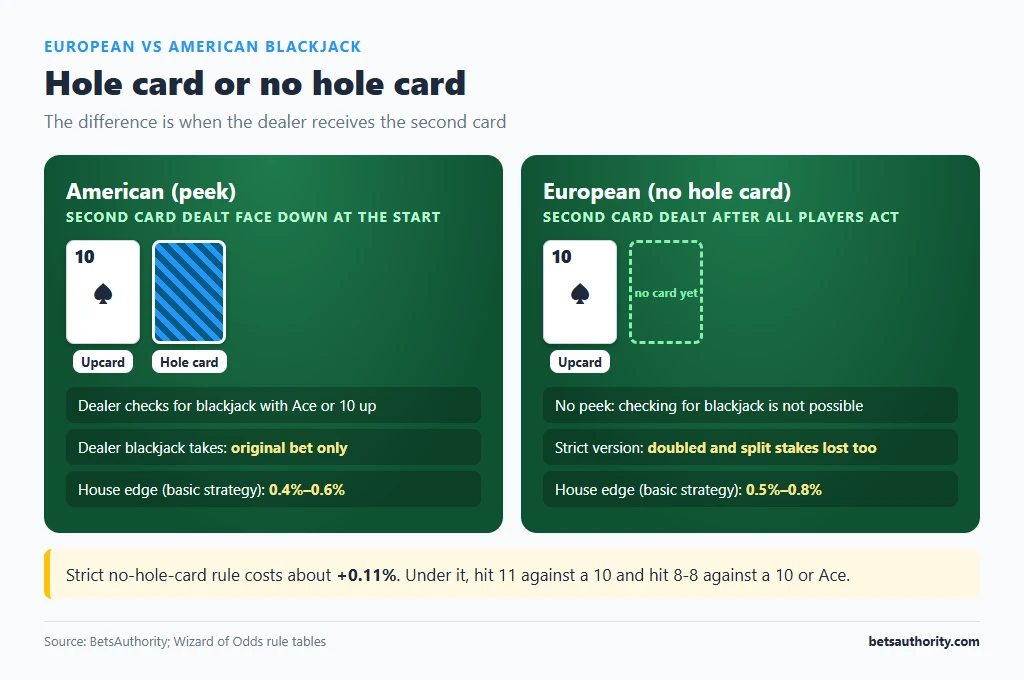
“European” and “American” blackjack are not two different games. They are two sets of table procedures, and the main difference is when the dealer receives the second card. In American blackjack the dealer takes a hole card and checks for blackjack before you act. In European blackjack there is no hole card: the dealer draws the second card after all players finish. That single change affects what you can lose to a dealer blackjack, and it changes a handful of strategy decisions. This page is part of our blackjack guide.
Side-by-Side Comparison
| Feature | American (hole card, peek) | European (no hole card) |
|---|---|---|
| Dealer’s second card | Dealt face down at the start | Dealt after all players act |
| Dealer checks for blackjack | Yes, with Ace or 10 up | Not possible |
| Loss to dealer blackjack | Original bet only (you could not double or split yet) | Strict version: all doubled and split stakes lost; some games return them (“original bets only”) |
| Typical decks | 6–8 (shoe), sometimes 1–2 (pitch) | Often 2–6 in RNG, 8 in live studios |
| Typical doubling | Any first two cards | Any two cards, or 9–11 / 10–11 only |
| Resplitting | Commonly to 3–4 hands | Often not allowed |
| Surrender | Late surrender at some tables | Rare |
| Approx. house edge (basic strategy) | 0.4%–0.6% | 0.5%–0.8% |
The figures assume 3:2 blackjack and dealer standing on soft 17. A 6:5 payout or H17 adds cost in both formats.
What the No-Hole-Card Rule Costs
The Wizard of Odds rule tables put the cost of the strict European no-hole-card rule (losing doubled and split stakes to a dealer blackjack) at about 0.11%, split into roughly 0.08% from doubling and 0.03% from splitting. “Original bets only” versions, where the extra stakes are returned, cost close to nothing compared with a peek game.
Other common European restrictions add more:
| European-style restriction | Added house edge |
|---|---|
| No hole card, lose all to dealer blackjack | +0.11% |
| Double on 9–11 only | +0.09% |
| Double on 10–11 only | +0.18% |
| No resplitting | +0.10% |
| No double after split | +0.14% |
A European game with strict no-hole-card, doubling on 9–11 only and no resplits costs about 0.30% more than the same game with American procedure.
Strategy Changes Under Strict No-Hole-Card Rules
When a dealer blackjack takes every chip on the table, putting extra money out against a 10 or Ace becomes more expensive. Adjust these cells of the multi-deck chart:
| Hand | vs | American (peek) play | European (lose all) play |
|---|---|---|---|
| 11 | 10 | Double | Hit |
| 11 | A | Hit (S17) / Double (H17) | Hit |
| 8-8 | 10 | Split | Hit |
| 8-8 | A | Split | Hit |
| A-A | A | Split | Hit |
Everything else follows the standard basic strategy chart. In “original bets only” games the American chart applies unchanged, because extra stakes are refunded if the dealer turns blackjack.
Why Peek Games Change Your Decisions
In a peek game, once the dealer has checked and play continues, you know the dealer does not have blackjack. Against a 10 that removes the 7.69% chance of an Ace in the hole; against an Ace it removes the 30.77% chance of a 10. Your double and split decisions are made with that information. In a no-hole-card game you act without it, so the doubled stake carries the risk of a dealer blackjack.
Where You Meet Each Format
- Online RNG games use both. Titles named “European Blackjack” usually follow the no-hole-card procedure with 2 decks and restricted doubling; “American” or “Vegas Strip” titles use a peek. The help screen is the only reliable source.
- Live dealer studios commonly deal without a hole card, and the treatment of doubled and split stakes against a dealer blackjack differs between providers. Check the help file before using the American chart. See live blackjack.
- Australian land-based casinos traditionally deal blackjack without a hole card, and rules on doubled and split stakes vary by venue. Read the table rule card. A local Spanish 21-style game, Pontoon, is covered on our variants page.
Worked Example
You bet A$20 with 6-5 (11) against a dealer 10.
- American peek game: the dealer has already checked: no blackjack. You double to A$40. Expected value favours doubling.
- European, original bets only: you double to A$40. If the dealer draws an Ace for blackjack, you lose A$20 and the extra A$20 is returned. Doubling is still correct.
- European, lose all: if the dealer draws an Ace (1 time in 13) you lose A$40. That extra risk is enough to make hitting the better play.
How to Identify the Procedure in a Game
- Open the help or rules screen and search for “hole card”, “peek” or “dealer checks for blackjack”.
- Look for a sentence on what happens to doubles and splits when the dealer has blackjack. “All bets lose” means strict European; “only the original bet is lost” means original bets only.
- Note the doubling rule (“any two cards” or “9, 10, 11 only”) and the maximum number of split hands.
- Watch one round with an Ace or 10 up. If the dealer has only one card while players act, it is a no-hole-card game.
Which Should You Choose?
At equal payouts and soft 17 rules, choose (in order): American procedure with peek, then European with original bets only, then strict European. Combine that with the rule list on our odds and house edge page to estimate the edge of any table you find. The dealer’s fixed procedure is explained on the dealer rules page.
Frequently Asked Questions
The hole card. American dealers take a face-down card and check for blackjack before players act; European dealers draw the second card after players act.
American (peek) with the same other rules. Strict European no-hole-card rules add about 0.11%, and typical European doubling and resplit limits add more.
Only for a few hands against a 10 or Ace if dealer blackjack takes all stakes: hit 11 against 10 and Ace, hit 8-8 against 10 and Ace, and hit A-A against an Ace.
If the dealer gets blackjack in a no-hole-card game, you lose only your original stake; doubled and split amounts are returned.
Many live studios deal without a hole card. Check the help file to see whether doubled and split stakes are lost or returned when the dealer makes blackjack.
18+. Free, confidential help: Gambling Help Online, 1800 858 858.