
12 Common Blackjack Mistakes and What They Cost
Blackjack has one of the lowest house edges in the casino, but only for players who use basic strategy at a table with standard rules. Most of the extra cost players pay comes from a short list of avoidable errors. The list below is grouped into table selection, playing decisions and money management, with the cost of each error where it can be measured. The background for each topic is in our blackjack guide.
Table Selection Mistakes
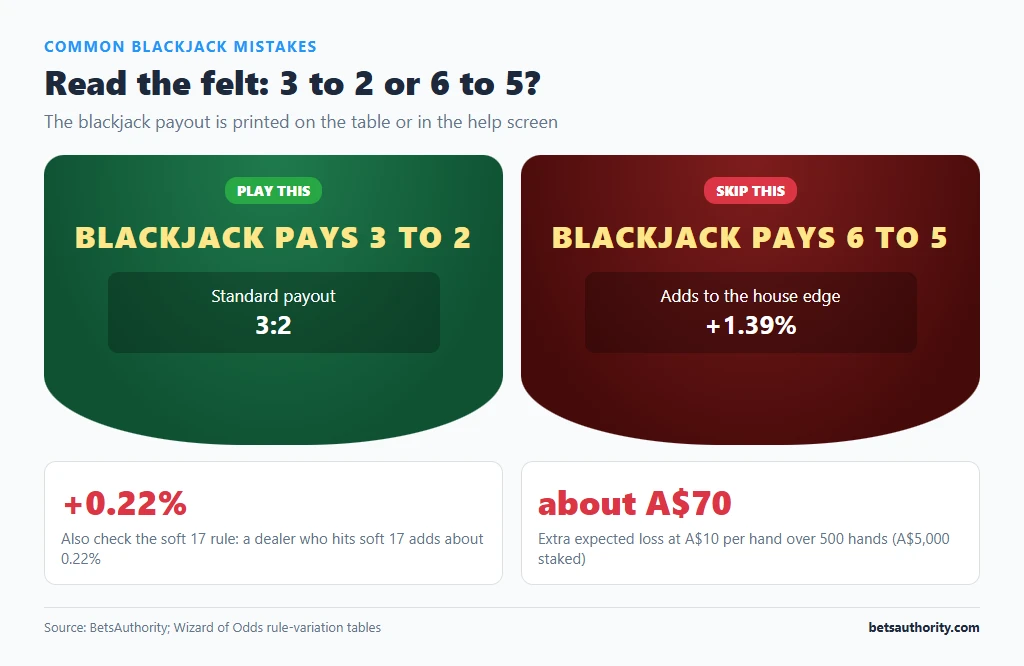
1. Playing a 6:5 table
A 6:5 blackjack payout adds about 1.39% to the house edge compared with 3:2. At A$10 per hand over 500 hands (A$5,000 staked), that is about A$70 of extra expected loss. Check the felt or help screen for “Blackjack pays 3 to 2”.
2. Ignoring the soft 17 rule
A dealer who hits soft 17 adds about 0.22%. If two otherwise identical tables are available, the S17 table costs less.
3. Not reading the game’s RTP and rules
The same branded game can run with different decks, doubling rules or payouts at different casinos. RTPs for standard 3:2 games usually sit around 99.3% to 99.6% with optimal play; a figure well below that points to a worse rule set. Our guide to checking a game’s RTP shows where to look.
Playing Mistakes
| Mistake | Correct play | Why |
|---|---|---|
| 4. Taking insurance or even money | Decline (unless counting at true count +3 or more) | Costs about 7.4% of the insurance stake in 6 decks |
| 5. Standing on 12–16 against 7 to Ace | Hit (surrender 16 vs 9/10/A and 15 vs 10 where allowed) | Dealer finishes on 17+ at least 74% of the time from these upcards |
| 6. Not splitting 8-8 | Split against every upcard (peek games) | Hard 16 is the weakest total |
| 7. Splitting 10-10 | Stand | 20 loses only to a dealer 21 |
| 8. Standing on soft 17 or soft 18 vs 9/10/A | Hit | Soft hands cannot bust on the next card |
| 9. Not doubling 11 vs 10, or 10 vs 9 | Double | Highest-value doubles in the game |
4. Insurance and even money
Insurance pays 2:1 but wins only about 30.9% of the time in a 6-deck shoe (96 of 311 unseen cards are 10s when you hold two non-10s). The expected value is −7.40% per unit. Even money on your blackjack is the same bet. Full maths: insurance page.
5. “Never bust” play
Standing on every 12–16 to avoid busting gives the dealer the chance to make a hand from a strong upcard. Against a 10 (after the peek), the dealer finishes on 17–21 about 77% of the time. Hitting 16 against a 10 busts often too, but it loses less than standing.
6–7. Wrong splits
8-8 is split against everything because two hands starting from 8 lose less than one 16. 10-10 is never split because a 20 wins most hands outright. Reasoning by pair: splitting pairs.
8. Misplaying soft hands
Soft 17 is never a stand. Soft 18 is a hit against 9, 10 and Ace and a double against 3 to 6. Details: soft hands.
9. Missing doubles
Never doubling at all adds about 1.48% to the house edge, according to the Wizard of Odds rule tables. Even partial reluctance (skipping soft doubles, not doubling 11 against a 10) adds measurable cost. See doubling down.
Money and Session Mistakes
10. Using progression systems
Doubling the bet after a loss (Martingale) or following other progressions does not change the house edge on any hand. It changes the size of the swings and creates occasional very large losses when a losing run meets the table maximum. In blackjack, doubles and splits also make the required stakes larger than in roulette. Our betting systems guide shows the numbers.
11. Side bets as a habit
A A$5 Perfect Pairs bet (house edge 4.10% at 8 decks) beside a A$10 main hand raises the expected cost per hand from about A$0.05 to about A$0.26, roughly five times as much. The figures are on our side bets page.
12. No stop point
Blackjack has low house edge but high hand-to-hand variance (standard deviation about 1.15 bets per hand). Without a fixed session budget and time limit, players often continue after a losing run. Casino deposit and session limits are explained in setting gambling limits.
Myths That Lead to Mistakes
| Myth | Fact |
|---|---|
| “A bad player at the table ruins the shoe for everyone” | Another player’s decisions change which cards you get, but not the odds of those cards. Over time the effect averages to zero. |
| “The dealer is due to bust” | Each hand is independent in RNG games; in shoe games the count matters, not recent results. See gambler’s fallacy. |
| “Always assume the hole card is a 10” | 10-value cards are 4 of 13 ranks (30.8%). Basic strategy uses the real probabilities. |
| “Insure good hands” | Your hand does not change the insurance odds, except that your own 10s make it worse. |
A Practical Checklist
- Confirm 3:2, S17 and double after split before betting.
- Keep the matching basic strategy chart open.
- Decline insurance and side bets.
- Fix a session budget and a time limit, and use the casino’s limit tools.
- Play bonus funds only if blackjack contributes to wagering (often 0%–10%; see game weighting).
Frequently Asked Questions
Playing a 6:5 table (+1.39% house edge) and taking insurance (−7.4% on every insurance stake) are the two biggest. Not doubling at all costs about 1.48%.
No. Both hitting and standing lose money on average, but hitting loses less. Surrender, if offered, is better still.
No. They change which cards appear, but not the probabilities. On average their choices help you as often as they hurt you.
No. Progressions change bet sizes, not the odds of each hand. The house edge applies to every dollar staked.
Typical intuitive play costs 2% or more; basic strategy brings a standard game to about 0.4%–0.6%.
18+ only. Gambling Help Online: 1800 858 858, free and available 24/7.