
Blackjack Side Bets: Odds and House Edge
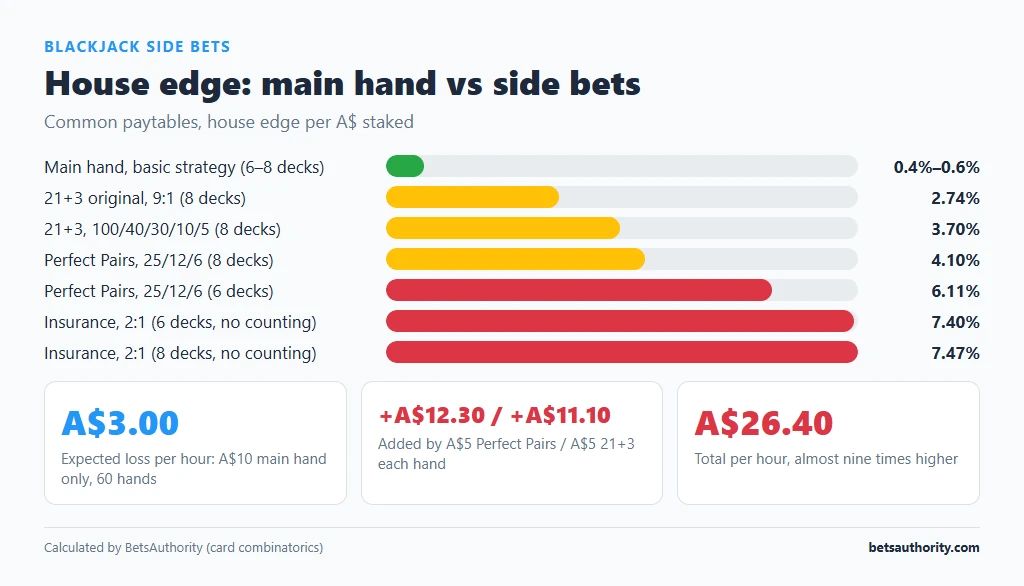
A side bet is an optional wager placed alongside the main blackjack hand and settled independently, usually on the first two player cards and the dealer’s upcard. Side bets pay large multiples, which makes them visible on live tables, but each one carries a house edge many times higher than the main game played with basic strategy (about 0.4%–0.6%). The figures below are calculated from the card combinatorics for the deck counts stated. More on the game itself is in our blackjack guide.
Summary Table
| Side bet | Common paytable | Decks | House edge |
|---|---|---|---|
| Perfect Pairs | 25 / 12 / 6 | 8 | 4.10% |
| Perfect Pairs | 25 / 12 / 6 | 6 | 6.11% |
| 21+3 | 100 / 40 / 30 / 10 / 5 | 8 | 3.70% |
| 21+3 (original) | 9:1 on any qualifying hand | 8 | 2.74% |
| Insurance | 2:1 | 8 | 7.47% (no counting) |
| Insurance | 2:1 | 6 | 7.40% (no counting) |
| Main hand, basic strategy | 3:2, S17 | 6–8 | about 0.4%–0.6% |
Insurance figures assume your own hand contains two non-10 cards. The calculation is on the insurance page.
Perfect Pairs
Wins if your first two cards are a pair.
| Outcome | Example | Pays | Probability (8 decks) |
|---|---|---|---|
| Perfect pair (same rank, same suit) | 7♠ 7♠ | 25:1 | 7/415 = 1.69% |
| Coloured pair (same rank and colour, different suit) | 7♥ 7♦ | 12:1 | 8/415 = 1.93% |
| Mixed pair (same rank, different colour) | 7♠ 7♥ | 6:1 | 16/415 = 3.86% |
| No pair | — | loses | 384/415 = 92.53% |
How the probability works with 8 decks: after your first card, 415 cards remain. Seven are an exact copy of your card, eight are the same rank in the other suit of the same colour, and sixteen are the same rank in the two suits of the other colour. Expected value per A$1 = (25×7 + 12×8 + 6×16 − 384) ÷ 415 = −17/415 = −4.10%.
With 6 decks the counts are 5, 6 and 12 out of 311, giving −19/311 = −6.11%. Fewer decks make a pair less likely relative to the payouts. Some tables pay 30/10/5 or 25/10/5; recalculate with the same counts before betting.
21+3
Combines your first two cards and the dealer’s upcard into a three-card poker hand. The version used at most live tables pays:
| Hand | Pays | Probability (8 decks) |
|---|---|---|
| Suited three of a kind | 100:1 | 0.024% |
| Straight flush | 40:1 | 0.206% |
| Three of a kind | 30:1 | 0.517% |
| Straight | 10:1 | 3.095% |
| Flush | 5:1 | 5.884% |
| Nothing | loses | 90.274% |
The expected value is −3.70%, so the return to player is 96.30%. The older version paying 9:1 on any flush, straight or trips returns more over time at 8 decks (house edge 2.74%) but has no 100:1 top prize. Aces count high or low for straights (A-2-3 and Q-K-A both qualify).
Other Live Side Bets
Live studios add bets with their own rules, such as Hot 3 (your two cards plus the dealer upcard total 19, 20 or 21, with bonus for 7-7-7), Bust It (pays when the dealer busts, more for busting with more cards) and Push 22 in Free Bet Blackjack. Their paytables and RTPs are printed in the game’s help screen; they are typically several percentage points below the main game’s RTP. Variants that use them are covered in blackjack variants and live blackjack.
How to Check a Side Bet’s House Edge Yourself
Paytables differ between casinos and providers, and a single changed line can move the edge by several points. You can check any pair-type bet in four steps:
- Note the number of decks (D). After your first card, 52×D − 1 cards remain.
- Count the cards that complete each winning outcome: identical card D − 1, same rank and colour in the other suit D, same rank in the other colour 2×D.
- Multiply each count by its payout and add the results. Subtract the number of losing cards (all remaining cards minus the winning ones).
- Divide by the remaining cards. A negative result is the house edge.
Example for a 25/10/5 paytable with 8 decks: (25×7 + 10×8 + 5×16 − 384) ÷ 415 = (175 + 80 + 80 − 384) ÷ 415 = −49/415, a house edge of 11.81%. The same bet with 25/12/6 costs 4.10%. Two small paytable changes almost triple the cost.
For three-card bets such as 21+3 the counting is longer, but the method is identical: list every outcome, multiply probability by payout, add, and subtract the losing probability. Published RTP figures in the game’s help panel should match your result; if a casino’s help screen does not show an RTP for a side bet, treat that as a reason to skip it.
Why Side Bets Feel Attractive
The appeal is frequency and size: a mixed pair (6:1) arrives roughly once every 26 hands at 8 decks, and a flush in 21+3 (5:1) about once every 17 hands. Wins arrive often enough to be noticed, yet the payouts are set below the true odds. A flush at 5:1 would need to pay about 16:1 to be a fair bet on its own; the shortfall on each line is what produces the overall house edge.
Cost per Hour: Worked Example
Assume A$10 on the main hand and an assumed 60 hands per hour.
| Play | Hourly stake | House edge | Expected loss per hour |
|---|---|---|---|
| Main hand only (basic strategy) | A$600 | 0.5% | A$3.00 |
| + A$5 Perfect Pairs (8 decks) | A$300 extra | 4.10% | +A$12.30 |
| + A$5 21+3 (8 decks) | A$300 extra | 3.70% | +A$11.10 |
| All three | A$1,200 | — | A$26.40 |
Two A$5 side bets turn an average A$3 hourly cost into more than A$26, almost nine times higher, while doubling the total amount staked. These are long-run averages; individual sessions vary. Hourly cost is the most useful number for setting a budget, explained in our bankroll management guide and gambling budgeting tips.
Side Bets and Bonuses
Most casino bonus terms exclude side bets from wagering or count them at 0%. Some terms list side bets or “bets on both sides” among prohibited play while a bonus is active, which can void bonus winnings. Read the game weighting rules and the bonus terms before placing side bets with bonus funds.
When Is a Side Bet Worth Considering?
From an expected-value view, almost never. The exceptions are narrow:
- Insurance at a high true count. A card counter takes insurance at a Hi-Lo true count of +3 or above in multi-deck games, when it becomes positive (see card counting).
- Pair and suit side bets can be tracked by specialised counts in a dealt shoe, but the gain is small and does not apply to RNG games that reshuffle every round.
If you place side bets for entertainment, size them as part of your session budget and compare their house edge with the main game before deciding.
Frequently Asked Questions
With 8 decks and the 100/40/30/10/5 paytable the house edge is 3.70% (RTP 96.30%). The older 9:1 paytable has a 2.74% edge at 8 decks.
With 8 decks, 7 in 415 (1.69%) for a same-suit pair. Any pair of the same rank occurs 31 times in 415, or 7.47%.
With the 25/12/6 paytable, yes: the house edge is 4.10% with 8 decks and 6.11% with 6 decks, because more decks make identical cards more likely.
No. They are settled separately. The main hand’s odds and strategy stay the same.
Often not. Many bonus terms count side bets at 0% towards wagering or list them as restricted play. Check the terms first.
Gambling is for adults 18+. For confidential help call Gambling Help Online on 1800 858 858.