
Card Counting in Blackjack: Hi-Lo Explained
Card counting is a method of tracking which cards have left a shoe so that you can bet more when the remaining cards favour the player and less when they favour the dealer. It works because blackjack is dealt without replacement: once cards are used, the odds of the next hand change. It is a mathematical technique, not a trick, and it requires no memory of individual cards. This page explains the Hi-Lo system, the true count conversion, the main strategy deviations and the reasons counting does not work in most online play. It sits in our blackjack guide.
Why the Remaining Cards Matter
A shoe rich in 10s and Aces helps the player for four reasons:
- Blackjacks become more frequent, and the player is paid 3:2 while the dealer’s blackjack wins only 1:1.
- The dealer must hit 12–16 and busts more often with many 10s left.
- Doubles on 9, 10 and 11 succeed more often.
- Insurance becomes profitable once the proportion of 10s rises high enough.
A shoe rich in 2s to 6s has the opposite effect: dealer stiff hands improve and player doubles fail more often.
The Hi-Lo Count
| Cards | Value |
|---|---|
| 2, 3, 4, 5, 6 | +1 |
| 7, 8, 9 | 0 |
| 10, J, Q, K, A | -1 |
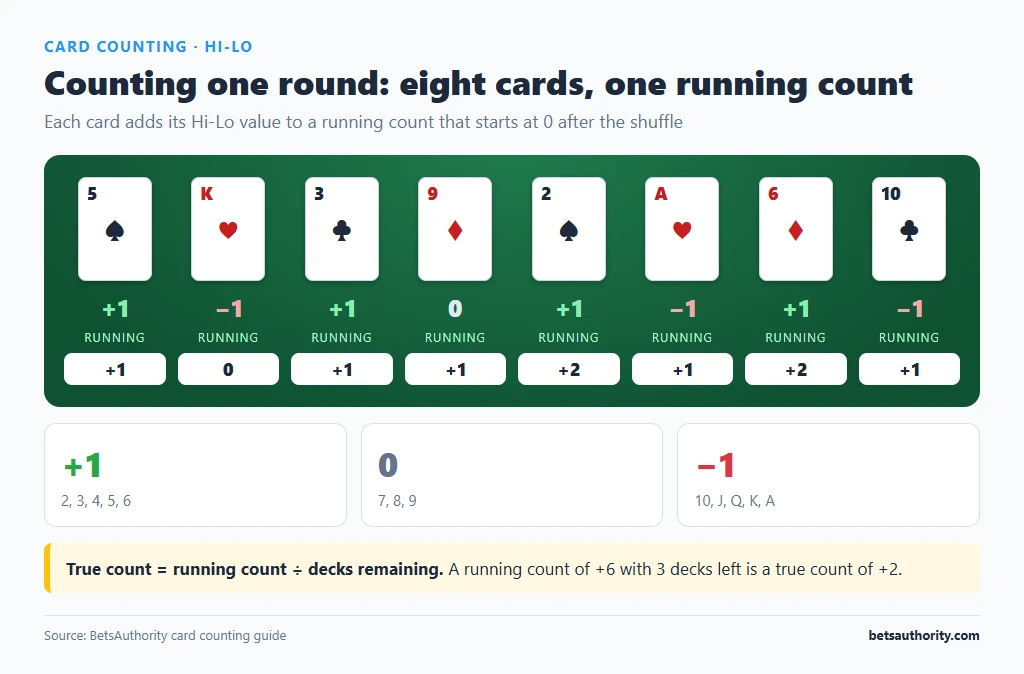
Every card seen is added to a running count that starts at 0 after the shuffle. The system is balanced: a full deck counts to exactly 0 (20 low cards, 20 high cards, 12 neutral).
Example: the first round shows 5, K, 3, 9, 2, A, 6, 10. Values: +1, -1, +1, 0, +1, -1, +1, -1. Running count: +1.
Converting to a True Count
A running count of +6 means much more with one deck left than with six. The true count adjusts for this:
True count = running count ÷ decks remaining
| Running count | Decks remaining | True count |
|---|---|---|
| +6 | 6 | +1 |
| +6 | 3 | +2 |
| +6 | 1.5 | +4 |
| -4 | 2 | -2 |
Decks remaining are estimated by looking at the discard tray. As a working rule, each +1 of true count shifts the expected return by about 0.5% in the player’s favour. A 6-deck S17 game with a 0.4%–0.5% house edge off the top therefore reaches roughly break-even around a true count of +1 and a player advantage of about 0.5% to 1% at +2 to +3.
Betting with the Count
The profit comes almost entirely from the bet spread: betting the table minimum at true counts of +1 or lower and raising the bet as the count climbs. A common illustrative ramp for a 6-deck game:
| True count | Bet (units) |
|---|---|
| +1 or lower | 1 |
| +2 | 2 |
| +3 | 4 |
| +4 | 6 |
| +5 or higher | 8 |
With A$10 units, that is A$10 to A$80. Counters accept large swings: the advantage is around 1% on average, while the standard deviation of a single blackjack hand is about 1.15 units. A bankroll of several hundred maximum bets is usually quoted for this reason. Our bankroll management guide explains how variance relates to session budgets.
Index Plays: When to Deviate from Basic Strategy
Basic strategy assumes a neutral shoe. Counters change some decisions when the true count crosses a threshold (index). The most valuable Hi-Lo indices for multi-deck S17 games, commonly published as part of the “Illustrious 18”:
| Decision | Basic play | Change to | When true count is |
|---|---|---|---|
| Insurance | Decline | Take | +3 or higher |
| 16 vs 10 | Hit | Stand | 0 or higher |
| 15 vs 10 | Hit | Stand | +4 or higher |
| 10-10 vs 5 | Stand | Split | +5 or higher |
| 10-10 vs 6 | Stand | Split | +4 or higher |
| 10 vs 10 | Hit | Double | +4 or higher |
| 12 vs 3 | Hit | Stand | +2 or higher |
| 12 vs 2 | Hit | Stand | +3 or higher |
| 11 vs A | Hit | Double | +1 or higher |
| 9 vs 2 | Hit | Double | +1 or higher |
| 10 vs A | Hit | Double | +4 or higher |
| 9 vs 7 | Hit | Double | +3 or higher |
| 16 vs 9 | Hit | Stand | +5 or higher |
| 13 vs 2 | Stand | Hit | -1 or lower |
| 12 vs 4 | Stand | Hit | below 0 |
The insurance index alone accounts for a large share of the gain from deviations. The underlying maths is on the insurance page, and the starting chart is our basic strategy chart.
Does Card Counting Work Online?
RNG (software) blackjack: no. Each round is dealt from a freshly shuffled virtual shoe, so cards seen in earlier rounds carry no information. Our RNG explainer describes how this is implemented.
Live dealer blackjack: in theory, with heavy limits. Live tables deal from a real shoe, typically 8 decks, so the count is valid. Practical problems:
- Penetration. The cut card is usually placed so that a large part of the shoe is never dealt. The deeper the cut, the more often high counts occur; shallow penetration removes most of the opportunity.
- Bet spread. A spread of 1 to 8 units is visible in the bet history, and casinos can restrict or close accounts. Offshore casinos accepting Australians operate under their own terms and can limit stakes at their discretion.
- Shared-hand formats. In Infinite Blackjack and similar games every player receives the same cards, and the shoe is handled under the game’s own rules; check the help file before assuming conventional counting applies.
- Speed. Live tables deal fewer rounds per hour than a busy land-based table, so the hourly expectation of a 1% edge on small bets is low.
The live format is covered on our live blackjack page.
Is Card Counting Legal in Australia?
Counting with your own mind is not a criminal offence. Using an electronic device or software to track cards at the table is a different matter: casinos treat it as cheating and it can breach state casino laws. Land-based casinos can also refuse entry or exclude players they identify as counters, and online operators can apply their terms to restrict accounts. If you are interested in how Australian rules apply to offshore sites in general, see is online gambling legal in Australia.
Common Counting Errors
- Using the running count to size bets without dividing by decks remaining.
- Raising bets after a loss rather than on the count (that is a progression system, not counting — see betting systems).
- Skipping basic strategy accuracy: a counter who misplays 1% of hands gives back much of the edge.
- Counting RNG games where every hand is reshuffled.
Frequently Asked Questions
With the Hi-Lo system, a good bet spread and reasonable penetration, the player edge in a 6-deck game is usually around 0.5% to 1.5%. Each +1 of true count is worth about 0.5%.
Not in RNG blackjack, because the virtual shoe is reshuffled every round. Live dealer tables use real shoes, but limited penetration and account restrictions make counting impractical for most players.
No. Hi-Lo tracks one number: +1 for 2–6, 0 for 7–9 and -1 for 10s and Aces, then divides by the decks remaining.
At a Hi-Lo true count of +3 or higher in multi-deck games. Below that, insurance has a negative expected value.
Counting in your head is not a crime in Australia, but casinos can refuse service. Using electronic devices to count is treated as cheating.
Gambling is for 18+ only. Free support is available from Gambling Help Online on 1800 858 858.