
Casino Betting Systems: Martingale, Fibonacci, D’Alembert and Paroli Compared
A betting system is a rule for changing your stake based on previous results: raise after a loss, raise after a win, follow a number sequence, or cross numbers off a list. Systems change the shape of your results (how often you win, how big the swings are). They do not change the average result, because every bet you place still carries the game’s house edge. This page shows the six systems most often promoted for roulette, baccarat and blackjack, with A$ examples, and the formula that decides how much each one costs. It is part of our casino tips and strategy guides.
The One Formula Every System Obeys
Expected loss = total amount wagered x house edge
On European roulette the edge is 2.70% on every bet. If a session involves A$1,000 of total bets, the expected loss is A$27, whether those bets were flat A$10 stakes or a mix of A$5 and A$80 stakes chosen by a system. A system only changes the expected loss by changing the total amount you bet, and most progressions increase it because the average stake rises during losing runs.
| 100 spins of European roulette on red | Average stake | Total wagered | Expected loss |
|---|---|---|---|
| Flat betting, A$10 every spin | A$10 | A$1,000 | A$27.00 |
| A system that averages A$15 per spin | A$15 | A$1,500 | A$40.50 |
| A system that averages A$25 per spin | A$25 | A$2,500 | A$67.50 |
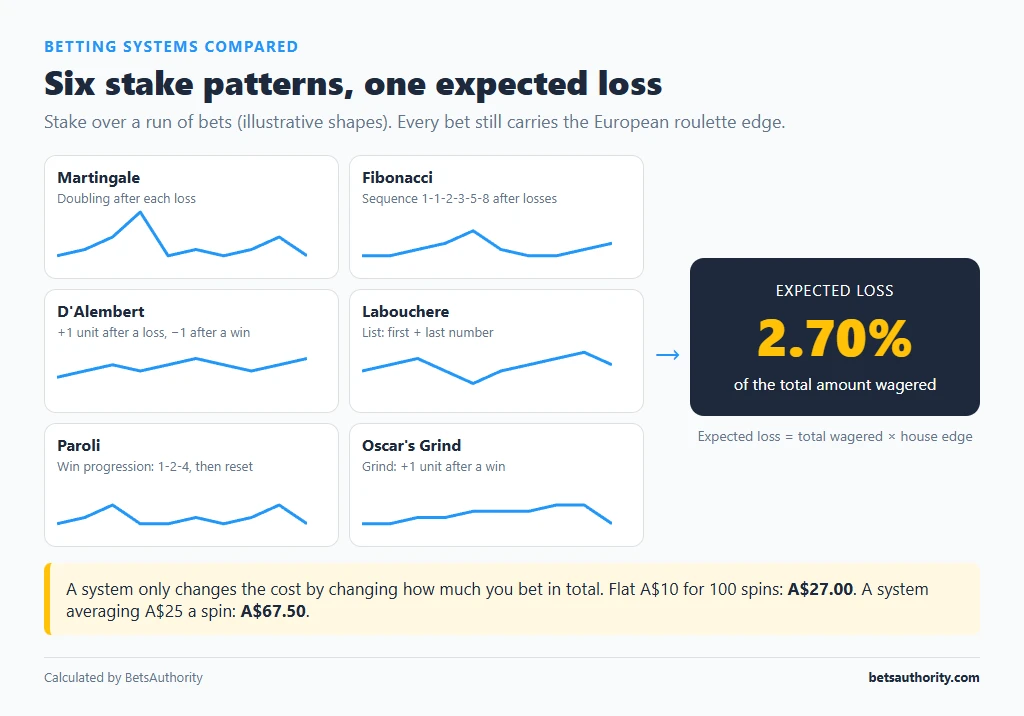
The Six Systems Compared
| System | Rule | Typical session | Main risk |
|---|---|---|---|
| Martingale | Double after each loss, reset after a win | Many small wins of one unit | Seven losses in a row on a A$5 base costs A$635 |
| Fibonacci | Move one step along 1-1-2-3-5-8-13 after a loss, two steps back after a win | Slower growth than Martingale, frequent small wins | Ten losses in a row cost 143 units |
| D’Alembert | Add one unit after a loss, remove one after a win | Gentle swings | Long uneven runs push stakes steadily higher |
| Labouchere | Bet the sum of the first and last numbers on a list; cross off on a win, add on a loss | Completes the list most of the time | The list and stake grow quickly in a bad run |
| Paroli (Reverse Martingale) | Double after a win, reset after three wins or any loss | Frequent small losses, occasional 7-unit wins | Slow bleed of single units |
| Oscar’s Grind | Raise one unit after a win, keep stake after a loss, stop each cycle at +1 unit | Long cycles of small stakes | Cycles can run for hundreds of bets and stack up losses |
Negative Progressions: Martingale, Fibonacci, D’Alembert, Labouchere
These systems raise your stake after losses so that a later win recovers the deficit. They all share one weakness: the bigger your losing run, the bigger the bet you need, and losing runs are more common than intuition suggests. On European roulette the chance of losing five even-money bets in a row is 3.57%. Over 200 sequences, that is expected to happen around seven times.
Fibonacci in numbers
With a A$5 unit, ten straight losses run through A$5, 5, 10, 15, 25, 40, 65, 105, 170 and 275. That is A$715 lost, and the eleventh bet is A$445. A win at that point only recovers the last two bets, so the system needs several more wins to get back to even. The progression is slower than Martingale but it does not escape the same arithmetic.
D’Alembert in numbers
D’Alembert assumes wins and losses will even out. On a single-zero wheel they don’t: you lose 19 spins for every 18 you win on average. Start at A$10 with a A$1 step. After a run of 30 losses and 20 wins in 50 spins (a normal fluctuation), your stake has climbed to A$20 and you are down. Equal numbers of wins and losses would leave you slightly ahead, but the zero makes equal numbers less likely than not.
Labouchere in numbers
Start with the list 1-2-3 (six units of target profit). Bet 1 + 3 = 4 units. Win: cross off both, list becomes 2, bet 2, win, done (+6 units). Lose the first bet: add 4 to the end, list 1-2-3-4, next bet 5 units. Six losses from the start push the list to 1-2-3-4-5-6-7-8-9 with a next bet of 10 units and 39 units already lost.
Positive Progressions: Paroli and Oscar’s Grind
Positive systems raise your stake after wins, so your own money is only risked at the base level. Paroli bets 1, 2 and 4 units on three straight wins, then resets. Three wins in a row on red happen 11.5% of the time ((18/37)^3), returning 7 units. The other 88.5% of cycles lose at least one unit. The cycle result averages out to a loss of 2.70% of the total staked, the same as flat betting.
Oscar’s Grind looks safer because it only raises stakes after wins and stops at +1 unit. The catch is cycle length: a few unlucky streaks can keep a cycle open for a long time at gradually increasing stakes, and any cycle you abandon is a loss.
What Systems Can Legitimately Do
- Set structure. A written stake plan can stop impulsive bet increases, which is useful for bankroll management.
- Change the risk profile. Negative progressions trade frequent small wins for rare large losses; positive ones do the opposite. Pick the shape you are comfortable with, knowing the average is fixed.
- Define a stop. Every system needs a pre-set exit (a maximum step or a loss limit). Without one, the table limit or your balance becomes the exit.
What Actually Lowers the Cost of Play
If the goal is to lose less over time, the levers are the game and the rules, not the stake pattern:
- Choose low-edge games: blackjack with basic strategy (about 0.5%), baccarat Banker (1.06%), French roulette with La Partage on even-money bets (1.35%).
- Avoid American roulette (5.26%) and high-edge side bets.
- Play fewer bets per hour. Live tables run slower than RNG games.
- Check pokie RTP versions; see the payout percentage guide.
- Lower your stake. Halving the stake halves the expected loss.
For a full step-by-step breakdown of doubling, read our page on the Martingale system. The belief that a streak must end soon is covered under the gambler’s fallacy, and roulette-specific approaches are in roulette strategies.
Frequently Asked Questions
Negative progressions like Martingale and Labouchere win the highest share of sessions, but their rare losing sessions are large enough that the overall average is still a loss equal to the house edge on total stakes.
No. Each spin on European roulette has a 2.70% house edge, and a sequence of negative-expectation bets has a negative total expectation regardless of how the stakes are arranged.
Stakes rise more slowly, so wipe-outs take longer to develop, but ten straight losses with a A$5 unit still cost A$715 and recovery needs several wins.
Stake progressions do not change blackjack’s edge. Basic strategy decisions lower the edge to about 0.5% under common rules; card counting is a separate technique that is ineffective against continuous shufflers and online RNG games.
Using them with real money is generally allowed, but bonus terms often prohibit doubling or low-risk patterns while wagering and set a maximum bet.
No staking plan turns gambling into income. Play only if you are 18+, and call Gambling Help Online on 1800 858 858 for free, confidential support.