
Casino Payout Percentage and RTP: What the Numbers Really Mean
“Payout percentage” is used for two different numbers, and mixing them up leads to bad decisions. One is a game’s RTP (return to player), a theoretical figure built into its maths. The other is a casino-wide payout rate, a measured figure for everything played at a site over a period. This page explains both, how RTP versions work, and how much your own results can differ from either. It is part of our casino tips and strategy guides.
Game RTP: The Theoretical Return
RTP is the percentage of all money wagered on a game that it is designed to pay back over a very large number of rounds. A pokie with 96% RTP returns, on average, A$96 for every A$100 bet across millions of spins. The other A$4 is the house edge. RTP is set by the game’s paytable and reel configuration and confirmed by testing labs during certification.
| Game | Typical RTP | House edge |
|---|---|---|
| Online pokies (most current releases, maximum version) | 95% to 97% | 3% to 5% |
| European roulette | 97.30% | 2.70% |
| Blackjack, common online rules, basic strategy | about 99.5% | about 0.5% |
| Baccarat, Banker | 98.94% | 1.06% |
| 9/6 Jacks or Better, optimal play | 99.54% | 0.46% |
| Progressive jackpot pokies | often 88% to 94% (part of the return sits in the jackpot) | 6% to 12% |
RTP Versions: Same Game, Different Return
Many large studios sell the same pokie in several RTP configurations, and the casino chooses which to run. The artwork, features and maximum win are identical; only the frequency or size of wins differs slightly. For popular titles the published range can run from about 96.5% down to the low 90s, and some studios offer versions in the 80s.
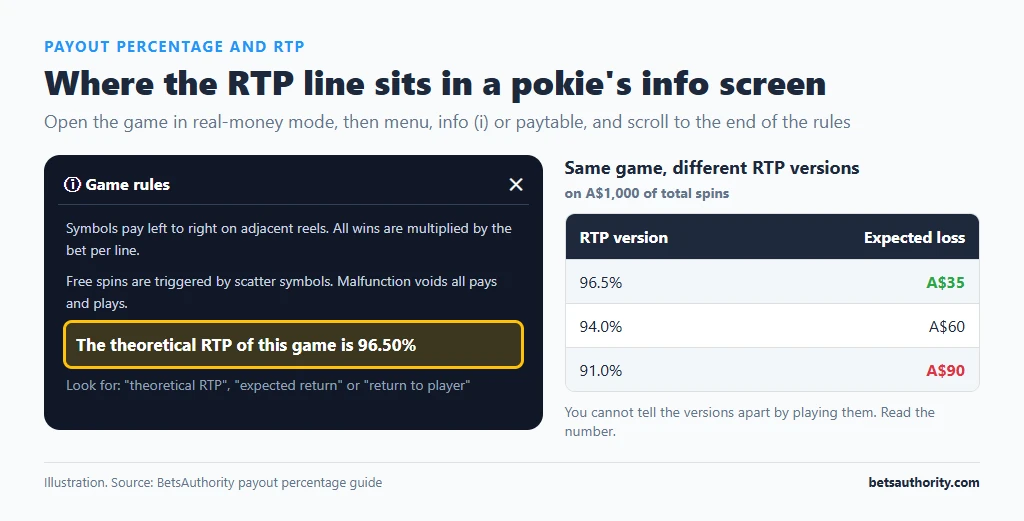
The cost difference is significant. On A$1,000 of total spins:
| RTP version | Expected return | Expected loss |
|---|---|---|
| 96.5% | A$965 | A$35 |
| 94.0% | A$940 | A$60 |
| 91.0% | A$910 | A$90 |
A 94% version costs about 70% more per dollar wagered than the 96.5% version of the same game. You cannot tell them apart by playing them.
How to Find the RTP You Are Playing
- Log in and open the game in real-money mode (demo mode at some casinos loads the provider’s default version).
- Open the menu, info (i) or paytable screen and scroll to the bottom of the game rules.
- Look for “theoretical RTP”, “expected return” or “return to player”. If several figures appear (for example with a bonus buy), note the base game figure.
- Compare it with the maximum RTP listed on the game page or provider’s site. Our RTP check walkthrough has screenshots of where common providers place it.
- If the number is noticeably lower, look for the same game at another casino, or pick a different title. The high-RTP pokies list is a starting point.
Casino-Wide Payout Reports
Some casinos publish a monthly payout percentage audited by a testing firm, for example “96.8% in September”. This is a measured average across every game and every player. It is useful as a sign of transparency, but it has limits:
- It blends high-RTP table games with lower-RTP pokies, so it says little about the game you choose.
- Large wins in one month can lift the figure; it moves around from month to month.
- It does not measure how quickly or reliably withdrawals are paid, which matters more at offshore sites. That is covered in withdrawing winnings and our fast payout casino comparison.
“Payout speed” is also sometimes called “payout” in marketing. Fast withdrawals and high RTP are separate qualities.
Why Your Results Differ From RTP
RTP is a long-run average. In the short run, variance dominates. To show the scale, take a pokie with 96% RTP and assume a standard deviation of 10 times the stake per spin, a plausible figure for a high-volatility game (lower-volatility games have smaller values).
| Spins at A$1 | Expected return | Roughly two-thirds of sessions return between |
|---|---|---|
| 100 | A$96 | A$0 and A$196 (bounded at zero) |
| 1,000 | A$960 | A$644 and A$1,276 |
| 10,000 | A$9,600 | A$8,600 and A$10,600 |
| 1,000,000 | A$960,000 | A$950,000 and A$970,000 |
Over 1,000 spins, a session returning 70% or 120% is ordinary. Only over hundreds of thousands of spins does the result settle close to 96%. Real pokie results are also skewed: most sessions finish below the average and a minority finish far above it because of large bonus wins. More on this in the volatility guide.
RTP and Bonus Features
- Bonus buy: many games list a separate RTP for buying the feature, often similar to or slightly higher than the base game. Higher cost per round still means higher hourly loss. See bonus buy explained.
- Ante or double-chance bets: usually raise the stake by 25% to 50% while keeping RTP roughly the same.
- Progressive jackpots: part of the RTP is the jackpot contribution, which most players never receive.
Practical Rules
- Check RTP in every new casino, even for a game you know.
- Prefer games where the RTP is shown clearly in the rules; hidden RTP is a warning sign.
- For bonus wagering, a higher RTP game reduces the expected cost of clearing; check which games are excluded under game weighting.
Frequently Asked Questions
Current pokies from large studios commonly run at 95% to 97% in their maximum version. Anything below about 94% means a noticeably higher cost per spin.
No. RTP is a game’s theoretical return. A casino payout percentage is a measured average across all games and players over a period.
A casino can choose which certified RTP version of a game to offer. It cannot adjust individual spins of a certified game from a major provider.
RTP is an average over millions of spins. Over a few hundred spins, results can easily be far below or above it, especially on high-volatility pokies.
No. It means you lose less on average per dollar wagered. Every game with RTP below 100% loses money over time.
RTP below 100% means gambling costs money over time. Play only if you are 18+; Gambling Help Online is available on 1800 858 858.