
Budgeting for Gambling
A gambling budget is the amount you decide in advance that you can spend on gambling in a set period, treated as the price of entertainment, not as an investment. Because every casino game has a house edge, the expected result of gambling over time is a loss. A budget makes that cost visible and fixed before you play.
This page gives a method to set a budget from your real income, shows how to estimate what a session costs, and lists practical ways to stop the budget from creeping up.
Step 1: Start From Discretionary Money
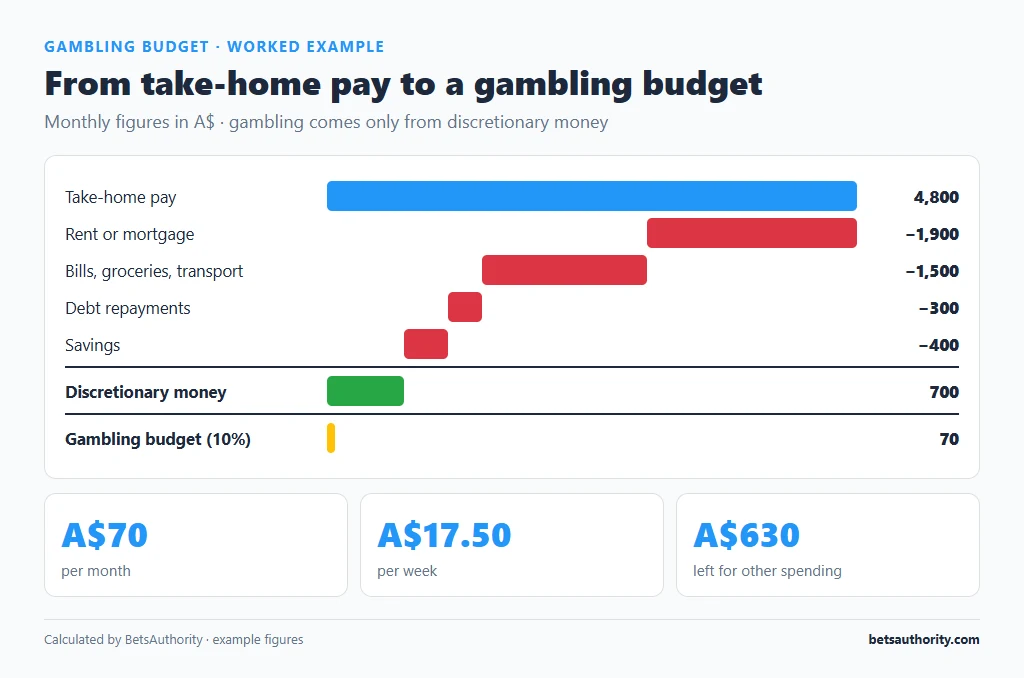
Gambling money should come only from discretionary money: what is left after essentials, debt repayments and savings.
| Monthly item | Example (A$) |
|---|---|
| Take-home pay | 4,800 |
| Rent or mortgage | 1,900 |
| Bills, groceries, transport, insurance | 1,500 |
| Debt repayments | 300 |
| Savings | 400 |
| Discretionary money left | 700 |
From the discretionary amount, gambling competes with everything else you do for fun: eating out, sport, streaming, holidays. In this example a gambling budget of A$70 a month (10% of discretionary money) leaves A$630 for other spending.
There is no official “safe” percentage. The principle the main responsible gambling page sets out is simpler: if losing the amount would cause stress or affect bills, it is too much.
Step 2: Decide the Period and Split It
- Monthly budget: A$70.
- Weekly budget: A$17.50 (so one bad night does not use the month).
- Session budget: A$17.50 or less, played once a week.
Step 3: Estimate What a Session Costs
The expected cost of casino play depends on the stake, the number of bets and the house edge:
Expected cost = stake per bet × number of bets × house edge
| Game | House edge (typical) | Stake | Bets per hour (approx.) | Expected cost per hour |
|---|---|---|---|---|
| Online pokie, 96% RTP | 4% | A$0.50 | 500 | A$10.00 |
| European roulette | 2.70% | A$2 | 60 | A$3.24 |
| Blackjack with basic strategy | about 0.5% | A$5 | 70 | A$1.75 |
| Online pokie, 96% RTP | 4% | A$2 | 600 | A$48.00 |
Actual results vary widely around these figures, especially on high-volatility pokies, but the table shows why stake size and speed matter more than game choice. See house edge explained and RTP explained.
How far a session budget goes
Expected cost is an average. Volatility decides how quickly a session budget can disappear before that average shows up.
| Session budget | Stake | Starting spins | What to expect |
|---|---|---|---|
| A$20 | A$0.20 | 100 | Room for several bonus triggers on a low or medium volatility pokie |
| A$20 | A$1.00 | 20 | Often ends before any feature on a high volatility pokie |
| A$50 | A$0.50 | 100 | Similar spread to the first row at a higher cost |
If you want a longer session from the same budget, lower the stake rather than raising the budget. Our guide to pokies volatility explains how hit frequency changes the experience.
Step 4: Ring-Fence the Money
- Open a separate bank account or sub-account for gambling.
- Set an automatic transfer of the monthly budget on payday, and nothing more.
- Use only that account’s card or PayID for deposits.
- Turn on a gambling block on your main cards. ANZ, CommBank, NAB and Westpac all offer one.
- Set deposit limits at each site equal to your budget; see setting limits.
Step 5: Track Every Dollar
- Record each deposit and withdrawal with the date and site.
- Compare monthly totals with your budget.
- Licensed Australian betting providers must send monthly activity statements; use them. Offshore casinos show history in the account area.
- Our spending tracker guide shows a simple layout.
Rules That Keep a Budget Intact
| Rule | Why |
|---|---|
| Winnings do not increase the budget | Replaying wins turns a winning session into a loss |
| Unused budget does not roll over | Rolled budgets grow into large single sessions |
| No top-ups from savings or credit | Breaks the link between budget and income |
| Withdraw wins above a set level, for example 50% of the session budget | Locks in part of a good result |
| Bonuses do not change the budget | Wagering requirements increase play, not value; see wagering requirements |
Budgeting With Crypto
Crypto prices move, so a budget set in A$ can be exceeded without noticing. Set and track the budget in A$, convert on the day you deposit, and record the A$ value. Crypto transfers cannot be reversed, which removes one of the few safety nets cards provide. Tax treatment of crypto deposits is explained on gambling tax in Australia.
Signs the Budget Is Not Working
- You often finish the monthly budget in the first week.
- You move money from essentials or savings into the gambling account.
- You change the budget after losing.
- You hide gambling spending from a partner.
If these apply, a budget alone is not enough. Consider a break or self-exclusion; see cooling-off and signs of problem gambling. The National Debt Helpline (1800 007 007) offers free financial counselling if gambling has already created debt.
Frequently Asked Questions
Only money left after essentials, debt repayments and savings, and only an amount you can lose without stress. There is no official safe percentage; many people use a small fixed share of discretionary money.
Multiply your stake per bet by the number of bets and the house edge. For example, A$0.50 spins at 500 spins an hour on a 96% RTP pokie cost about A$10 per hour on average.
No. Treat winnings as separate. Adding them to the budget is one of the most common ways a winning session becomes a loss.
Yes. A dedicated account with a fixed monthly transfer is a hard cap, and it makes tracking simple.
Contact the National Debt Helpline on 1800 007 007 for free financial counselling and Gambling Help Online on 1800 858 858 for gambling support.
A budget is a tool, not a guarantee. If you are spending more than you planned, call Gambling Help Online on 1800 858 858 for free, confidential support, 24/7. Gambling is for adults 18+ only.