
Pokies RTP Explained: What Return to Player Means
RTP (return to player) is the percentage of all money wagered on a pokie that the game is designed to pay back as winnings over a very large number of spins. A game with 96% RTP pays back A$96 for every A$100 wagered on average, and keeps A$4. That A$4, or 4%, is the house edge. RTP is fixed by the game’s maths model and certified by a testing lab, but it describes the average of millions of spins, not what happens in one session.
This page is part of our online pokies guide. For the mechanics behind the number, start with how pokies work.
RTP and House Edge in One Formula
House edge = 100% minus RTP. The expected cost of a session is:
Expected loss = stake per spin x number of spins x house edge
| Game RTP | House edge | Expected loss on 1,000 spins at A$1 | Expected loss on 1,000 spins at A$0.20 |
|---|---|---|---|
| 98.00% | 2.00% | A$20 | A$4 |
| 96.50% | 3.50% | A$35 | A$7 |
| 96.00% | 4.00% | A$40 | A$8 |
| 94.00% | 6.00% | A$60 | A$12 |
| 92.00% | 8.00% | A$80 | A$16 |
Note that RTP applies to turnover, not to your deposit. If you deposit A$100 and keep re-betting your winnings, you can turn that A$100 over many times. At A$1 per spin, 1,000 spins means A$1,000 of turnover, and the expected loss at 96% is A$40, even though the deposit was A$100. See our page on house edge for the same maths applied to table games.
Why Your Session Rarely Matches the RTP
RTP is an average across all possible outcomes. Short sessions are dominated by variance. In a high-volatility pokie, a large share of the RTP sits in rare events: big free spins rounds, max-win hits or jackpots. If those events do not occur in your session, your actual return will be well below the stated figure. If one does occur, it can be far above it.
A simple illustration with A$1 spins on a 96% game:
- After 100 spins (A$100 turnover), results between losing most of the A$100 and finishing well ahead are both normal.
- After 10,000 spins (A$10,000 turnover), the average result drifts closer to a A$400 loss, but a single large feature can still swing it by thousands.
- Only over millions of spins does the measured return settle close to 96%.
How wide the swings are depends on volatility, not on RTP. That is why the two figures should always be read together.
RTP Versions: The Same Game, Different Settings
Most large studios supply each game in several certified RTP configurations, and the casino chooses which one to run. The reels, graphics and features look identical; the difference is in the reel strips or feature odds. Examples taken from our game reviews:
| Pokie | Default / top RTP | Lower settings noted |
|---|---|---|
| Big Bad Wolf (Quickspin) | 97% | 90% model; the free demo runs 90% |
| Money Train 2 (Relax) | 96.40% | Versions down to 90% exist |
| Big Bamboo (Push Gaming) | 96.13% | 94.13% |
| Fat Banker (Push Gaming) | 96.43% | 94.45% |
| Book of Dead (Play’n GO) | 96.21% | Several lower versions exist |
| Gates of Olympus (Pragmatic Play) | 96.50% | Lower versions exist |
A 6-point gap between a 96% and a 90% setting means the house edge is 2.5 times larger on the low version: A$100 expected loss per A$1,000 wagered instead of A$40.
How to Check the RTP You Are Actually Playing
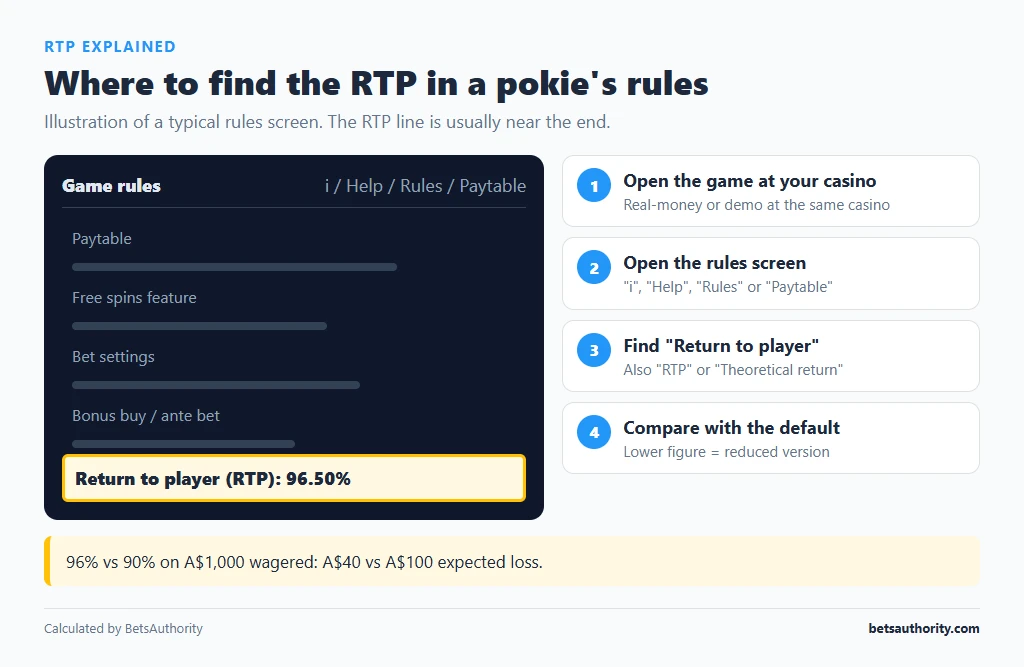
- Open the game at the casino (real-money mode or demo at the same casino).
- Open the menu, then the “i”, “Help”, “Rules” or “Paytable” screen.
- Scroll to the section titled “Return to player”, “RTP” or “Theoretical return”. Most studios print it near the end of the rules.
- Compare it with the studio’s default figure. If it is lower, the casino runs a reduced configuration.
- If the rules show a range (for example a minimum and maximum, as Sweet Bonanza does: 96.49% to 96.60%), the figure depends on the bet mode used.
Our step-by-step guide on how to check a game’s RTP includes screenshots for the major studios. Some games list a separate RTP for bonus buy or ante bet modes; see bonus buy pokies.
RTP, Hit Frequency and Payout Percentage
These three terms are often confused:
| Term | What it measures | Example |
|---|---|---|
| RTP | Average share of wagers returned as winnings | Starburst: 96.08% |
| Hit frequency | Share of spins that return any win | Starburst: 23% (NetEnt figure) |
| Payout percentage | Usually a casino-wide or audited average across many games | Varies by casino and period |
A hit frequency of 23% means roughly 1 spin in 4.3 returns something, and many of those wins are smaller than the stake. The casino-wide figure is covered on our payout percentage page.
What RTP Does Not Tell You
- It is not a guarantee. No pokie owes you a return, and there is no catch-up mechanism after losses. See the gambler’s fallacy.
- It is not adjusted to your play. The RNG does not track your balance.
- It does not show volatility. A 96% game can have a maximum win of 800x or 100,000x.
- It may include features you rarely see. Jackpot contributions and rare top prizes are part of the average.
Online Pokies vs Pub Pokies
Land-based machines in Australia are set under state rules. Queensland requires gaming machines to return between 85% and 92% over their lifetime (Business Queensland). Online pokies from major studios usually run default settings around 94% to 96.5%, which means a lower house edge, but online play is faster and available at all hours, so total turnover can be much higher. A full comparison is on online vs pub pokies.
Using RTP in Practice
- Prefer games where your casino runs the default setting of 96% or higher.
- For a list of pokies with published RTPs above 96.5%, see high RTP pokies.
- When clearing a bonus, the RTP of the games you use affects how much of the balance survives the wagering; see game weighting.
- For casinos where the default versions are common, see our list of high RTP casinos.
Frequently Asked Questions
Most current pokies from major studios list a default RTP between about 95% and 96.8%. A figure of 96% or more is standard for a default setting. Anything below 94% is a low configuration, and games such as Blood Suckers (98%) or Book of 99 (99%) are exceptions.
Not necessarily. RTP measures how much is paid back on average, not how often. Hit frequency and volatility decide how often wins land. A 96% high-volatility game can have long losing runs, while a 94% low-volatility game can pay small wins often.
A casino cannot alter a certified game build, but it can choose which certified RTP configuration to offer when the studio supplies several. That is why the same title can run 96% at one casino and a lower setting at another.
RTP is a property of the game’s maths model, measured across all spins the game could ever produce. It is not tracked per player and does not adjust to balance anyone’s results.
For progressive jackpot pokies, the stated RTP usually includes the expected value of the jackpot. Because the jackpot is rarely won, the return most players experience from the base game is lower than the headline figure.
Gambling is for adults 18+ and should stay within a budget you can afford to lose. Free, confidential support is available 24/7 from Gambling Help Online on 1800 858 858.