
Blackjack Rules: How to Play, Step by Step
Blackjack is a comparing game: each player plays only against the dealer, and the hand closer to 21 without going over wins. This page sets out the standard rules used in online RNG blackjack and live dealer studios, the order of play in one hand, and the table rules you should check before sitting down. It is part of our blackjack guide within the wider casino game guides section.
Card Values
| Card | Value |
|---|---|
| 2 to 9 | Face value |
| 10, Jack, Queen, King | 10 |
| Ace | 1 or 11, whichever helps the hand |
Suits have no effect on the main game. A hand that contains an Ace counted as 11 is a soft hand (A-6 is soft 17). If counting the Ace as 11 would take the total over 21, it counts as 1 and the hand becomes hard (A-6-9 is hard 16). Soft hands are covered in detail on our soft hands page.
The Objective
You win when your final total is higher than the dealer’s without exceeding 21, or when the dealer busts and you have not. Going over 21 is a bust and loses immediately, even if the dealer later busts too. That ordering is the source of the house edge: the player always acts first.
A blackjack (or natural) is an Ace plus any 10-value card as the first two cards. It beats every other 21, including a three-card 21. Equal totals are a push: the stake is returned.
How One Hand Is Played
- Place your bet in the betting box before the deal. Table minimums and maximums are shown on the table or in the game info.
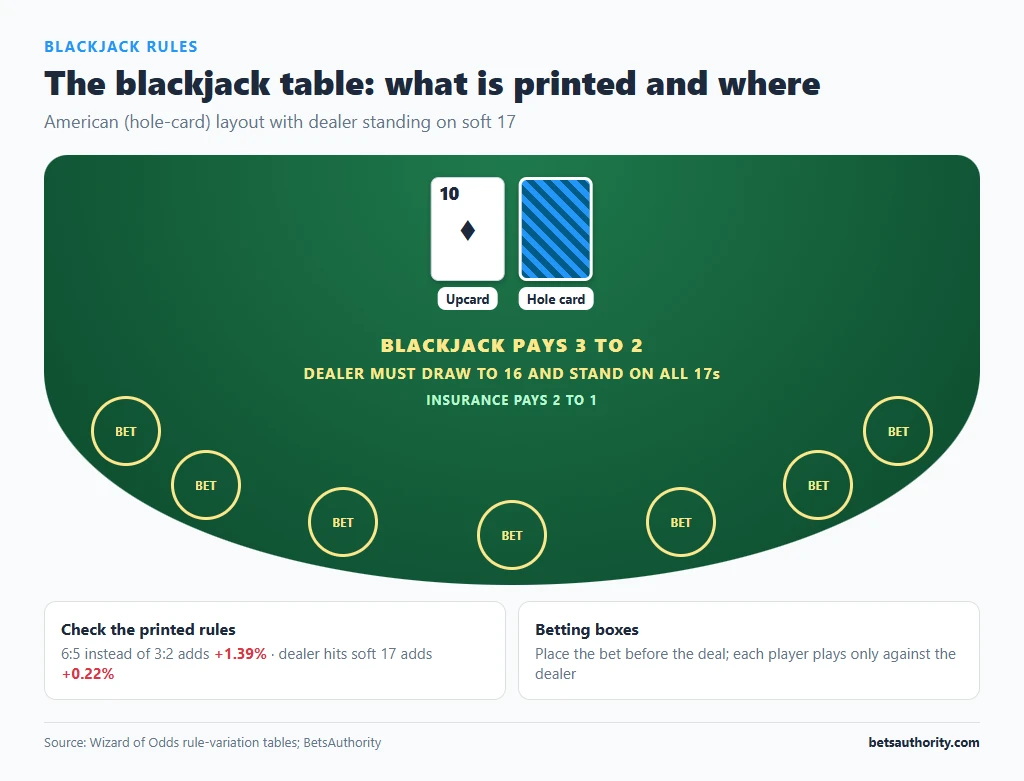
- Every player receives two cards face up. The dealer receives one card face up (the upcard) and, depending on the format, a second card face down (the hole card) or no second card until later.
- If the upcard is an Ace, insurance is offered (see below). Under the American hole-card rule the dealer then checks (“peeks”) for blackjack; if the dealer has one, the hand ends immediately.
- Players with a blackjack are paid, unless the dealer also has one, which is a push.
- Each player acts in turn: hit, stand, double, split or surrender, as allowed.
- The dealer reveals or draws the second card and draws to a fixed rule.
- Remaining hands are settled: higher total wins, ties push.
Player Options
| Option | What it does | Usual restriction |
|---|---|---|
| Hit | Take another card | None until you bust or reach 21 |
| Stand | Keep the current total | None |
| Double down | Double the stake, receive exactly one more card | Often any first two cards; some games only 9, 10, 11 or 10, 11 |
| Split | Separate a pair into two hands, adding an equal stake | Split Aces usually get one card each; resplits limited |
| Surrender | Give up half the stake and end the hand | Late surrender only, after the dealer checks; not offered at many tables |
| Insurance | Side bet of half the stake that the dealer has blackjack | Only when the upcard is an Ace; pays 2:1 |
Doubling and splitting have their own pages: doubling down and splitting pairs. Insurance has a negative expected value for players who do not count cards: with 6 decks and two non-10 cards in your hand it returns about -7.4% per unit staked. The calculation is on the insurance page.
What the Dealer Must Do
The dealer has no choices. In every licensed game the dealer:
- draws on 16 or less;
- stands on hard 17 or more;
- either stands on soft 17 (S17) or hits soft 17 (H17) — the rule is printed on the felt or in the help file.
H17 adds about 0.22% to the house edge compared with S17. Other effects of dealer procedure, including bust rates by upcard, are on the dealer rules page.
Payouts
| Result | Payout |
|---|---|
| Blackjack (3:2 table) | 3 to 2 — a A$20 bet wins A$30 |
| Blackjack (6:5 table) | 6 to 5 — a A$20 bet wins A$24 |
| Ordinary win | 1 to 1 |
| Insurance win | 2 to 1 on the insurance stake |
| Push | Stake returned |
| Surrender | Half the stake returned |
Always check the blackjack payout. A 6:5 game costs about 1.39% extra house edge compared with 3:2, which is more than three times the edge of a standard 3:2, S17 game played with basic strategy. A 1:1 blackjack payout costs 2.27%.
Rule Variations That Change the House Edge
The figures below are changes in house edge relative to an 8-deck, S17 game with doubling on any two cards, doubling after splits and resplitting to four hands, as published by the Wizard of Odds rule-variation tables. Positive numbers are bad for the player.
| Rule | Change in house edge |
|---|---|
| Blackjack pays 6:5 | +1.39% |
| Blackjack pays 1:1 | +2.27% |
| Dealer hits soft 17 | +0.22% |
| Double on 10 and 11 only | +0.18% |
| No double after split | +0.14% |
| European no hole card (lose doubles and splits to dealer blackjack) | +0.11% |
| No resplitting | +0.10% |
| Double on 9 to 11 only | +0.09% |
| Six decks instead of eight | -0.02% |
| Late surrender against a 10 | -0.07% |
| Resplit Aces | -0.08% |
| Single deck instead of eight | -0.48% |
A standard multi-deck game with 3:2, S17 and doubling after splits has a house edge of roughly 0.4% to 0.5% with perfect basic strategy. A full breakdown, including live dealer and RNG versions, is on our blackjack odds and house edge page, and the general concept is explained in house edge explained.
Hole Card vs No Hole Card
In the American (peek) format, the dealer takes a face-down card and checks for blackjack when showing an Ace or 10. If the dealer has blackjack you lose only the original bet, because you never had the chance to double or split.
In the European no-hole-card (ENHC) format, the dealer takes the second card only after all players finish. If it makes blackjack, the strict version takes all doubled and split stakes too. Some games (including many live studios) return the extra stakes, called “original bets only”. Basic strategy changes slightly under strict ENHC: do not double 11 against a 10 or Ace, and do not split 8s against a 10 or Ace if the full stake can be lost. See European vs American blackjack.
Online Rules to Check Before Playing
- Number of decks — RNG games often use 1 to 8 decks; live tables commonly use 8. RNG games shuffle after every round, so card counting has no effect.
- Soft 17 rule — S17 or H17.
- Blackjack payout — 3:2 or 6:5.
- Doubling and splitting limits — any two cards or 9–11 only; resplits; split Aces.
- Surrender — available or not.
- Theoretical RTP — listed in the game info panel; standard 3:2 games usually sit between about 99.3% and 99.6% with basic strategy.
- Bonus weighting — most casinos count blackjack at 0% to 10% towards wagering. Read game weighting before using a bonus on table games.
Example Hand
You bet A$20 and receive 10-6 (hard 16). The dealer shows a 10. Basic strategy says surrender if allowed (you lose A$10), otherwise hit. You hit and draw a 4 for 20; you stand. The dealer turns a 7 for 17 and stands. You win A$20.
Second example: you hold 5-6 (11) against a dealer 6. You double to A$40 and receive a 9 for 20. The dealer turns 10 for 16, draws an 8 and busts. You win A$40.
Correct decisions for every total are on our basic strategy chart. Casinos with live and RNG tables are compared on the blackjack sites list.
Frequently Asked Questions
Yes. A two-card Ace and 10-value hand is a blackjack and beats any other 21. If both you and the dealer have blackjack, the hand is a push.
Yes. The player acts first, so a player who busts loses the stake before the dealer plays. This is the main source of the house edge.
The dealer must stop on any 17 that includes an Ace counted as 11, such as A-6. Tables where the dealer hits soft 17 add about 0.22% to the house edge.
About 1.39% in house edge compared with a 3:2 payout. On A$20 bets, each blackjack pays A$24 instead of A$30.
It depends on the table. Most online and live games allow it. Where it is not allowed, the house edge rises by about 0.14%.
Gambling is for adults 18+. If it stops being entertainment, call Gambling Help Online on 1800 858 858 (free, 24/7).