
Blackjack Odds and House Edge by Rule Set
The house edge in blackjack is not one number. It depends on the table rules and on how well the hand is played. With basic strategy, a standard multi-deck 3:2 game costs roughly 0.4%–0.6% of the amount staked over the long run. A 6:5 game, a dealer that hits soft 17 and restricted doubling can push that above 2%, and playing by feel usually adds more. This page gives the numbers. It is part of our blackjack guide; the general idea is explained in what house edge means.
Basic Hand Probabilities
For a multi-deck game played with basic strategy, results per hand are approximately:
| Outcome | Probability |
|---|---|
| Player wins | about 42% |
| Push | about 8.5% |
| Player loses | about 49% |
The player loses more hands than they win, yet the house edge is under 1%, because the player is paid 3:2 on blackjacks and wins double stakes on successful doubles and splits.
| Event | 8 decks | 6 decks | 1 deck |
|---|---|---|---|
| Player blackjack | 4.75% (about 1 in 21) | 4.75% | 4.83% |
| Dealer shows an Ace | 7.69% | 7.69% | 7.69% |
| Dealer has blackjack given Ace up | 30.84% | 30.87% | 31.37% |
The Ace-up blackjack probability is the share of 10-value cards among the unseen cards (for 8 decks, 128 of 415 when no other cards are known). That number decides whether insurance is ever worth taking; see the insurance page.
Cost of Each Rule
These are changes in house edge relative to an 8-deck game with dealer standing on soft 17, doubling on any two cards, double after split and resplits to four hands, from the Wizard of Odds rule-variation tables. A plus sign means worse for the player.
| Rule | Change |
|---|---|
| Blackjack pays 1:1 | +2.27% |
| Blackjack pays 6:5 | +1.39% |
| Blackjack pays 7:5 | +0.45% |
| Dealer hits soft 17 | +0.22% |
| Player may not split Aces | +0.18% |
| Double on 10 and 11 only | +0.18% |
| No double after split | +0.14% |
| European no hole card | +0.11% |
| No resplitting | +0.10% |
| Double on 9 to 11 only | +0.09% |
| Six decks | -0.02% |
| Four decks | -0.06% |
| Late surrender against a 10 | -0.07% |
| Resplit Aces | -0.08% |
| Double deck | -0.19% |
| Draw to split Aces | -0.19% |
| Single deck | -0.48% |
| Blackjack pays 2:1 | -2.27% |
The figures add up approximately. Start from about 0.45% for the 8-deck base game, add the changes for your table, and you have a close estimate of its house edge.
House Edge of Common Tables
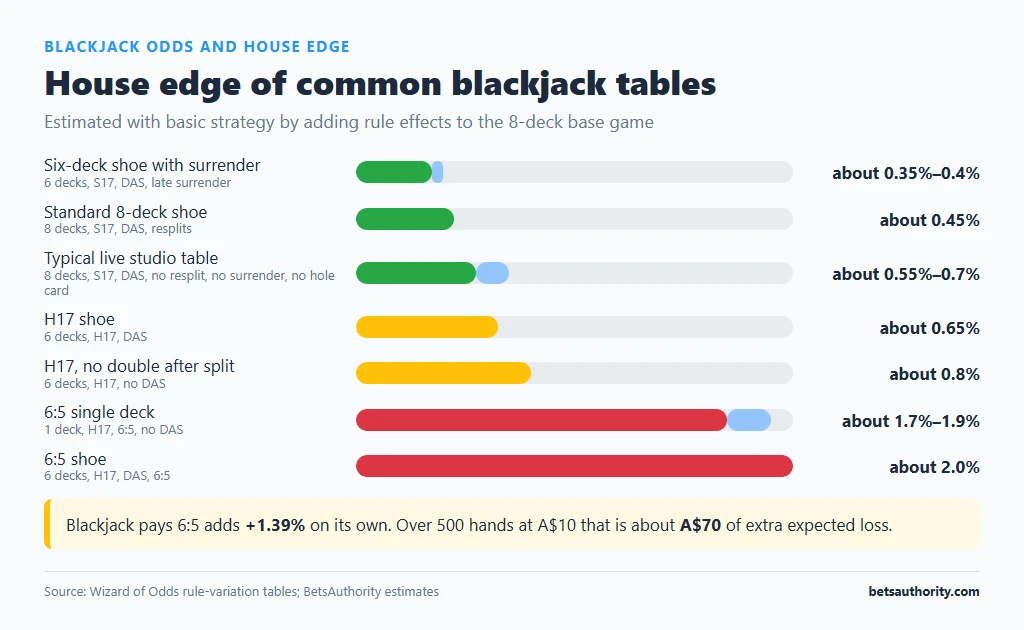
Estimated with basic strategy by adding the rule effects above to the base game.
| Table | Rules | Approx. house edge |
|---|---|---|
| Six-deck shoe with surrender | 6 decks, S17, DAS, late surrender | about 0.35%–0.4% |
| Standard 8-deck shoe | 8 decks, S17, DAS, resplits | about 0.45% |
| Typical live studio table | 8 decks, S17, DAS, no resplit, no surrender, no hole card | about 0.55%–0.7% |
| H17 shoe | 6 decks, H17, DAS | about 0.65% |
| H17, no double after split | 6 decks, H17, no DAS | about 0.8% |
| 6:5 shoe | 6 decks, H17, DAS, 6:5 | about 2.0% |
| 6:5 single deck | 1 deck, H17, 6:5, no DAS | about 1.7%–1.9% |
Provider RTPs in game info screens use the same maths. For example an RTP of 99.5% equals a house edge of 0.5%.
What the House Edge Means in A$
Expected loss = total amount staked × house edge. The total staked is your average bet × number of hands, including doubles and splits (which add roughly 10%–15% to the amount staked per initial bet).
| Average initial bet | Hands | 0.5% edge | 2.0% edge (6:5 game) |
|---|---|---|---|
| A$5 | 200 | A$5 | A$20 |
| A$10 | 500 | A$25 | A$100 |
| A$25 | 1,000 | A$125 | A$500 |
Over 500 hands at A$10, the 6:5 payout rule on its own adds about A$70 of expected loss (1.39% of A$5,000). These are long-run averages. A single hand has a standard deviation of about 1.15 initial bets, so a session of a few hundred hands can end well above or below the expectation.
How Player Skill Changes the Edge
The quoted house edges assume basic strategy. Typical deviations:
- Mimic the dealer (hit to 17, never double or split): house edge around 5.5%, because the player busts first and gives up the 3:2 bonus value of doubling and splitting.
- Never bust (stand on 12+): several percent, because 12–16 is left standing against strong dealer upcards.
- Basic strategy with occasional errors: each error type costs a small amount; together they commonly add 0.5%–1%.
- Card counting in a dealt shoe can turn the edge to a player advantage of roughly 0.5%–1.5%, explained on the card counting page.
The correct decisions are on our basic strategy chart, and typical errors are listed in common mistakes.
Reading the RTP in an Online Game
Most RNG and live blackjack games show a “theoretical RTP” in the help or paytable screen. Three points to check:
- The RTP assumes optimal strategy. The figure is calculated for perfect basic strategy (sometimes “optimal strategy”). Your real return is lower if you deviate.
- Side bets have separate RTPs. A main game at 99.5% may list 21+3 at 96.30% and pair bets around 95.9%; those are different products (see side bets).
- The same title can run with different rules. Deck count, the soft 17 rule and the blackjack payout can differ between casinos offering the same branded game. Compare the help screen, not the game name. Our guide on how to check a game’s RTP shows where to find it.
To convert: house edge = 100% − RTP. An RTP of 99.29% means you lose A$0.71 per A$100 staked on average; at 99.60% the figure is A$0.40.
Blackjack Compared with Other Casino Games
| Game | Bet | House edge |
|---|---|---|
| Blackjack (basic strategy, 3:2, S17) | Main hand | about 0.4%–0.6% |
| Baccarat | Banker (5% commission) | 1.06% |
| Baccarat | Player | 1.24% |
| European roulette | Any standard bet | 2.70% |
| American roulette | Any bet except five-number | 5.26% |
| Online pokies | Spin | commonly 3%–6% (RTP 94%–97%) |
Details on the other games: baccarat odds, roulette odds and payouts and pokies RTP explained.
Frequently Asked Questions
With basic strategy, about 0.4%–0.6% in a standard multi-deck 3:2 game where the dealer stands on soft 17. Poor rules such as 6:5 payouts or H17 can raise it above 2%.
About 4.75% of hands in a 6- or 8-deck game, roughly once every 21 hands.
With basic strategy the player wins about 42% of hands, pushes about 8.5% and loses about 49%. Payouts on blackjacks, doubles and splits make up most of the gap.
Yes, slightly. Single deck is about 0.48% better for the player than 8 decks, all other rules equal; 6 decks is 0.02% better than 8.
The blackjack payout. A 6:5 payout adds 1.39% and an even-money payout adds 2.27%, more than every other common rule change combined.
For adults 18+. Gambling Help Online offers free 24/7 support on 1800 858 858.