
Casino Account Security: Passwords, 2FA, Phishing and Document Safety
A casino account holds three things worth stealing: your balance, your payment details and the identity documents you uploaded for verification. Offshore casinos also tend to change domains, which gives phishing sites cover. This page lists how accounts are typically compromised and the specific steps that prevent each one. It belongs to our casino tips and strategy section.
How Casino Accounts Get Compromised
| Attack | How it works | Main defence |
|---|---|---|
| Credential stuffing | Email/password pairs leaked from other sites are tried automatically | A unique password for every site |
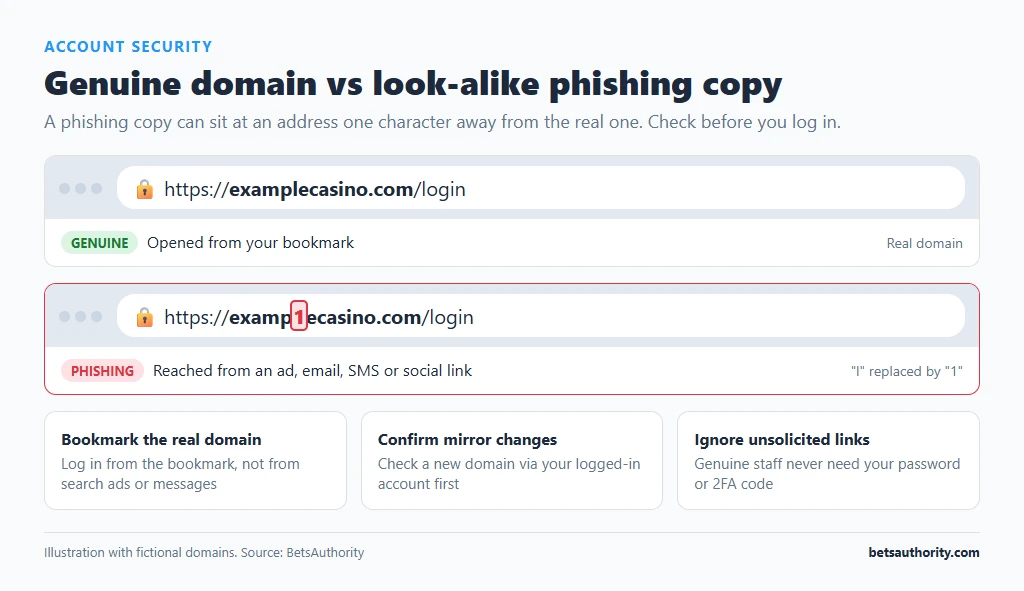
| Phishing domain | A copy of the casino at a look-alike address captures your login | Bookmarks; checking the domain before logging in |
| Fake support | “Support agents” on Telegram, WhatsApp or social media ask for passwords, codes or documents | Contact support only inside the logged-in site |
| SIM swap | Your number is moved to an attacker’s SIM to receive SMS codes | App-based 2FA; a carrier account PIN |
| Clipboard malware | A copied crypto address is replaced with the attacker’s | Checking pasted addresses; device security |
| Shared or public device | Saved sessions or passwords on a shared computer | Logging out; private browsing; no saved passwords |
12 Steps to Secure Your Account
Login
- Use a unique, generated password. A password manager can create and store a 16+ character password for each site. Reuse is the single most common way accounts are taken over.
- Turn on two-factor authentication (2FA). Prefer an authenticator app (Google Authenticator, Microsoft Authenticator, Authy) over SMS codes. Save the backup codes offline. Our 2FA setup guide shows where common casinos place the setting.
- Use a dedicated email address for gambling accounts with its own strong password and 2FA. If your main email is compromised, your casino accounts are not automatically exposed.
- Add a PIN or passphrase to your mobile carrier account to make SIM-swap attacks harder.
Phishing
- Bookmark the real domain and log in from the bookmark. Do not log in via search ads, emails, SMS or social media links.
- Check the domain on mirror changes. If a casino moves to a new domain, confirm it via a message inside your logged-in account or the casino’s official channels before entering your password.
- Treat unsolicited messages as hostile. Genuine casino staff never need your password or 2FA code. Bonus offers that require you to “verify your wallet” on an external page are scams.
Documents and payments
- Upload KYC documents only through the casino’s verification page, not by email or chat apps, unless support requests it from the logged-in chat. See verifying your account.
- Watermark copies with text such as “For [casino name] verification only, [date]”. It makes stolen copies less useful for other purposes.
- Check crypto addresses after pasting, comparing the first and last six characters, and use whitelisted withdrawal addresses if the casino offers them. See crypto casino tips.
- Use cards or wallets with notifications so every deposit triggers an alert on your phone.
Devices
- Keep your phone and browser updated, install apps only from official stores, and avoid entering passwords on public Wi-Fi without a trusted connection. Installing casino APK files from unknown websites carries a malware risk; see mobile casino tips.
Check Your Recovery Options
Password resets go to your email, so the email account’s own recovery settings are part of your casino security. An old phone number or a backup address you no longer control is another way in. Review the recovery phone, backup email and connected apps on your gambling email once a year, and remove anything you do not recognise.
Signs Your Account May Be Compromised
- Login alerts or 2FA prompts you did not trigger.
- Changed email, phone number or withdrawal details.
- Withdrawal requests or bets you did not place.
- Password reset emails you did not request.
What to Do If It Happens
- Change the password from a clean device and sign out of all sessions if the option exists.
- Contact casino support through live chat and ask them to freeze withdrawals and record the incident.
- Change the password on your gambling email and any site where you reused it.
- If payment details were exposed, contact your bank or card issuer.
- If identity documents were exposed, IDCARE (Australia and New Zealand’s identity and cyber support service) can advise on next steps, and scams can be reported to Scamwatch.
- If you cannot regain access, follow recovering a casino account.
Casino-Side Security to Look For
| Feature | Why it helps |
|---|---|
| 2FA option | Stops logins with a stolen password |
| Login and withdrawal notifications | Lets you spot activity quickly |
| Withdrawal address whitelist (crypto) | Blocks payouts to new addresses without confirmation |
| Session history | Shows devices and IP addresses that accessed the account |
| Secure document upload | Keeps ID copies out of email |
Missing features are worth weighing alongside the other points in the casino checklist.
Shared Households
Most casinos allow one account per household, IP address or payment method. If two adults at the same address play, check the T&Cs and tell support in advance; otherwise both accounts may be flagged as duplicates at withdrawal. Never let anyone else use your account or payment method, and never use someone else’s. Keep your device locked if there are minors at home.
Frequently Asked Questions
Yes, if offered. An authenticator app is more secure than SMS codes because it is not exposed to SIM-swap attacks.
Upload only through the casino’s verification page at a site you have checked, and consider watermarking copies with the casino name and date.
Check the exact domain before logging in, use a bookmark, and be suspicious of links from ads, emails or chat apps. Look-alike domains often change a single character.
No. Genuine support never needs your password or 2FA code. Anyone asking for them is attempting fraud.
Change the password, ask support to freeze withdrawals, secure your email, contact your bank if payment details are exposed and report identity theft to IDCARE.
Account security also means protecting your limits. Gambling is for adults 18+; Gambling Help Online is on 1800 858 858.