
Doubling Down in Blackjack: When and Why
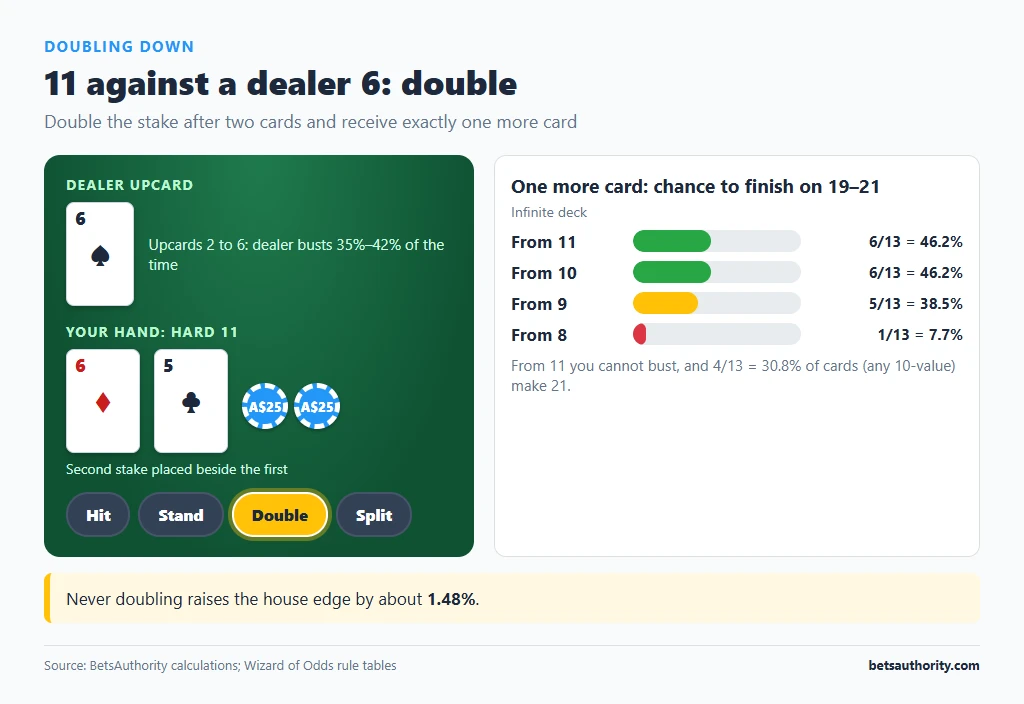
Doubling down means doubling your stake after seeing your first two cards, in exchange for receiving exactly one more card. It is the main way a basic-strategy player gets more money on the table in favourable situations, and it accounts for a large part of the value that brings blackjack’s house edge under 1%. Never doubling raises the house edge by about 1.48% according to the Wizard of Odds rule tables. This page covers when to double, the probabilities behind the decision and the rules that limit it. It is part of our blackjack guide.
The Doubling Chart (4–8 Decks, Dealer Stands on Soft 17)
D = double if allowed, otherwise hit. Ds = double if allowed, otherwise stand.
| Your hand | 2 | 3 | 4 | 5 | 6 | 7 | 8 | 9 | 10 | A |
|---|---|---|---|---|---|---|---|---|---|---|
| Hard 9 | H | D | D | D | D | H | H | H | H | H |
| Hard 10 | D | D | D | D | D | D | D | D | H | H |
| Hard 11 | D | D | D | D | D | D | D | D | D | H |
| A-2, A-3 | H | H | H | D | D | H | H | H | H | H |
| A-4, A-5 | H | H | D | D | D | H | H | H | H | H |
| A-6 | H | D | D | D | D | H | H | H | H | H |
| A-7 | S | Ds | Ds | Ds | Ds | S | S | H | H | H |
| 5-5 | D | D | D | D | D | D | D | D | H | H |
Hands not listed are never doubled in multi-deck S17 games. In H17 games, also double 11 against an Ace, A-7 against a 2 and A-8 against a 6. The full chart is on our basic strategy page.
Why 9, 10 and 11 Are the Doubling Totals
With one more card coming, you want totals where that card is likely to make a strong hand and cannot bust you.
| Starting total | Cards that make 19–21 | Probability (infinite deck) | Chance of 21 |
|---|---|---|---|
| 11 | 8, 9, 10/J/Q/K | 6/13 = 46.2% | 4/13 = 30.8% (any 10-value) |
| 10 | 9, 10/J/Q/K, A | 6/13 = 46.2% | 1/13 = 7.7% (Ace) |
| 9 | 10/J/Q/K, A | 5/13 = 38.5% | 0% (needs a 12) |
| 8 | A | 1/13 = 7.7% | 0% |
From 11 you cannot bust, and almost half the time you finish on 19, 20 or 21. From 8 you mostly finish on 18 or less. This is why 8 is a hit, 9 is a double only against the weakest upcards, and 10 and 11 are doubled against most.
The dealer’s upcard decides the rest. Against 2 to 6 the dealer busts 35%–42% of the time, so even a modest final total often wins. Against 10 and Ace the dealer is strong: 10 against 10 is a hit, and 11 against an Ace is a hit in S17 games because a dealer Ace still finishes on 17–21 about 83% of the time after the peek.
Soft Doubles
Soft hands (an Ace counted as 11) cannot bust with one card, and the dealer upcards 4 to 6 are the weakest. That combination makes soft doubles profitable even when the starting total is low, such as A-2 against a 5. A-7 (soft 18) is doubled against 3 to 6 and otherwise stood on or hit. Details are on the soft hands page.
Doubling Rules That Vary
| Rule | Effect on house edge | Where you meet it |
|---|---|---|
| Double on any first two cards | base | Most live and RNG tables |
| Double on 9, 10, 11 only | +0.09% | Some European-style RNG games |
| Double on 10 and 11 only | +0.18% | Some European rules, older land-based tables |
| No double after split | +0.14% | Some RNG and land-based games |
| Double on any number of cards | −0.23% | Spanish 21 and some promotional variants |
| No-hole-card, lose doubled stake to dealer blackjack | part of +0.11% | Strict European games |
If doubling is restricted to 10–11, play soft doubles and 9s as hits (or stand for “Ds” hands). In strict no-hole-card games do not double 10 or 11 against a 10 or Ace.
Double for Less
Most online games double the full stake. A few allow “double for less”. Mathematically, if a double is correct you should double for the full amount; doubling for less gives up value. The option exists for players who cannot cover the full stake.
A$ Examples
11 against a 6. You bet A$25, double to A$50 and receive a 7 for 18. The dealer turns a 10 for 16, draws a 5 for 21. You lose A$50. A loss like this is part of normal variance; over many repetitions this double gains more than hitting.
A-6 against a 4. You bet A$10 with soft 17, double to A$20 and draw a 3 for 20. The dealer shows 4, turns a Queen for 14 and draws a 9 to bust. You win A$20.
10 against a 10. Chart says hit. Doubling here would put A$20 at risk where the dealer finishes 17–21 about 77% of the time after the peek, so the extra stake lowers expected value.
Free Doubles in Free Bet Blackjack
Free Bet Blackjack gives a free double on hard 9, 10 and 11: the casino adds the second stake. The house recovers the cost through the rule that a dealer 22 pushes all player hands. Strategy changes: you take every free double offered, including 11 against an Ace. See blackjack variants.
Common Doubling Errors
- Not doubling 11 against a 10 in peek games (it is a double).
- Doubling hard 12 or more, which can bust and gains nothing.
- Skipping soft doubles against 4 to 6.
- Doubling 10 or 11 against a dealer Ace or 10 in strict no-hole-card games.
More errors and their cost are listed in common blackjack mistakes; doubles also interact with pair splitting.
Frequently Asked Questions
In multi-deck S17 games: hard 11 against 2–10, hard 10 against 2–9, hard 9 against 3–6, and soft totals A-2 to A-7 against the weaker upcards shown in the chart.
In S17 multi-deck games, hit. In H17 games and in single and double deck, double.
In most online and live games, yes. Without double after split the house edge rises by about 0.14%.
That is the price of the doubled stake. It is why doubles are made on totals where one card is likely to produce a strong hand.
No. If the double is correct, the full double has the highest expected value.
18+. If you need support, call Gambling Help Online on 1800 858 858 (24/7).