
Blackjack Dealer Rules and Bust Odds by Upcard
The dealer in blackjack has no decisions. Every action follows a fixed rule printed on the table or in the game’s help file, which means the dealer’s final total can be calculated in advance for each upcard. Those probabilities are the foundation of basic strategy: you stand on 13–16 against a 2–6 because the dealer is likely to bust, and you hit against a 7–Ace because the dealer is likely to finish on 17 or more. This page sets out the rules and the numbers. It is part of our blackjack guide.
The Dealer’s Fixed Rules
- Take one card face up (the upcard). In hole-card games, take a second card face down; in no-hole-card games, take it after the players have acted.
- With an Ace upcard, offer insurance. With an Ace or 10 upcard in peek games, check for blackjack before players act.
- After the players act, reveal the hole card or draw the second card.
- Draw on 16 or less.
- Stand on hard 17 or more.
- Soft 17: stand (S17) or hit (H17), as printed on the table.
- The dealer cannot double, split or surrender, and plays the same way regardless of players’ hands.
Rule 6 is the one that differs. The printed phrases are “Dealer must stand on all 17s” or “Dealer must draw to 16 and stand on all 17s” (S17), and “Dealer hits soft 17” (H17). H17 adds about 0.22% to the house edge.
Dealer Outcome Probabilities — Dealer Stands on Soft 17
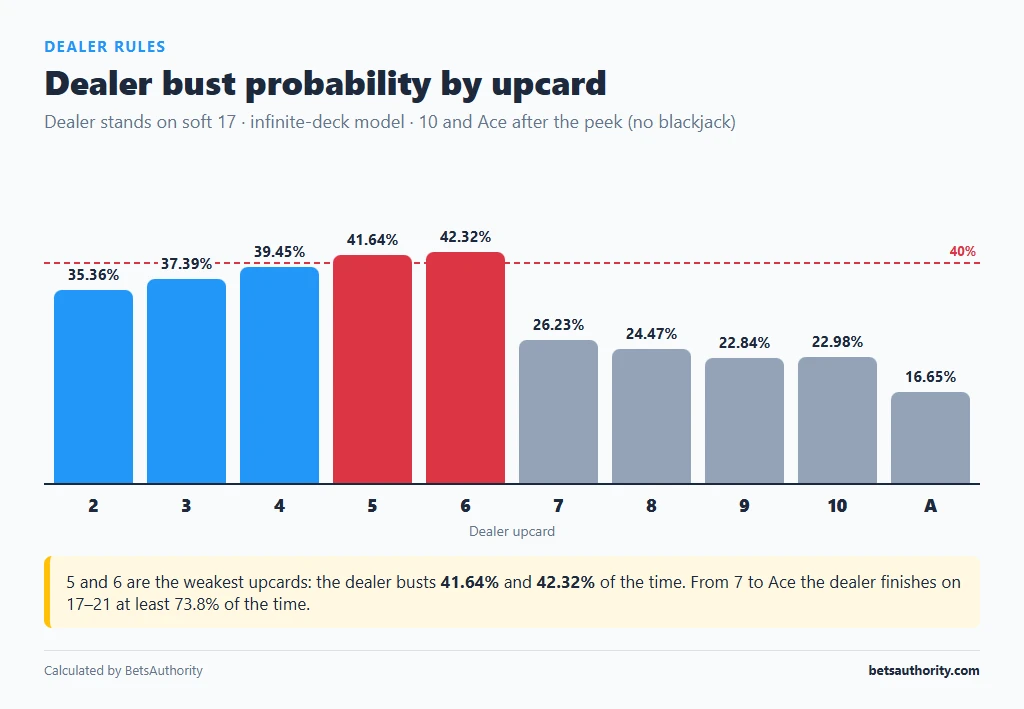
The table below shows the probability of each final dealer total for each upcard. Figures were calculated with the infinite-deck model (each rank drawn with fixed probability), which is within a fraction of a percentage point of 6- and 8-deck results. For 10 and Ace upcards, the figures assume the dealer has already checked and does not have blackjack, as in peek games.
| Upcard | 17 | 18 | 19 | 20 | 21 | Bust |
|---|---|---|---|---|---|---|
| 2 | 13.98% | 13.49% | 12.97% | 12.40% | 11.80% | 35.36% |
| 3 | 13.50% | 13.05% | 12.56% | 12.03% | 11.47% | 37.39% |
| 4 | 13.05% | 12.59% | 12.14% | 11.65% | 11.12% | 39.45% |
| 5 | 12.23% | 12.23% | 11.77% | 11.31% | 10.82% | 41.64% |
| 6 | 16.54% | 10.63% | 10.63% | 10.17% | 9.72% | 42.32% |
| 7 | 36.86% | 13.78% | 7.86% | 7.86% | 7.41% | 26.23% |
| 8 | 12.86% | 35.93% | 12.86% | 6.94% | 6.94% | 24.47% |
| 9 | 12.00% | 12.00% | 35.08% | 12.00% | 6.08% | 22.84% |
| 10 (no blackjack) | 12.07% | 12.07% | 12.07% | 37.07% | 3.74% | 22.98% |
| A (no blackjack) | 18.89% | 18.89% | 18.89% | 18.89% | 7.78% | 16.65% |
Before the peek, a 10 upcard has blackjack when the hole card is an Ace: 1 time in 13 (7.69%). An Ace upcard has blackjack when the hole card is any 10-value card: 4 times in 13 (30.77%).
Dealer Outcome Probabilities — Dealer Hits Soft 17
Only upcards that can produce soft 17 change: 2 to 6 and Ace. Upcards 7 to 10 are identical to the S17 table.
| Upcard | 17 | 18 | 19 | 20 | 21 | Bust |
|---|---|---|---|---|---|---|
| 2 | 13.01% | 13.65% | 13.13% | 12.57% | 11.96% | 35.67% |
| 3 | 12.63% | 13.20% | 12.71% | 12.18% | 11.62% | 37.67% |
| 4 | 12.24% | 12.73% | 12.28% | 11.79% | 11.26% | 39.71% |
| 5 | 11.84% | 12.29% | 11.84% | 11.38% | 10.89% | 41.77% |
| 6 | 11.48% | 11.48% | 11.48% | 11.03% | 10.57% | 43.95% |
| A (no blackjack) | 8.30% | 20.69% | 20.69% | 20.69% | 9.57% | 20.07% |
The biggest changes are with an Ace up: under H17 the dealer turns many soft 17s into 18–21, and busts more often too (20.07% vs 16.65%). Both reduce the value of a player’s 17, which is why H17 changes several strategy decisions against an Ace (double 11, surrender 15 and 17).
What the Numbers Mean for Your Decisions
- 2 to 6 are “bust cards”. The dealer busts 35%–44% of the time. With hard 13–16 you stand and let the dealer draw. 5 and 6 are the weakest upcards, which is why soft doubles concentrate there.
- 2 and 3 are not as weak as they look. Bust rates of 35%–37% are why 12 is a hit against them.
- 7 to Ace are strong. The dealer finishes on 17–21 at least 73.8% of the time, so 12–16 must be hit.
- The 7 lands on 17 about 37% of the time. That is why 18 is a stand against a 7 and why 9-9 is not split against a 7.
- The 10 lands on 20 about 37% of the time after the peek. Your 19 is an underdog against a 10, but hitting it is worse.
Each decision is listed in the basic strategy chart; soft hands are covered on the soft hands page.
Overall Dealer Results
Across all upcards in an S17 game, the dealer’s final total is distributed roughly as: 17 about 14.5%, 18 about 14.0%, 19 about 13.4%, 20 about 18.0%, 21 (including blackjack) about 12.0%, and bust about 28%. The single most frequent bust total is 22 (about 7.3% of all dealer hands), which is the number Free Bet Blackjack uses for its push rule (see blackjack variants).
Dealer Procedure in Online and Live Games
| Item | RNG blackjack | Live studio blackjack |
|---|---|---|
| Dealer rules | Coded per game; shown in help file | Printed on the felt and in the help file |
| Hole card | Varies; many European-style RNG games use no hole card | Many studios deal the second card after players act |
| Peek | Peek games settle dealer blackjack before your decision | No peek when no hole card is dealt |
| Speed | Instant | Physical dealing; slower rounds |
Whether the dealer peeks matters for doubling and splitting against a 10 or Ace; see European vs American blackjack and live blackjack.
Frequently Asked Questions
No. The dealer follows the printed rule: draw to 16, stand on 17, with the soft 17 rule (stand or hit) fixed by the table.
The 6, at about 42% under S17 and 44% under H17, followed by the 5 at about 42%.
About 28% of the time across all upcards in an S17 game.
The dealer improves soft 17 to 18–21 more often than it busts from it, so the player’s 17s and 18s win less often. The cost is about 0.22% in house edge.
No. Dealer actions are fixed by rule and do not depend on player bets or hands.
18+ only. Gambling Help Online offers free support on 1800 858 858.