
Blackjack Insurance and Even Money: The Maths
Insurance is a side bet offered only when the dealer’s upcard is an Ace. You stake up to half your original bet that the dealer’s other card is a 10-value card, giving blackjack. If it is, insurance pays 2:1; if not, the insurance stake is lost and the main hand continues. The name suggests protection, but the bet is independent of your hand and, for a player who is not counting cards, it has a negative expected value in every standard game. This page shows the calculation. It belongs to our blackjack guide.
How Insurance Is Settled
Example: you bet A$20, the dealer shows an Ace, you take insurance for A$10.
| Dealer hole card | Insurance result | Main hand result (you hold 18) | Net |
|---|---|---|---|
| 10-value (dealer blackjack) | +A$20 | −A$20 | A$0 |
| Any other card, dealer finishes below 18 or busts | −A$10 | +A$20 | +A$10 |
| Any other card, dealer makes 18 | −A$10 | push | −A$10 |
| Any other card, dealer makes 19–21 | −A$10 | −A$20 | −A$30 |
In no-hole-card games the dealer’s second card is drawn after all players act, but insurance is settled the same way.
Why the Bet Is Negative
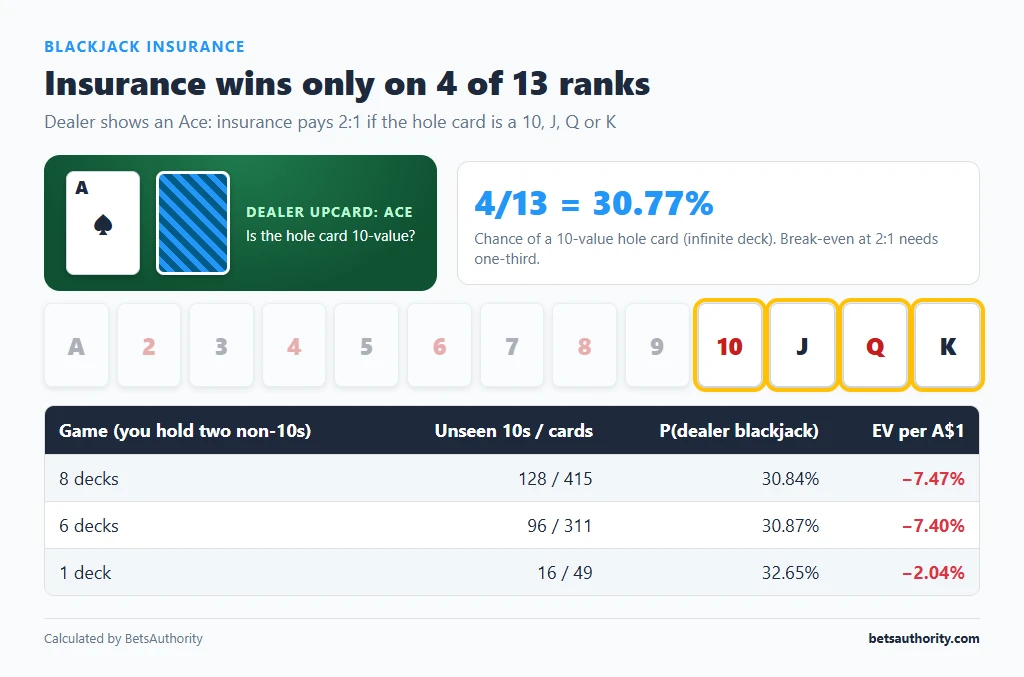
Insurance wins only when the next unseen card is a 10, J, Q or K. In a full deck those are 16 of 52 cards (4 of 13 ranks). For insurance to break even at 2:1, that probability would need to be one-third. It is less:
Expected value per A$1 insured = P(10) × 2 − (1 − P(10))
| Game | Unseen 10s / unseen cards (you hold two non-10s, dealer shows Ace) | P(dealer blackjack) | EV per A$1 |
|---|---|---|---|
| Infinite deck (approximation) | 4/13 | 30.77% | −7.69% |
| 8 decks | 128 / 415 | 30.84% | −7.47% |
| 6 decks | 96 / 311 | 30.87% | −7.40% |
| 1 deck | 16 / 49 | 32.65% | −2.04% |
If your own hand contains 10s, insurance is worse because fewer 10s remain. In single deck with 10-10 against an Ace, P(10) = 14/49, and the EV is −14.3%.
Compared with the main game (house edge about 0.4%–0.6% with basic strategy), insurance costs over ten times as much per dollar staked in multi-deck games.
Even Money Is the Same Bet
When you have blackjack and the dealer shows an Ace, the dealer offers “even money”: you take a guaranteed 1:1 win now instead of risking a push. This is insurance under another name:
- Take insurance (half bet) with your blackjack: if the dealer has blackjack, the main hand pushes and insurance pays 2:1 on half = 1× your bet. If not, you win 3:2 on the main hand and lose the half-bet insurance = 1× your bet.
- Either way you win exactly 1× your bet, the same as even money.
Worked example for a blackjack in a 6-deck game: unseen cards are 312 − 3 = 309; tens remaining 96 − 1 = 95. P(dealer blackjack) = 95/309 = 30.74%. Declining: 0.6926 × A$15 = A$10.39. Even money: A$10.00. Declining is worth about A$0.39 more per A$10 blackjack on average.
What “Always Insure” Costs Over a Session
The dealer shows an Ace on 1 in 13 hands (7.69%). Over 1,000 hands at A$10 in a 6-deck game:
| Item | Calculation | Expected cost |
|---|---|---|
| Main game, basic strategy | 1,000 × A$10 × 0.45% | about A$45 |
| Insurance offers | 1,000 × 7.69% | about 77 offers |
| Insuring every offer at A$5 | 77 × A$5 × 7.40% | about A$28 |
| Total with insurance | about A$73 |
Taking insurance every time raises the expected cost of the session by roughly 60%, from one decision that comes up once every 13 hands. Declining is a simple rule that removes a large share of avoidable cost. Session costs and how to budget for them are covered in bankroll management.
When Insurance Becomes Positive
The bet turns positive when more than one-third of the remaining cards are 10s. Card counters measure this with the Hi-Lo true count: in multi-deck games the standard index is take insurance at a true count of +3 or higher. At that level the 10-density is usually above 1/3. Insurance is the single most valuable count-based deviation, ahead of standing on 16 against a 10. See card counting for the full index list.
In RNG blackjack, which reshuffles every round, the remaining-card count is always the full shoe minus the cards on the table, so the index is never reached.
“Insure a Good Hand” — Myths
| Claim | Reality |
|---|---|
| “Insure a 20, it’s a strong hand” | Your hand’s strength does not change the insurance EV. Holding 10-10 removes two 10s and makes insurance worse. |
| “Insurance reduces risk” | It reduces variance on that hand slightly, at a price of about 7.4% of the insurance stake. Over a session, it increases expected loss. |
| “Always take even money, it’s a sure win” | Same EV as insurance; declining gives about A$0.39 more per A$10 blackjack over time (6 decks). |
| “The dealer often has blackjack with an Ace” | Under one in three times (about 31%). |
Insurance in Live and Online Games
- Live tables show an “Insurance” prompt with a short timer when the dealer has an Ace; ignoring it declines automatically in most games.
- Some RNG games include an “auto-decline insurance” setting.
- Insurance is usually excluded from bonus wagering or counted at 0% (see game weighting).
Related decisions: our basic strategy chart and common mistakes, and for the concept of expected value in general, understanding casino odds.
Frequently Asked Questions
Not unless you count cards. Without counting, the bet loses about 7.4% per dollar in 6-deck games and 7.5% in 8-deck games. Counters take it at a Hi-Lo true count of +3 or more.
No. It is mathematically identical to insurance. Declining it returns about 3.9% more on average in a 6-deck shoe.
Up to half the original bet. It pays 2:1, so a full-size insurance bet returns exactly the main bet if the dealer has blackjack.
About 31% in 6- and 8-deck games when your own cards are not 10s, and slightly lower if you hold 10-value cards.
No. The bet is settled on the dealer’s second card in the same way, whenever that card is dealt.
18+ only. If gambling is no longer fun, Gambling Help Online is available on 1800 858 858.