
Sic Bo Rules
Sic Bo is a dice game played with three standard dice. You bet on the result before the dice are shaken, and a lit-up table shows which bets have won. Each roll has 216 equally likely outcomes (6 × 6 × 6), and every payout and house edge on this page is calculated from that number.
How a Round Works
- Place chips on one or more areas of the table during the betting window.
- The dealer shakes the three dice in a covered container or an automatic shaker.
- The dice are revealed. Winning areas light up and are paid; losing bets are collected.
- A new round starts. There is no point or follow-up phase: every roll settles every bet.
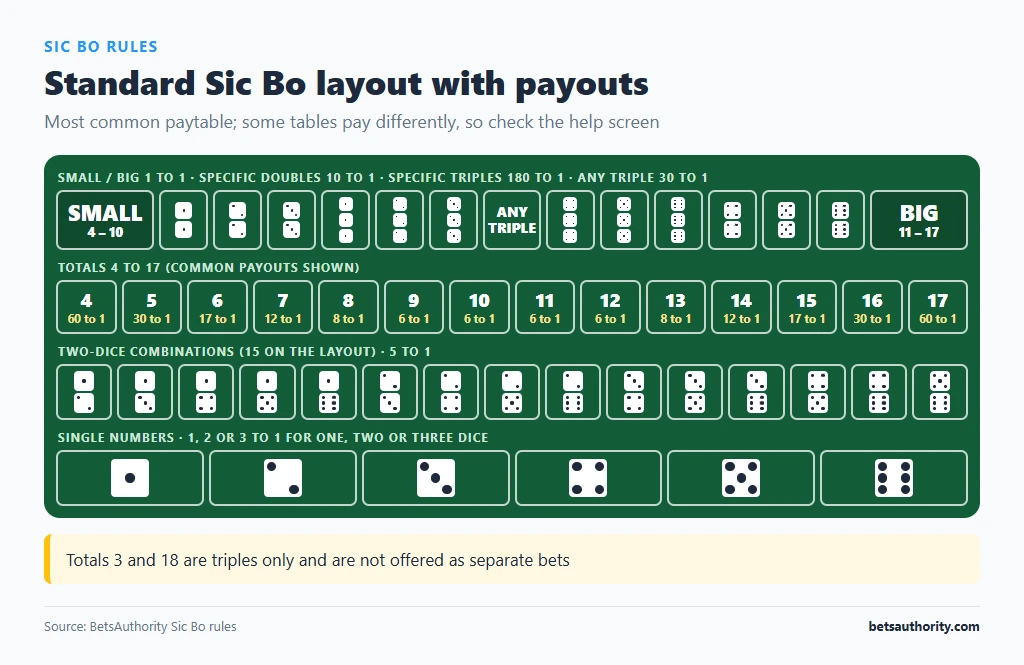
Types of Bets
Small and Big
- Small wins if the total is 4 to 10.
- Big wins if the total is 11 to 17.
- Both lose on any triple (for example 2-2-2 or 5-5-5), even if the total is in range.
- Pays 1 to 1. Probability of winning: 105/216 = 48.61%.
Odd and Even
Odd wins on an odd total, Even on an even total, and both lose on any triple. Pays 1 to 1, with the same 48.61% chance as Small and Big. Not every table offers this bet.
Total (4 to 17)
You bet on the exact total of the three dice. Totals 3 and 18 can only be made by a triple and are not offered as separate bets.
| Total | Ways out of 216 | Probability |
|---|---|---|
| 4 or 17 | 3 | 1.39% |
| 5 or 16 | 6 | 2.78% |
| 6 or 15 | 10 | 4.63% |
| 7 or 14 | 15 | 6.94% |
| 8 or 13 | 21 | 9.72% |
| 9 or 12 | 25 | 11.57% |
| 10 or 11 | 27 | 12.50% |
Single number (1 to 6)
You pick a number. The bet pays according to how many dice show it: 1 to 1 for one die, 2 to 1 for two, 3 to 1 for three (some tables pay 12 to 1 or more for three).
| Dice showing your number | Ways out of 216 |
|---|---|
| None | 125 |
| One | 75 |
| Two | 15 |
| Three | 1 |
Two-dice combination
You pick two different numbers (for example 3 and 5). It wins if both appear among the three dice. There are 15 such combinations on the layout, each with 30/216 = 13.89% probability.
Specific double
You pick a number that must appear on at least two dice (for example two 4s). Probability: 16/216 = 7.41%.
Specific triple and any triple
- Specific triple: all three dice show your chosen number. Probability 1/216.
- Any triple: all three dice show the same number. Probability 6/216 = 2.78%.
Payouts and House Edge
Paytables vary between casinos and game providers. The table shows the most common payouts and the house edge they produce. Where two versions are common, both are listed.
| Bet | Common payout | House edge | Alternative payout | House edge |
|---|---|---|---|---|
| Small / Big | 1 to 1 | 2.78% | — | — |
| Odd / Even | 1 to 1 | 2.78% | — | — |
| Single number | 1, 2, 3 to 1 | 7.87% | 1, 2, 12 to 1 | 3.70% |
| Two-dice combination | 5 to 1 | 16.67% | 6 to 1 | 2.78% |
| Specific double | 10 to 1 | 18.52% | 8 to 1 | 33.33% |
| Any triple | 30 to 1 | 13.89% | 24 to 1 | 30.56% |
| Specific triple | 180 to 1 | 16.20% | 150 to 1 | 30.09% |
| Total 4 or 17 | 60 to 1 | 15.28% | 50 to 1 | 29.17% |
| Total 5 or 16 | 30 to 1 | 13.89% | — | — |
| Total 6 or 15 | 17 to 1 | 16.67% | 14 to 1 | 30.56% |
| Total 7 or 14 | 12 to 1 | 9.72% | — | — |
| Total 8 or 13 | 8 to 1 | 12.50% | — | — |
| Total 9 or 12 | 6 to 1 | 18.98% | 7 to 1 | 7.41% |
| Total 10 or 11 | 6 to 1 | 12.50% | — | — |
The spread is wide: the same “two-dice combination” bet costs 2.78% at 6 to 1 and 16.67% at 5 to 1. Always open the paytable in the game help before placing anything other than Small or Big.
How the house edge is calculated
Take the total 7 bet at 12 to 1. It wins 15 times in 216 and loses 201 times. Expected result per A$1: (15 × 12 − 201) ÷ 216 = −21 ÷ 216 = −9.72%. The same method works for any bet: multiply the winning ways by the payout, subtract the losing ways, divide by 216.
Multiplier Versions
Live studios offer Sic Bo variants with random multipliers, such as Evolution’s Super Sic Bo. Before each roll, some bets (typically totals, triples or combinations) are selected and given multipliers that replace their normal payout if they win. To fund these, the base payouts on the multiplier-eligible bets are lower than on a standard table. The overall return is stated in the game’s help screen; compare it with the 97.22% RTP of Small/Big on a standard table before choosing.
Worked Example
You place A$10 on Big, A$5 on total 11 (6 to 1) and A$5 on the combination 5 and 6 (5 to 1). The dice show 5-6-2 (total 13).
- Big: 13 is in 11 to 17 and is not a triple: win A$10.
- Total 11: lose A$5.
- 5 and 6 combination: both numbers appear: win A$25.
Net result: +A$30. On the next roll of 4-4-4 (total 12), Big would lose even though 12 is in its range, because a triple beats Small and Big.
For strategy built on these numbers, read our Sic Bo strategy guide. For another dice game priced from exact probabilities, compare the craps bets and odds table; RNG dice games use a single random number instead of three physical dice. Casinos with Evolution and Pragmatic Play Live studios, such as Golden Crown, carry live Sic Bo tables. The Sic Bo guide hub and the casino game guides section list related pages.
Frequently Asked Questions
Small wins on totals 4 to 10 and Big on totals 11 to 17, both paying 1 to 1. Both lose on any triple, which gives the house its 2.78% edge.
10 and 11, each made 27 ways out of 216 (12.5%).
Usually 180 to 1 (16.20% house edge) or 150 to 1 (30.09%). The probability is 1 in 216.
It is a fixed rule of the bet. Without it, Big and Small would have no house edge.
The dice rules are the same, but payouts differ. The house edge on the same bet can range from under 3% to over 30% depending on the paytable.
Every Sic Bo bet carries a house edge. Play only if you are 18 or older; Gambling Help Online (1800 858 858) offers free, confidential support.