
Sic Bo Strategy
Sic Bo has no decisions after the dice are shaken, so strategy means one thing: choosing which bets to place and how much. The house edge across the layout runs from 2.78% to more than 30%, so bet selection has a larger effect on your results than in almost any other table game. All figures here come from the 216 possible outcomes explained in our Sic Bo rules guide.
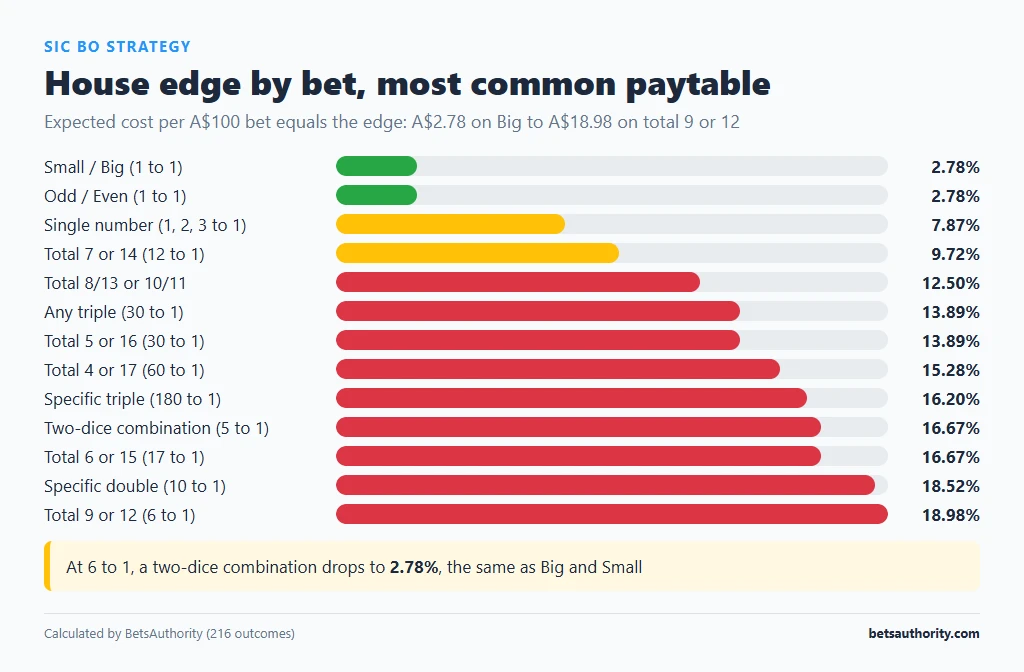
Rank the Bets by Cost
Using the most common paytable:
| Bet | Payout | House edge | Cost per A$100 bet |
|---|---|---|---|
| Small / Big | 1 to 1 | 2.78% | A$2.78 |
| Odd / Even | 1 to 1 | 2.78% | A$2.78 |
| Single number | 1, 2, 3 to 1 | 7.87% | A$7.87 |
| Total 7 or 14 | 12 to 1 | 9.72% | A$9.72 |
| Total 8 or 13, 10 or 11 | 8 to 1, 6 to 1 | 12.50% | A$12.50 |
| Any triple | 30 to 1 | 13.89% | A$13.89 |
| Total 5 or 16 | 30 to 1 | 13.89% | A$13.89 |
| Total 4 or 17 | 60 to 1 | 15.28% | A$15.28 |
| Specific triple | 180 to 1 | 16.20% | A$16.20 |
| Two-dice combination | 5 to 1 | 16.67% | A$16.67 |
| Total 6 or 15 | 17 to 1 | 16.67% | A$16.67 |
| Specific double | 10 to 1 | 18.52% | A$18.52 |
| Total 9 or 12 | 6 to 1 | 18.98% | A$18.98 |
Base strategy: put most of your money on Small or Big (or Odd/Even). Use other bets only in small amounts and only where the paytable is better than average.
Check These Paytable Lines First
Three lines change the most between tables. If a table offers the better version, that bet becomes reasonable:
| Bet | Poor version | Better version |
|---|---|---|
| Two-dice combination | 5 to 1 (16.67%) | 6 to 1 (2.78%) |
| Single number, triple | 3 to 1 (7.87%) | 12 to 1 (3.70%) |
| Total 9 or 12 | 6 to 1 (18.98%) | 7 to 1 (7.41%) |
A two-dice combination at 6 to 1 has the same 2.78% edge as Big and Small, with much higher variance (it wins 13.89% of the time). On the other hand, a table paying 150 to 1 on a specific triple (30.09%) or 24 to 1 on any triple (30.56%) roughly doubles the cost of those bets.
Why Covering More Bets Does Not Help
Spreading chips across many areas increases the chance that something wins on each roll. It does not change the average loss, which is the sum of each bet’s edge times its size.
Example: A$10 on Big plus A$2 each on totals 11, 12, 13 and 14 (6, 6, 8 and 12 to 1). Expected loss per roll: 10 × 2.78% + 2 × (12.50% + 18.98% + 12.50% + 9.72%) = A$0.28 + A$1.07 = A$1.35. The same A$18 on Big alone would cost A$0.50 per roll. The side bets nearly triple the cost while adding only A$8 of stake.
Systems and Progressions
Players often apply roulette-style systems to Big and Small. They do not change the 2.78% edge.
- Martingale: double after each loss. Big and Small each win 48.61% of the time, so the probability of losing eight in a row is about 0.5%, and a A$5 base bet becomes A$640 on the eighth. Triples make long losing runs slightly more likely than with a coin flip. See the Martingale system.
- Following trends: live tables display the last results (“roadmaps”). Each roll is independent; the display shows history, not probabilities. Our page on the gambler’s fallacy explains why streaks do not predict the next roll.
- Betting both Big and Small: you win one and lose the other on every non-triple roll and lose both on a triple (2.78% of rolls). This only produces a steady loss, and many casinos treat it as prohibited “risk-free” play under bonus terms.
Multiplier Games: How to Compare
Variants with random multipliers, such as Evolution’s Super Sic Bo or Pragmatic Play Live’s Mega Sic Bo, pay reduced base odds on eligible bets and add multipliers to a few bets each round. Before you play:
- Open the help screen and find the RTP listed per bet type.
- Compare it with 97.22%, the return on Big/Small at a standard table.
- Check which bets can receive multipliers. Small and Big usually do not, so their edge stays close to standard.
- Expect much higher volatility on the multiplier-eligible bets: most of their return arrives in rare, large wins.
Budgeting a Session
Live Sic Bo typically runs a round every 30 to 60 seconds; RNG versions can be faster. To estimate the cost of a session:
Expected loss = average stake per round × house edge × number of rounds.
| Plan | Stake per round | Rounds | Expected loss |
|---|---|---|---|
| Big/Small only | A$10 | 100 | A$27.80 |
| Big/Small + small total bets | A$18 | 100 | A$135 |
| Triples and doubles only | A$10 | 100 | About A$139–A$185 |
Set a loss limit that you can afford to lose in full, and a time limit. Our guide to bankroll management shows how to size each bet relative to the session bankroll.
Bonus Terms
Sic Bo often contributes 10% to 20% (or 0%) towards wagering requirements, and Big/Small combinations on opposite outcomes may be classed as irregular play. Read the game-weighting table in the bonus terms before using bonus funds on Sic Bo.
Where to Play
Live Sic Bo tables are provided mainly by Evolution and Pragmatic Play Live. Casinos listing both studios include Cosmobet and MORI WIN. For live table conduct and stream settings, see our live dealer tips. All Sic Bo pages are listed in the Sic Bo guide.
Frequently Asked Questions
Small or Big (and Odd or Even where offered), with a 2.78% house edge. A two-dice combination paying 6 to 1 has the same edge but much higher variance.
No. Every bet has a fixed house edge, and combining bets or changing stake sizes does not remove it. Strategy can only reduce the cost by choosing low-edge bets.
No. Each roll of the three dice is independent. Past results shown on the screen do not change the 216 equally likely outcomes of the next roll.
Only as small entertainment bets. A specific triple wins once in 216 rolls on average and costs 16.20% at 180 to 1, or 30.09% at 150 to 1.
Not necessarily. They lower base payouts to fund the multipliers. Compare the RTP in the help screen with 97.22% for Big/Small on a standard table.
Sic Bo is a game of chance with a house edge on every bet. Play only if you are 18 or older; Gambling Help Online (1800 858 858) is available 24/7.