
Signs of Problem Gambling
Problem gambling rarely starts with one big loss. It usually shows up as small changes: betting a bit more to get the same feeling, going back to win back losses, borrowing to cover a gap. Researchers and health services in Australia measure these changes with the Problem Gambling Severity Index (PGSI), a nine-question tool that the AIHW uses when it reports national figures.
This page lists the nine PGSI questions so you can score yourself, explains what the score means, adds the signs that family members and friends usually notice first, and sets out the next steps.
The Nine PGSI Questions
Think about the last 12 months. For each question, score 0 for never, 1 for sometimes, 2 for most of the time and 3 for almost always.
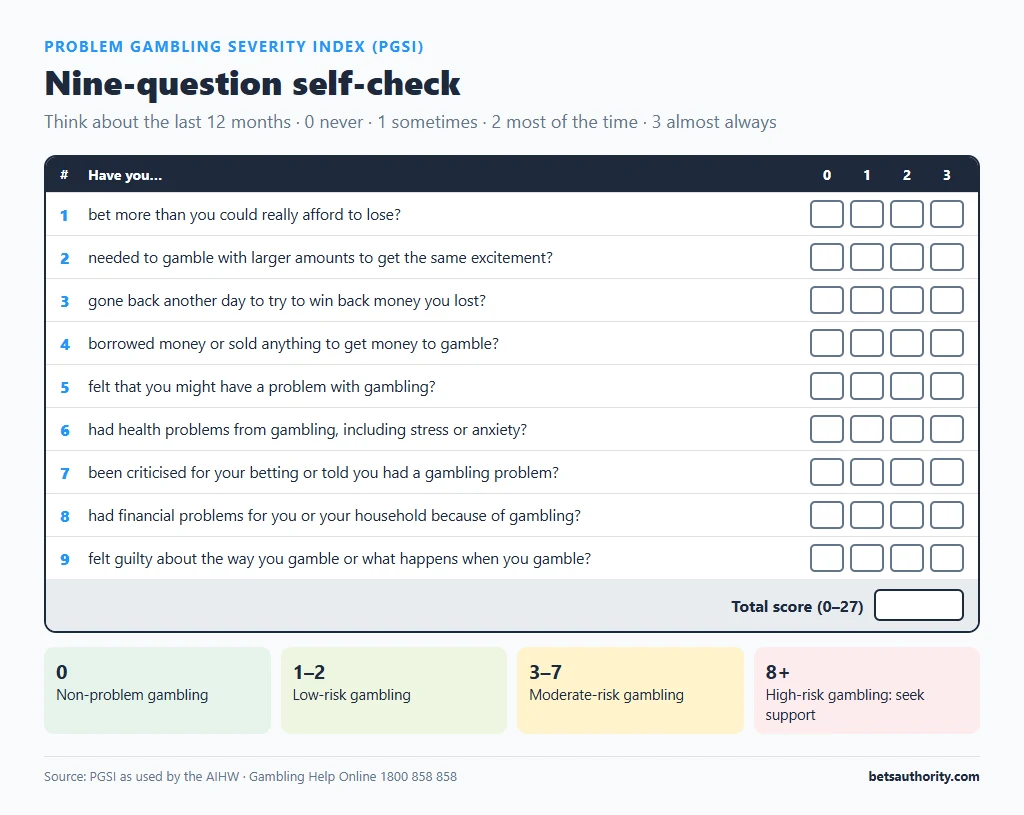
| # | Question |
|---|---|
| 1 | Have you bet more than you could really afford to lose? |
| 2 | Have you needed to gamble with larger amounts of money to get the same feeling of excitement? |
| 3 | Have you gone back another day to try to win back the money you lost? |
| 4 | Have you borrowed money or sold anything to get money to gamble? |
| 5 | Have you felt that you might have a problem with gambling? |
| 6 | Has gambling caused you any health problems, including stress or anxiety? |
| 7 | Have people criticised your betting or told you that you had a gambling problem, regardless of whether you thought it was true? |
| 8 | Has your gambling caused any financial problems for you or your household? |
| 9 | Have you felt guilty about the way you gamble or what happens when you gamble? |
What Your Score Means
| Total score (0–27) | PGSI category | What it suggests |
|---|---|---|
| 0 | Non-problem gambling | No reported problems in the last 12 months |
| 1–2 | Low-risk gambling | Some risk; worth setting firm limits now |
| 3–7 | Moderate-risk gambling | Gambling is causing some negative consequences |
| 8 or more | High-risk (“problem”) gambling | Gambling is causing significant harm; professional support is recommended |
The AIHW notes that anyone scoring 1 or more may be at some risk of, or already experiencing, gambling-related harm. The PGSI measures risk, not every harm; a low score does not mean gambling is harmless for you.
How Common Each Level Is in Australia
According to the HILDA Survey, as reported by the AIHW, in 2022:
- 4.9% of adults were low-risk gamblers (3.7% in 2018);
- 3.1% were moderate-risk gamblers (2.5% in 2018);
- 1.8% were high-risk gamblers (1.1% in 2018).
High-risk gambling was reported by 2.4% of men (about 310,000) and 1.2% of women (about 157,000). More figures are on our Australian gambling statistics page.
Behaviour Signs You Can Check Yourself
The PGSI covers attitudes and outcomes. These behaviour signs are often easier to spot in your own records:
| Sign | Where to look |
|---|---|
| Deposits after a planned stop | Casino or betting account history |
| Several deposits in one session | Bank statement: repeated transfers within an hour |
| Raising deposit limits | Account settings history |
| Using credit, buy-now-pay-later or cash advances for gambling | Card statements |
| Playing later at night or longer than planned | Session history, phone screen-time reports |
| Switching to faster games or higher stakes after losses | Game history |
| Hiding statements or deleting apps before others see them | Your own habits |
Online accounts keep detailed records. Licensed Australian betting providers must send monthly activity statements; offshore casinos usually show history in the account area. Our guide to tracking your spending shows how to pull this together.
Signs Other People Notice
Family members often see the effects before the person gambling does:
- unexplained shortfalls in money for bills, rent or groceries;
- new loans, credit cards or requests to borrow;
- long periods on the phone, often late at night;
- irritability or low mood after gambling, or when unable to gamble;
- missed work, study or family commitments;
- defensiveness when money or gambling is raised.
The 2019 National Telephone Survey of the Interactive Gambling Study estimated that 6.0% of Australian adults had been harmed by someone else’s gambling. If you are on that side, see helping a family member.
Online-Specific Warning Signs
- Claiming bonuses mainly to keep playing rather than for their value; see bonus red flags.
- Reversing a pending withdrawal to keep playing.
- Opening accounts at new casinos after hitting a limit or being excluded.
- Using a VPN or new email address to get around a restriction.
- Chasing losses with higher-volatility pokies or bonus buys.
What to Do Next
- Answer the nine questions honestly and write down the score.
- If you scored 1 or more, set deposit and time limits today; see setting limits.
- If you scored 3 or more, take a break with a time-out; see cooling-off periods.
- If you scored 8 or more, or you are borrowing to gamble, contact Gambling Help Online on 1800 858 858 and consider self-exclusion through BetStop and each casino you use.
- Add a bank gambling block and blocking software; see blocking software.
Our main responsible gambling page covers the principles behind these steps.
Frequently Asked Questions
Betting more than you can afford, needing bigger bets for the same excitement, chasing losses, borrowing to gamble, guilt, health effects such as stress, and financial problems for you or your household. These are the nine areas the PGSI measures.
Surveys such as HILDA use the Problem Gambling Severity Index: nine questions scored 0 to 3, giving a total from 0 to 27. A score of 8 or more is classed as high-risk gambling.
Any score of 1 or more indicates some risk. A score of 3 to 7 is moderate risk and 8 or more is high risk. Free counselling is available at any score from Gambling Help Online.
The HILDA Survey found 1.8% of adults were high-risk gamblers in 2022, up from 1.1% in 2018.
Yes. Frequency matters less than consequences. If gambling causes money problems, stress, conflict or guilt, it is causing harm.
If any of these signs apply to you, free and confidential help is available 24/7 from Gambling Help Online on 1800 858 858, by chat or email at gamblinghelponline.org.au. If you are in crisis, call Lifeline on 13 11 14 or 000 in an emergency. Gambling is for adults 18+ only.