
Online Dice Casino Game: Win Chance, Payouts and Edge
Online dice is the simplest instant casino game. The game generates a random number, typically between 0.00 and 99.99. Before each roll you set a target and choose roll over or roll under. That choice sets your win chance, anywhere from about 1% to 98% depending on the game, and the payout is calculated directly from it: multiplier = RTP / win chance. Because you set the probability yourself, dice shows the house edge more plainly than any other casino game.
This page is part of our crash games guide, with Mines and Plinko covered on their own pages. It is a different game from table dice games such as craps and sic bo.
How a Roll Works
- Set the stake, for example A$1.
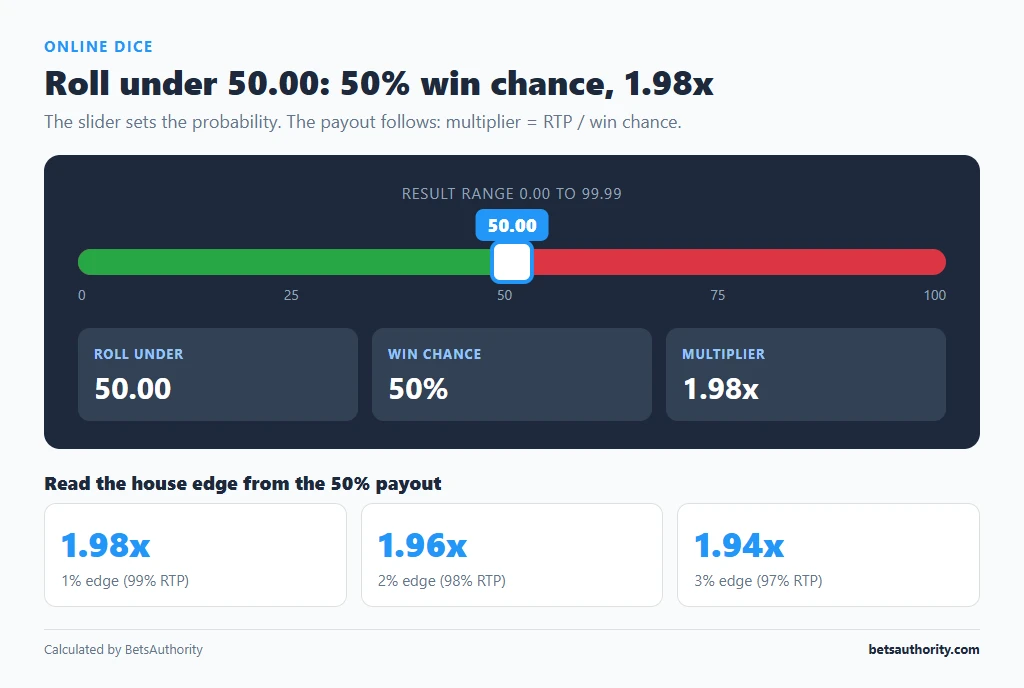
- Move the slider to a target, for example 50.00.
- Choose roll under (win if the result is below 50.00) or roll over (win if above).
- The game shows the win chance and the multiplier before you roll.
- The RNG produces the number. If it falls in your range, you receive stake x multiplier.
The slider is a probability control. Moving it towards one end makes the win more likely and the payout smaller.
Reading the Range Correctly
With results from 0.00 to 99.99 there are 10,000 possible numbers. A roll-under 25.00 bet wins on 0.00 to 24.99, which is 2,500 results or exactly 25%. A roll-over 75.00 bet covers a similar range at the other end. Some games define the boundary slightly differently (for example including the target number), so the win chance displayed next to the slider is the figure to trust, not your own estimate. Games that use a 0 to 100 range or whole numbers work the same way with different step sizes.
Two settings with the same win chance are identical in value. Roll under 30.00 and roll over 69.99 both cover 30% of outcomes and pay the same multiplier.
Win Chance vs Payout
| Win chance | Fair payout | At 99% RTP (1% edge) | At 97% RTP (3% edge) | Profit on A$10 win at 99% RTP |
|---|---|---|---|---|
| 90% | 1.111x | 1.10x | 1.078x | A$1.00 |
| 75% | 1.333x | 1.32x | 1.293x | A$3.20 |
| 50% | 2x | 1.98x | 1.94x | A$9.80 |
| 25% | 4x | 3.96x | 3.88x | A$29.60 |
| 10% | 10x | 9.90x | 9.70x | A$89.00 |
| 1% | 100x | 99x | 97x | A$980 |
Whatever you choose, the expected return per bet equals the RTP. A 90% chance and a 1% chance both return 99% of stakes on average in a 1%-edge game; the difference is only in variance.
Which House Edge Applies?
Dice games from different providers use different edges. Many crypto-casino “original” dice games use a 1% edge (99% RTP); studio versions such as Spribe’s Dice publish their RTP in the game’s info panel. The fastest check is the 50% payout:
- 1.98x means a 1% edge.
- 1.96x means a 2% edge.
- 1.94x means a 3% edge.
On A$1,000 of turnover, the difference between a 1% and 3% edge is A$10 versus A$30 of expected loss.
Turnover Is the Real Cost
Dice rolls resolve instantly, and auto-bet can run hundreds of rolls per minute. That speed matters more than the edge. At A$1 per roll:
| Rolls | Turnover | Expected loss at 1% edge | Expected loss at 3% edge |
|---|---|---|---|
| 100 | A$100 | A$1 | A$3 |
| 1,000 | A$1,000 | A$10 | A$30 |
| 10,000 | A$10,000 | A$100 | A$300 |
A player who deposits A$100 and runs 10,000 auto rolls at A$1 has turned the deposit over 100 times. Even with a 1% edge, the expected loss is the whole deposit. Limit auto-bet with a roll count and a stop-loss.
Betting Systems and Dice
Dice is where betting systems are most often automated, because auto-bet tools let you set “on loss, increase bet by 100%”. This is Martingale. At a 49.5% win chance (2x payout at 1% edge), the chance of 10 losses in a row is 0.505 to the power of 10, about 1 in 920. After 10 losses at a A$1 base, you have lost A$1,023 and the next bet is A$1,024. Over thousands of automated rolls, such streaks are expected. See the Martingale system and betting systems.
Other common settings, such as switching between over and under after a loss, have no effect. Each roll is independent; see the gambler’s fallacy.
Provably Fair Dice
Dice is the original provably fair game. Each roll is generated from a hashed server seed, your client seed and a nonce (the bet count). After rotating the seed, you can recompute any past roll and confirm the number. Our provably fair guide explains the process. Verification proves results were not altered; it does not change the edge.
Practical Notes
- Check the 50% payout to identify the house edge before playing.
- Pick a win chance you are comfortable with and keep it; changing it does not improve the expected result.
- Use manual rolls or a capped auto-bet count; set a stop-loss.
- Dice is commonly excluded from bonus wagering; see game weighting.
- Dice games are most common at crypto casinos; read about crypto casino risks and checks before depositing.
Frequently Asked Questions
The game generates a random number, usually from 0.00 to 99.99. You choose a target and whether you win by rolling over or under it, which sets your win chance. The payout multiplier is the RTP divided by the win chance, so lower chances pay more.
It depends on the house edge. At 99% RTP (1% edge) a 50% chance pays 1.98x. At 97% RTP it pays 1.94x. A fair game would pay exactly 2x.
No. Rolling over 50.00 and rolling under 50.00 have the same chance and pay the same. Only the win chance you set matters.
No. Martingale, Paroli, D’Alembert and similar systems change the size and order of bets but not the house edge on each bet. Over any number of rolls, the expected loss equals the total wagered multiplied by the house edge.
No. Online dice is a single random number with a chosen win chance. Craps and sic bo are table games with physical or simulated dice and fixed bet types. See our craps and sic bo guides for those.
Gambling is for adults 18+ and should stay within a budget you can afford to lose. Free, confidential support is available 24/7 from Gambling Help Online on 1800 858 858.