
Plinko: Online Casino Game Rules, Rows, Risk Levels and Odds

Plinko is an instant game in which a ball drops through a triangle of pegs and lands in one of the slots at the bottom. Each slot has a multiplier, and your payout is the stake times that multiplier. Online versions let you choose the number of rows (commonly 8 to 16) and a risk level (low, medium, high). The centre slots pay little, often less than the stake, and the edge slots pay the most but are hit very rarely.
This page is part of our crash games guide, which also covers Mines and Dice.
The Odds: A Binomial Distribution
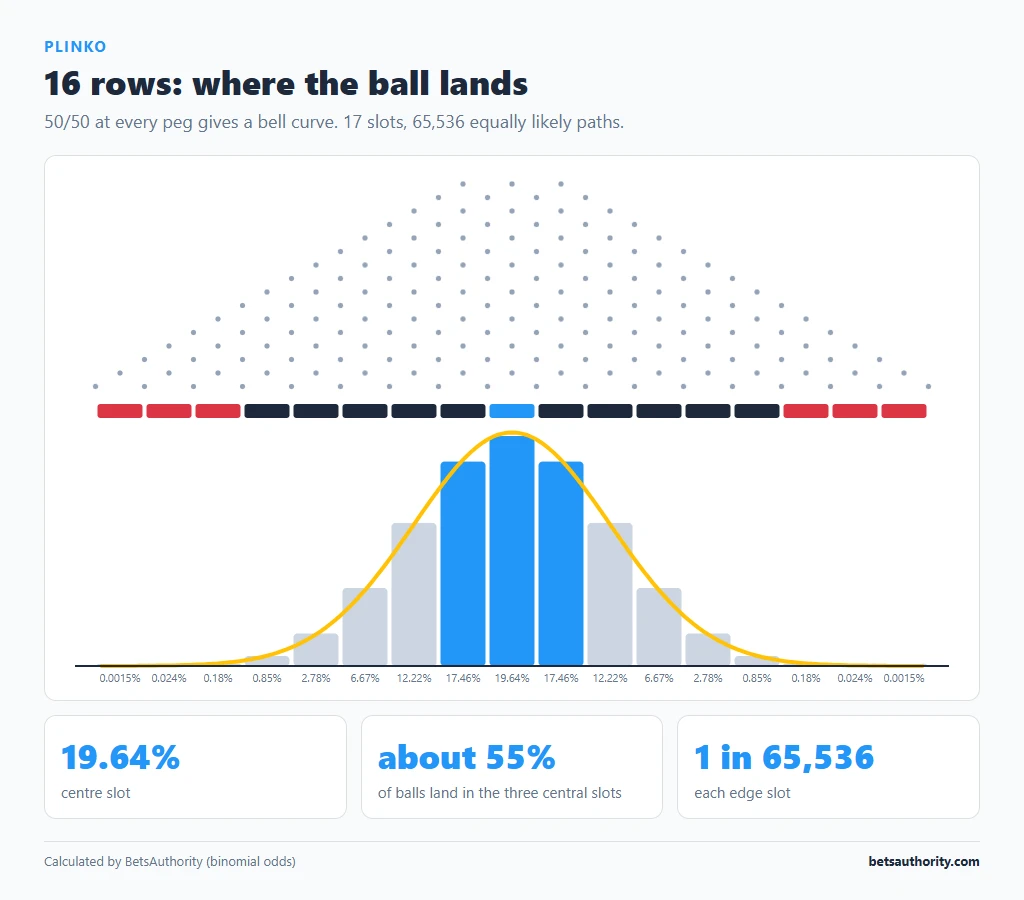
At every peg, the ball goes left or right with a 50% chance. With n rows there are n + 1 slots, and the chance of landing in slot k is C(n, k) / 2 to the power of n. This means the centre is far more likely than the edges.
8 rows (9 slots, 256 equally likely paths)
| Slot (from edge) | Paths | Probability |
|---|---|---|
| Edge (each side) | 1 | 0.39% (1 in 256) |
| 2nd | 8 | 3.13% |
| 3rd | 28 | 10.94% |
| 4th | 56 | 21.88% |
| Centre | 70 | 27.34% |
16 rows (17 slots, 65,536 equally likely paths)
| Slot (from edge) | Paths | Probability |
|---|---|---|
| Edge (each side) | 1 | 0.0015% (1 in 65,536) |
| 2nd | 16 | 0.024% |
| 3rd | 120 | 0.18% |
| 4th | 560 | 0.85% |
| 5th | 1,820 | 2.78% |
| 6th | 4,368 | 6.67% |
| 7th | 8,008 | 12.22% |
| 8th | 11,440 | 17.46% |
| Centre | 12,870 | 19.64% |
On 16 rows, about 55% of balls land in the three central slots, while a ball reaches either edge only about once in 32,768 drops.
How Multipliers Set the RTP
RTP = the sum of (probability of each slot x its multiplier). An example set of multipliers on 8 rows shows how this works:
| Slot | Probability | Example low-risk multiplier | Example high-risk multiplier |
|---|---|---|---|
| Edge (x2) | 0.39% each | 5.6x | 29x |
| 2nd (x2) | 3.13% each | 2.1x | 4x |
| 3rd (x2) | 10.94% each | 1.1x | 1.5x |
| 4th (x2) | 21.88% each | 1x | 0.3x |
| Centre | 27.34% | 0.5x | 0.2x |
| RTP | 98.98% | 99.06% |
The two columns return almost the same on average, but they feel very different. In the low-risk example, about 73% of balls return 1x or more. In the high-risk example, about 71% of balls return 0.3x or less, and the result depends on rare edge hits. The multipliers in real games differ by provider; the in-game paytable shows them for each row and risk setting.
Rows and Risk: What Changes
| Setting | Effect on maximum multiplier | Effect on frequency of large wins | Effect on house edge |
|---|---|---|---|
| More rows | Higher | Rarer | About the same |
| Higher risk | Higher edges, lower centre | Same rarity, bigger gap | About the same |
| Fewer rows, low risk | Lowest maximum | Most frequent near-stake returns | About the same |
Speed and Turnover
Plinko rounds take a second or two, and many games allow auto-drop of dozens of balls. At A$1 per ball and 20 balls a minute, that is A$1,200 of turnover per hour. With a 1% house edge the expected loss is about A$12 per hour; with 3%, about A$36. Variance on high-risk settings is much larger than either figure suggests. The same turnover logic is explained for pokies in RTP explained.
Provably Fair Plinko
Most Plinko games from crypto-focused studios are provably fair: the result for each ball is generated from a server seed (hashed before play), a client seed you can change, and a nonce that counts your bets. After you rotate the seed, you can verify every past drop. See provably fair for the procedure. Verification proves results were not changed; it does not change the odds.
Plinko Compared With Other Instant Games
| Game | Your decision | When the result is fixed | Typical RTP range | What sets variance |
|---|---|---|---|---|
| Plinko | Rows and risk before the drop | Before the ball falls | about 96% to 99% | Rows and risk level |
| Mines | Mines count and when to cash out | Layout fixed before the first pick | about 97% to 99% | Mines count and picks |
| Dice | Win chance before the roll | At the roll | about 97% to 99% | Win chance |
| Crash games | Cash-out target | Before the round starts | about 97% (Aviator) | Cash-out target |
Plinko is the only one of the four where you make no decision once the round starts. That makes it the most passive format, and with auto-drop, the fastest to turn over a budget.
A 100-Ball Session on 8 Rows
Using the example low-risk table above at A$1 per ball, the expected outcome of 100 drops is roughly: 27 centre hits (A$13.50 back), 44 fourth-slot hits (A$44), 22 third-slot hits (A$24.20), 6 second-slot hits (A$12.60) and less than one edge hit. That totals about A$94 to A$100 back from A$100, depending on whether an edge ball lands. Real sessions vary around this, and on high-risk settings the spread is much wider, because one edge hit at 29x outweighs dozens of 0.2x results.
Plinko Demo: Free Play Before Real Money
Several Plinko versions can be played free in demo mode with virtual credits. BGaming’s Plinko is one example: its official game page offers a demo and lists a 99% RTP, 8 to 16 lines, three risk levels (low, normal and high) and a maximum multiplier of x1000. A demo uses the same multiplier tables as the real-money version, so it is a fair way to see how often the edge slots are hit on 16 rows and how quickly a high-risk setting drains a balance. What a demo cannot show is the cost of turnover in real money. Before switching from demo to real play, note the RTP for your row and risk setting and set a ball count and a loss limit. Our guide to demo play explains where free modes are offered and their limits, and provably fair shows how to check a real-money drop afterwards.
Practical Notes
- Check the RTP and the multiplier table for your chosen rows and risk in the game info.
- Treat high-risk 16-row settings as lottery-style: most drops return a fraction of the stake.
- Limit auto-drop. Set a number of balls and a loss limit before starting.
- Expect Plinko to be excluded or reduced in bonus wagering; see game weighting.
- For a game with a similar risk choice and visible probabilities, compare Dice.
Plinko versions are offered by several instant-game studios, including Spribe and BGaming. Casinos that list Plinko are compared on our Plinko casinos page. Casinos with large instant-game sections are often crypto-focused; see crypto casinos.
Keep reading
All in Crash Games GuideFrequently Asked Questions
Yes. In online Plinko, each ball’s path is generated by a random number generator, usually a provably fair one. At each peg the ball goes left or right with equal probability, so the landing slot follows a binomial distribution. The animation shows a result that is already decided.
It depends on the provider and settings. Online Plinko games commonly list RTPs between about 96% and 99%. The figure is in the game’s info panel; check it at your casino before playing.
Rows change the shape of the distribution and the maximum multiplier. More rows make the edge slots rarer: 1 in 256 each on 8 rows, 1 in 65,536 each on 16 rows. The multipliers are scaled so the RTP stays roughly the same for each row setting.
Low, medium and high risk change the multipliers on each slot. High risk raises the edge multipliers and lowers the centre ones, often below 1x. The house edge stays about the same; only variance changes.
No. Dropping the ball at a different time or position on screen does not change the outcome in RNG-based online Plinko. The path is determined by the random result.
Yes, many Plinko games have a demo mode. BGaming offers a free demo of its Plinko (99% RTP, 8 to 16 lines, three risk levels) on its official game page; demo results use the same multipliers as the real version.
Gambling is for adults 18+ and should stay within a budget you can afford to lose. Free, confidential support is available 24/7 from Gambling Help Online on 1800 858 858.