
12 Pokies Myths and What the Maths Actually Says
Most pokies myths come from the same source: treating a random, memoryless game as if it had patterns, moods or a schedule. Below are 12 common beliefs, each checked against how pokies actually work. The core principle is simple. Each spin is decided by a random number generator (RNG), each spin is independent of every previous spin, and the long-run return is fixed by the game’s maths model, not by the casino in real time.
This page is part of our online pokies guide. The underlying mechanics are explained in how pokies work and our RNG explainer.
Myths 1 to 4: Timing and Streaks
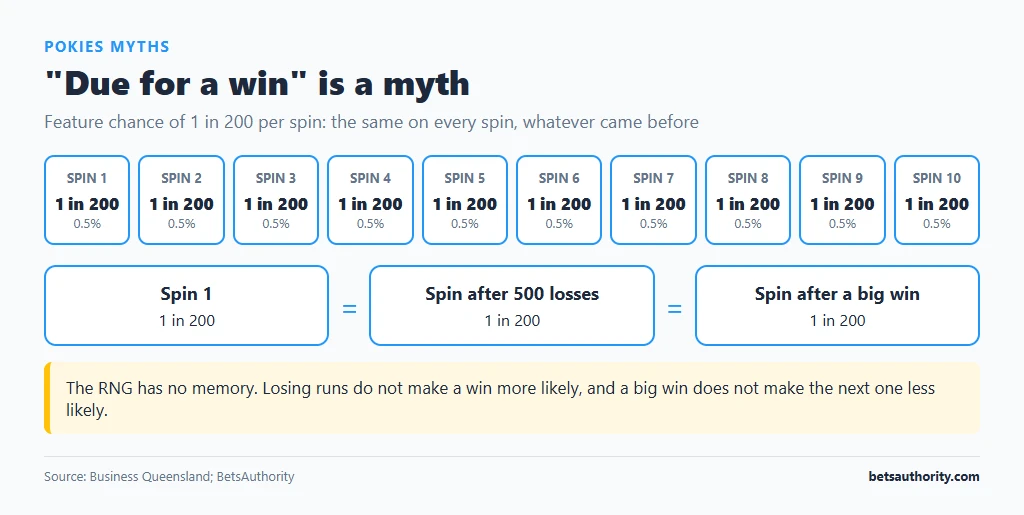
1. “This machine is due for a win”
False. The RNG has no memory. If a feature has a 1 in 200 chance per spin, it has a 1 in 200 chance on the spin after 500 losses, exactly as on the first spin. The belief that a run of losses makes a win more likely is the gambler’s fallacy. Queensland’s regulator lists “losing makes you more likely to win next time” among common myths (Business Queensland).
2. “It just paid big, so it will go cold”
False, for the same reason. A big win does not lower the chance of another one. Two features in ten spins are uncommon but entirely possible.
3. “Pokies pay more at certain times”
False. The RNG does not know the time, date or how many people are playing. Queensland’s regulator lists payout timing as a myth. Online, the same applies to “Friday night” or “after a jackpot” theories.
4. “A machine with a long dry streak is cold and should be avoided”
False. There is no cold or hot state. Streaks are what random sequences look like. In 1,000 spins of a game with a 25% hit rate, runs of 15 or more losing spins in a row occur about three times on average (1,000 x 0.25 x 0.75 to the power of 15 = 3.3), even though each spin is independent.
Myths 5 to 8: Control and Technique
5. “Stopping the reels early changes the result”
False. The result is decided when you press spin. Quick stop ends the animation sooner; it does not pick different symbols. The regulator’s myth list includes “touching the buttons a certain way will influence a payout”.
6. “Changing bet size tricks the game into a feature”
False in most games. Feature probability is the same at every stake unless the rules say otherwise. The exceptions are explicit: ante bets such as the one in Gates of Olympus charge a higher stake for a higher trigger rate, and some jackpots require a minimum bet.
7. “Autoplay pays less than manual spins”
False. Autoplay sends the same spin request to the same RNG. It can make you play faster and longer, which raises total losses, but it does not change the odds per spin.
8. “Lucky items, rituals and concentration help”
False. Lucky shirts, favourite machines and positive thinking are on the regulator’s list for a reason: none of them can influence an RNG.
Myths 9 to 12: RTP, Casinos and Demos
9. “96% RTP means I get A$96 back from A$100”
False for a session. RTP is a long-run average across millions of spins. A A$100 session can end at A$0 or A$1,000. Over large turnover, the expected loss is 4% of everything wagered, which can be more than your deposit if you re-bet winnings. See RTP explained.
10. “The casino tightens the game when I’m winning”
False for certified games from major studios: the maths cannot be changed mid-session. What is true is that casinos choose among several certified RTP versions before you play. Book of Dead at 96.21% and a reduced version look identical. Check the figure using our guide on how to check game RTP. Unlicensed casinos running unofficial copies of games are a separate risk; see how to spot a scam casino.
11. “Demo mode is rigged to pay more”
Mostly false. Major studios use the same maths in demo and real-money mode. The RTP version can differ, though: Quickspin’s free demo of Big Bad Wolf runs the 90% model, while casinos may offer 97%. Demo results over 100 spins are also too short to show anything about RTP. See demo play.
12. “Near misses mean I’m getting close”
False. Two scatters and a third just above the reel window feels close, but it is one of many losing outcomes. The next spin is independent. Games are designed to show anticipation (slow reels when two scatters land), which is presentation only.
Summary Table
| Myth | Reality |
|---|---|
| Due for a win | Each spin independent; no memory |
| Hot / cold machines | Streaks are normal randomness |
| Time-of-day payouts | RNG ignores time |
| Quick stop changes result | Result fixed at spin request |
| Bet changes trigger features | Only where the rules say so (ante bets, jackpot qualification) |
| Autoplay pays less | Same odds; faster play increases total loss |
| RTP = session return | Long-run average only |
| Casino tightens mid-game | Certified maths can’t change; RTP version chosen in advance |
| Demo pays more | Same maths; check RTP version |
| Near miss = close | Just a losing outcome |
What You Can Actually Control
- Game choice: pick titles running 96%+ at your casino; see high RTP pokies.
- Volatility: match it to your budget; see volatility.
- Stake and time: these decide total turnover and therefore the expected loss.
- Limits: deposit and loss limits set before you start; see setting limits.
If beliefs like “I’m due” or “one more spin will win it back” keep you playing, the Queensland regulator notes they can be a sign of gambling-related harm. Our signs of problem gambling page explains what to look for.
Frequently Asked Questions
No. Licensed pokies use a random number generator that does not know the time or day. Queensland’s gaming regulator lists “machines pay out at certain times of the day” as a myth.
No. Each spin is independent. A long losing run does not change the probability of the next spin. Believing otherwise is the gambler’s fallacy.
A casino cannot change a certified game’s maths during play. It can choose which certified RTP version to offer before you play, which is why checking the RTP in the game rules matters.
No. In most games, the probability of triggering a feature is the same at every stake. Exceptions are stated in the rules, such as ante bets, which raise the stake to increase feature frequency, or jackpots that only qualify at certain bet levels.
No. The outcome is decided before the reels stop. A near miss is just one of many losing outcomes and says nothing about the next spin.
Reputable studios use the same maths in demo and real modes, but the RTP version can differ. Big Bad Wolf’s free demo, for example, runs the 90% model, while casinos may offer the 97% model.
Gambling is for adults 18+ and should stay within a budget you can afford to lose. Free, confidential support is available 24/7 from Gambling Help Online on 1800 858 858.