
Casino Bankroll Management: Budgets, Stake Sizes and Stop Limits
Bankroll management is a set of rules for how much money you bring to gambling, how you split it, and how much you risk per bet. It does not change the house edge or make winning more likely. What it does is control two things you can control: how much you can lose in a month, and how long your money lasts in a session. This page is part of our casino tips and strategy guides.
Step 1: Set a Monthly Budget From Spare Money Only
Your bankroll is money already spent on entertainment, like a concert ticket. Work it out from what is left after rent or mortgage, bills, groceries, transport, debt repayments and savings. If that number is zero, the budget is zero.
- Write the figure down, for example A$300 per month.
- Never add to it from savings, credit or a pay advance. Since June 2024, licensed Australian online wagering services have been banned from accepting credit cards, which reflects how quickly borrowed money turns into debt.
- Set the same figure as a deposit limit at every casino you use. Our deposit limit guide shows where to find the setting.
Step 2: Split the Budget Into Sessions
A single A$300 session can disappear in an hour on a high-volatility pokie. Splitting gives you more, shorter sessions and a natural stopping point.
| Monthly budget | Sessions | Session bankroll |
|---|---|---|
| A$100 | 4 | A$25 |
| A$300 | 6 | A$50 |
| A$600 | 6 | A$100 |
| A$1,200 | 8 | A$150 |
Rule: money left at the end of a session does not roll into the next one automatically. Withdraw it or treat it as next month’s budget. This stops a winning session from becoming a bigger losing one.
Step 3: Choose a Stake That Fits the Game
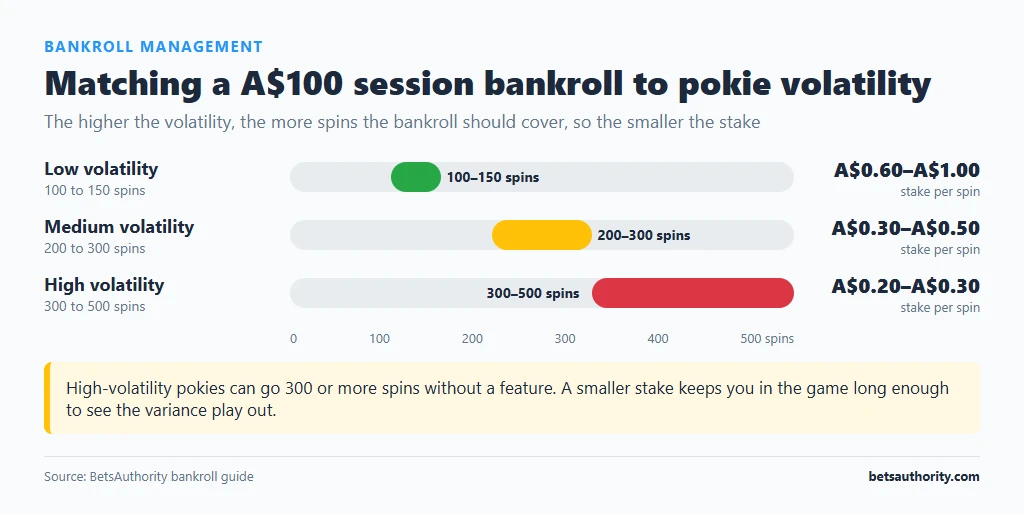
The right stake depends on volatility: how widely results swing. A common rule of thumb is to size the stake so the session bankroll covers a set number of bets.
| Game type | Bets the session should cover | Stake with A$100 session bankroll |
|---|---|---|
| Low-volatility pokie | 100 to 150 spins | A$0.60 to A$1.00 |
| Medium-volatility pokie | 200 to 300 spins | A$0.30 to A$0.50 |
| High-volatility pokie (e.g. Nolimit City, Hacksaw) | 300 to 500 spins | A$0.20 to A$0.30 |
| Blackjack with basic strategy | 40 to 50 hands’ worth | A$2 to A$2.50 |
| European roulette, even-money bets | 40 to 50 bets | A$2 to A$2.50 |
| Baccarat, Banker or Player | 40 to 50 bets | A$2 to A$2.50 |
High-volatility pokies can go 300 or more spins without a feature, and their bonus rounds produce most of the return. A small stake keeps you in the game long enough to see that variance play out. The volatility guide explains how to identify a game’s rating. For a specific example, the Gates of Olympus page shows the spread of results on a popular medium-volatility title.
Step 4: Know the Expected Cost of the Session
Use the house edge formula: stake x bets per hour x house edge. A$0.40 spins at 600 spins an hour on a 96% RTP pokie means A$240 wagered and an expected cost of about A$9.60 an hour. Your actual result will vary widely around that figure, but over many sessions it tends towards it. If the expected hourly cost feels too high, lower the stake or switch to a lower-edge game; don’t raise the stake to “win it back faster”.
Step 5: Set a Loss Limit and a Win Point
- Loss limit: the session bankroll. When it is gone, the session ends. No second deposit the same day.
- Win point: decide in advance, for example when the balance doubles. At that point withdraw at least the original session bankroll, then either stop or continue with the profit only.
- Time limit: a fixed session length such as 45 or 60 minutes, enforced with a phone timer or the casino’s reality check. See time management.
Step 6: Track Every Session
Keep a simple log: date, casino, deposit, withdrawal, net result, time played. Casino transaction histories are often incomplete across multiple sites, and crypto deposits are easy to lose track of. After a month, compare the total with your budget. Our guide to tracking your spending includes a template layout.
| Date | Casino | Deposited | Withdrawn | Net | Minutes |
|---|---|---|---|---|---|
| 3 Nov | Casino A | A$50 | A$0 | -A$50 | 40 |
| 9 Nov | Casino A | A$50 | A$110 | +A$60 | 55 |
| 16 Nov | Casino B | A$50 | A$20 | -A$30 | 45 |
Bonuses and Bankroll
A deposit bonus adds funds but also locks your deposit until wagering is complete, and usually caps your bet size. A A$100 deposit with a 100% match and 40x bonus wagering means A$4,000 of bets before you can withdraw. At A$1 spins that is 4,000 spins. Factor this in before accepting; many players get better control by declining bonuses. See wagering requirements.
Rules That Protect the Bankroll
- Never increase the stake after losses. That is the logic of the Martingale system, which does not work.
- Keep gambling funds in a separate account or e-wallet so they are not mixed with bill money.
- Do not play while drunk, tired or upset; decisions on stakes slip first.
- Withdraw wins promptly instead of leaving them in the casino balance.
- If you exceed your monthly budget twice, take a break and review using our budgeting guide.
Frequently Asked Questions
Only money left after essential expenses, debt repayments and savings. Many people use a fixed monthly amount and set it as a deposit limit at each casino.
Size it so a session bankroll covers about 100 to 150 spins on low-volatility games and 300 or more on high-volatility games. With A$100, that means roughly A$0.60 to A$1 or A$0.20 to A$0.30 per spin.
No. It controls how much you can lose and how long money lasts. The house edge stays the same.
Yes. Decide in advance at what balance you will withdraw, for example when the session bankroll doubles, so wins are not played back.
Be cautious. Wagering requirements of 30x to 40x lock your deposit and can require thousands of dollars of bets, often with a maximum bet rule.
A budget only works if you stick to it. Gambling is for adults 18+; for support, call Gambling Help Online on 1800 858 858.