
How Casino RNGs Work: Random Number Generators Explained
Every online pokie, RNG table game and digital scratch card uses a random number generator (RNG) to decide results. Live dealer games are the exception: there the outcome comes from a physical wheel, cards or dice filmed in a studio. Understanding the RNG answers most of the common questions players ask: can a game be “hot”, does the casino control wins, and does stopping the reels early change anything. This page is part of our casino tips section.
What an RNG Is
Casino games use a pseudo-random number generator (PRNG): an algorithm that produces a long stream of numbers which pass statistical tests for randomness. It starts from a seed value, often mixed with hardware entropy such as timing noise, and generates numbers continuously. Well-designed generators have cycles so long that no sequence repeats in practice, and the next output cannot be predicted from previous outputs without knowing the internal state.
The RNG on its own only produces numbers. The game’s maths model turns those numbers into outcomes.
From Random Number to Pokie Spin
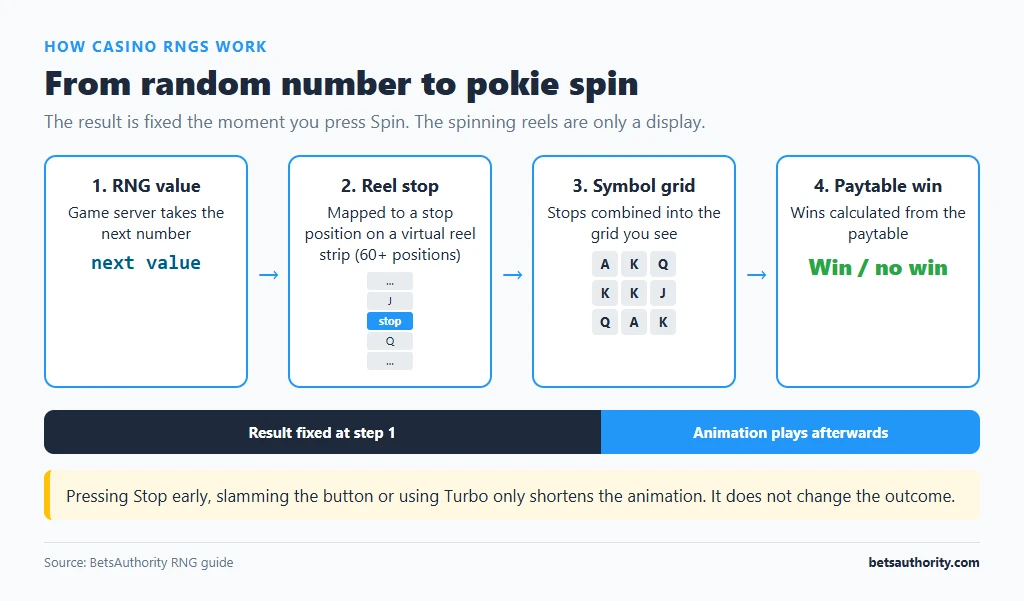
- You press Spin. The game server takes the next value(s) from the RNG.
- Each value is mapped to a stop position on a virtual reel strip. A reel might have 60 or more positions, with low-paying symbols appearing many times and premium symbols only a few.
- The stop positions are combined into the grid you see, wins are calculated from the paytable, and the animation plays.
The result is fixed at step 1. The spinning reels are a display. Pressing Stop early, slamming the button or using Turbo only shortens the animation.
How RNG Becomes RTP
The RNG is uniform, but the reel strips and paytable are not. Designers choose how often each symbol appears and how much each combination pays so that, over millions of spins, the game returns a target percentage such as 96.5%. That target is the RTP. When a pokie exists in several RTP versions (96.5%, 95.5%, 94%), the RNG is identical; the difference is in the maths configuration the casino has selected.
For card and table games the mapping is simpler. An RNG blackjack game shuffles a virtual shoe by drawing random positions; RNG roulette picks a number from 0 to 36. The house edge comes from the game rules, not from the RNG.
Who Tests RNGs
Game studios submit their RNG and game maths to independent testing laboratories before release in regulated markets. Commonly seen names are Gaming Laboratories International (GLI), BMM Testlabs, iTech Labs and eCOGRA. Testing typically covers:
- Statistical randomness of the raw output over very large samples.
- That the mapping from numbers to outcomes matches the documented game rules.
- That the measured return over simulated play matches the declared RTP.
- That the game cannot be altered after certification without a new version number.
Most pokies Australians play at offshore casinos come from large studios such as Pragmatic Play, Play’n GO, NetEnt and Nolimit City, whose games are certified for strictly regulated markets. The game server is usually run by the studio itself, not the casino, which limits the casino’s ability to tamper with individual outcomes. You can read more about each studio in our game providers section.
What a Certificate Does Not Prove
| A certified RNG proves | It does not prove |
|---|---|
| Outcomes are statistically random | The casino will pay withdrawals on time |
| The game matches its published rules and RTP | The casino runs the highest RTP version |
| Each spin is independent | You will receive the RTP in your session |
| The tested version behaves as declared | An unknown in-house game at an unlicensed site is fair |
The practical risk at offshore sites is rarely a rigged RNG from a major studio. It is unpaid winnings, retroactive bonus confiscations and slow verification. Those are covered in reading casino T&Cs and how to spot a scam casino.
Common RNG Myths
- “The casino tightens games after a big win.” RTP is part of the certified game configuration. Changing it means switching to a different version, not adjusting individual spins.
- “Games pay more at night or on weekends.” The RNG has no clock-based payout logic. See pokies myths.
- “Near misses mean a win is close.” Two scatters and a third just above the line is one random outcome among many, with no bearing on the next spin.
- “Demo mode pays better to hook you.” Reputable studios use the same maths in demo and real play, though the RTP version can differ between a provider’s public demo and a specific casino. Check in the game info screen; see demo play.
- “A cold machine is due.” Independent results cannot be due. This is the gambler’s fallacy.
RNG vs Provably Fair vs Live
| Type | Where the result comes from | How you verify it |
|---|---|---|
| Certified RNG | Game server algorithm | Trust the lab certificate and provider reputation |
| Provably fair | Server seed + your client seed + nonce, hashed | Check each round yourself with the revealed seed |
| Live dealer | Physical wheel, cards or dice on camera | Watch the event; studios are audited |
Crypto-native games such as crash, dice and Plinko often use the provably fair method, which lets you recompute each result.
How to Check a Game Before You Play
- Confirm the provider. Open the game’s info screen and look for the studio name and version.
- Read the RTP shown in the rules while logged in to real-money mode, since that reflects the version the casino runs. Our step-by-step RTP check shows where to find it.
- Avoid unbranded games with no visible provider, particularly at casinos without a verifiable licence.
- Look up the casino’s licence and complaint history; see how to check a casino licence.
Frequently Asked Questions
Games from established providers use certified pseudo-random number generators that are tested by independent labs. Each result is statistically random and independent of previous spins.
For major studios the game runs on the provider’s server and the RNG is certified. A casino can choose a lower RTP version of a game, which is why checking the RTP in the game rules matters.
No. The result is decided when you press Spin; stopping only skips the animation.
Independent laboratories such as GLI, BMM Testlabs, iTech Labs and eCOGRA test RNG output and game maths for studios and regulators.
The main outcome comes from physical equipment filmed live. Some live game shows also add RNG-generated multipliers, such as the lightning multipliers in Lightning Roulette.
Random results mean losses can run longer than expected. Play only if you are 18+; free support is available from Gambling Help Online on 1800 858 858.