
Cluster Pays Pokies: How Grid Wins and Cascades Work
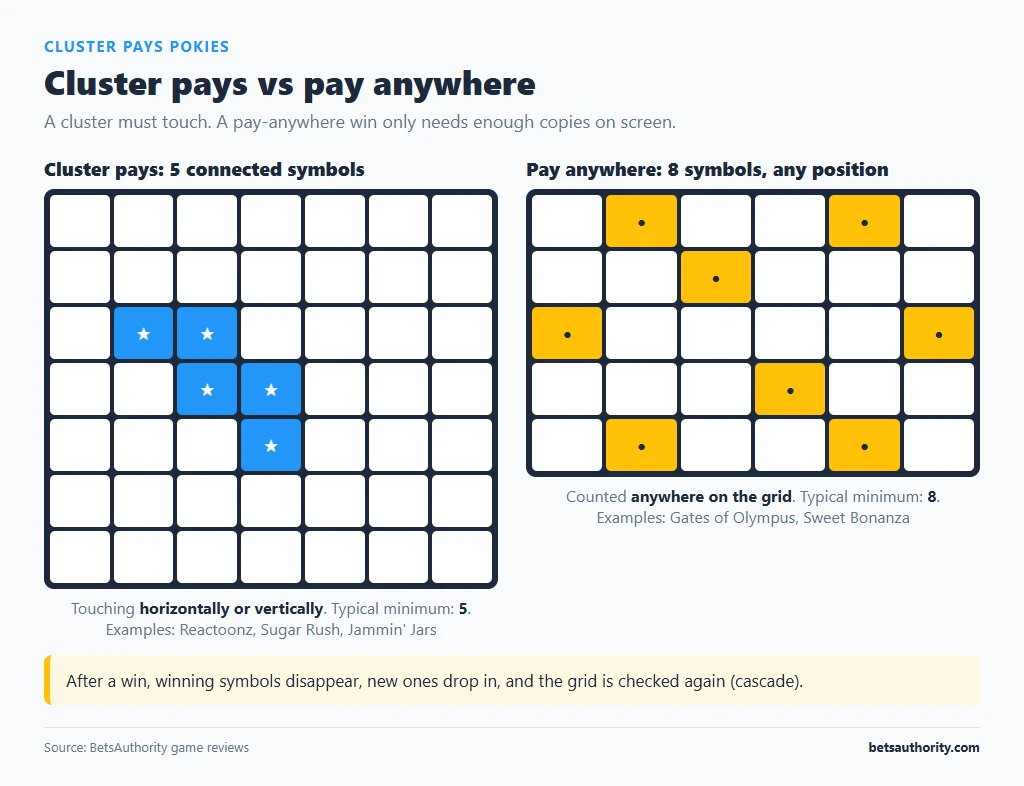
Cluster pays pokies replace paylines with a grid. A win forms when a minimum number of identical symbols, usually 5 or more, touch each other horizontally or vertically. The winning cluster is removed, new symbols drop in (a cascade, tumble or avalanche), and new clusters can form from the same paid spin. Larger clusters pay more, and many games add multipliers that grow as cascades continue.
This page is part of our online pokies guide. For line-based games, see paylines explained.
Cluster Pays vs Pay Anywhere vs Paylines
| System | Win condition | Typical minimum | Examples |
|---|---|---|---|
| Cluster pays | Connected group of identical symbols (horizontal / vertical) | 5 | Reactoonz, Sugar Rush, Jammin’ Jars |
| Pay anywhere (scatter pays) | Count of identical symbols anywhere on the grid | 8 | Gates of Olympus, Sweet Bonanza, Joker Bombs |
| Paylines | Symbols in a fixed pattern across adjacent reels | 3 | Book of Dead |
Pay anywhere is often grouped with cluster pays because both use large grids and tumbles, but the maths is different. A cluster must be connected; a pay-anywhere win only needs enough copies somewhere on screen.
How a Cascade Sequence Works
- The grid fills and the game checks for clusters of 5+.
- Every winning cluster pays according to its size (for example 5, 6, 7 … 15+ symbols in separate tiers).
- Winning symbols disappear. Symbols above fall down and new ones fill the gaps.
- The game checks again. Steps 2 and 3 repeat until no new cluster forms.
- Any feature meters, multipliers or charges that depend on wins are updated during the sequence.
The total win of the spin is the sum of all cascades. Because a single paid spin can produce several wins, many cluster games show a lower base-game paytable than line games and rely on chains to reach meaningful amounts.
Multiplier Systems in Cluster Pokies
The real difference between cluster pays titles is how they build multipliers:
| Pokie | Grid | Multiplier mechanic | RTP | Max win |
|---|---|---|---|---|
| Sugar Rush | 7×7 | Winning positions become multiplier spots, doubling from x2 to x128 | 96.50% | 5,000x |
| Xpander | 7×7 | The Hopper multiplier, x2 doubling up to x128, size up to 4×4 | 96.25% | 10,000x |
| Jammin’ Jars | 8×8 | Moving Jar wilds whose multipliers grow with each win they join | up to 96.83% | 19,998.5x |
| Reactoonz | 7×7 | Quantum Leap meter charges features; Gargantoon wild | up to 96.51% | 4,570x |
| Cubes 2 | 5×5, expands to 11×11 | Corner X multipliers worth the size of the cluster | 96.33% | 11,000x |
| Hand of Anubis | 5×6 | Soul Orb wilds with growing multipliers | 96.24% | 10,000x |
| Retro Tapes | about 9×6 | Cluster Links and instant prizes up to 1,000x | 96.47% | 10,000x |
| Le Bandit | 6×5 | Golden Squares and Super Cascades | up to 96.34% | 10,000x |
Most of these are rated high volatility. Sugar Rush’s multiplier spots, for example, stay on the grid for the whole free spins round, which is where the 5,000x cap becomes reachable. In the base game the spots reset after each paid spin.
Hit Frequency in Cluster Games
Because a 5-symbol cluster needs five identical symbols touching, cluster games tend to have lower hit rates than many line games. Hacksaw Gaming publishes figures: about 15.7% for Cubes 2 and about 36.9% for Hand of Anubis. The difference shows how symbol count and grid size affect frequency. A game with fewer symbol types on a larger grid forms clusters more often.
Compare that with medium-volatility line games such as Starburst at 23% or Blood Suckers at 45%. Hit frequency and its relationship to risk is covered on our volatility page.
Pay Anywhere Games in Detail
Pragmatic Play’s pay-anywhere titles count 8 or more symbols across a 6×5 grid. Payouts come in three tiers (8 to 9, 10 to 11, 12+). In Gates of Olympus, multiplier orbs from 2x to 500x are added together and applied to the whole tumble sequence. In Sweet Bonanza, multiplier bombs from 2x to 100x appear only in free spins. Hacksaw’s Joker Bombs uses the same 8+ rule with three bomb types.
Practical Tips for Cluster Pays Pokies
- Read the cluster tiers. A 5-cluster of low symbols often pays less than the stake; the value is in clusters of 10+ and multipliers.
- Watch the RTP version. Hand of Anubis exists in 96.24%, 94.32%, 92.28% and 88.41% versions. Check with our guide to checking a game’s RTP.
- Budget for the feature. Free spins are usually where multipliers persist. Plan for 300+ spins on high-volatility titles.
- Bonus buys are common. Xpander offers a buy at 129x, Sugar Rush at 100x. See bonus buy pokies and bonus buy vs free spins.
- Try the demo for 100 to 200 spins to see how often clusters chain; see demo play.
For studios behind many of these titles, see Hacksaw Gaming and Push Gaming.
Frequently Asked Questions
Most cluster pays pokies need 5 or more matching symbols connected horizontally or vertically. Reactoonz, Jammin’ Jars, Sugar Rush, Cubes 2, Xpander and Hand of Anubis all use 5+. Pay-anywhere games such as Gates of Olympus and Sweet Bonanza need 8+ matching symbols anywhere on the grid.
Usually not. Standard cluster pays count only horizontal and vertical neighbours. The game rules state the exact connection rule, so check them if you are unsure.
No. A cluster must be a connected group. Pay anywhere (also called scatter pays) counts identical symbols in any position, connected or not, which is why it usually needs a higher count such as 8.
Many are rated high volatility because multipliers grow during cascades and free spins. The mechanic itself does not set volatility; the paytable and multiplier design do.
No. The chance of follow-up wins from cascades is already part of the game’s RTP. Cascades change how wins are delivered, not the long-run average.
Gambling is for adults 18+ and should stay within a budget you can afford to lose. Free, confidential support is available 24/7 from Gambling Help Online on 1800 858 858.