
Deal or No Deal Live
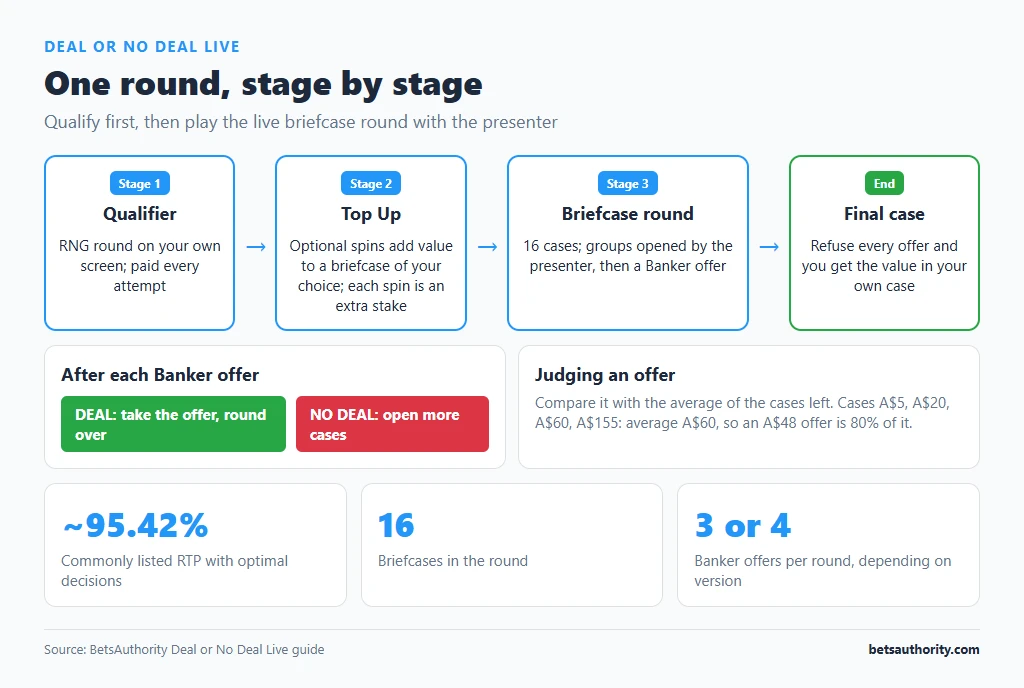
Deal or No Deal Live is a live game show from Evolution, launched in May 2019 in partnership with Endemol Shine Gaming, the format holder of the television show. Unlike the money wheels, it has a multi-stage structure: you first need to qualify, then you can add value to briefcases, and finally you decide whether to accept the Banker’s offers or keep your case. Every player who qualifies plays the same studio round together, but the case values are set for each player individually.
Stage 1: Qualification
You must qualify before you can take part in the live briefcase round. Qualification is decided by an RNG round on your own screen, separate from the studio.
- Original version (2019): a bank-vault style qualifier in which you aimed to line up gold segments on three rotating rings. You could adjust the setup to raise your chance of qualifying, at a higher cost.
- Later versions: several current guides describe a slot-style qualifier in which you need a scatter symbol on each reel to qualify, with optional paid spin modes (such as 15x or 75x the bet) that improve or guarantee qualification and can add multipliers.
The version in your casino’s lobby determines the exact mechanism, cost and qualifying odds. Open the game’s help screen before your first round, because the qualifier is where most of your spending goes.
Stage 2: Top Up
Once qualified, you see 16 briefcases with cash values. You can spin a Top Up wheel to add value to a briefcase of your choice before the timer runs out. Each Top Up spin costs an additional stake and adds a randomly selected amount to the chosen case.
Two points matter here:
- Topping up increases the values in play, which raises later Banker offers in proportion.
- Each Top Up spin is a separate bet with its own house edge. More Top Ups mean more money staked per round.
Stage 3: The Briefcase Round
The live part follows the TV format:
- You hold one briefcase, and the remaining cases are opened in groups by the presenter.
- After each group, the Banker makes an offer based on the values still in play.
- You choose Deal (take the offer, round over) or No Deal (continue). You usually have only a few seconds.
- If you refuse every offer, you receive the value in your own case. Some versions let you swap your case with the last remaining one before the final reveal.
The original release described 16 briefcases and three Banker offers per round; later versions are described with four. Check the help screen for the number of offers at your table.
How the Banker’s Offer Relates to Case Values
The fair value of continuing is the average of the remaining case values. The Banker’s offer is usually set below that average early in the round and moves closer to it as fewer cases remain.
Example: four cases remain, worth A$5, A$20, A$60 and A$155 (multiples of your stake, expressed in A$ for a A$1 stake). The average is A$60. An offer of A$48 is 80% of the average. If you take it, you lock in A$48. If you continue, your expected result is A$60, but with a 50% chance of finishing with A$20 or less.
| Situation | What the offer represents |
|---|---|
| Offer well below the average, early | Price of avoiding risk; continuing has higher expected value |
| Offer close to the average, late | Small cost for removing a large spread |
| You need to secure a result within your budget | Taking a deal reduces variance at a modest expected cost |
There is no “beat the Banker” strategy. Each offer is a choice between a certain amount and a gamble with a higher or similar average. Choose based on how much variance you are willing to accept.
RTP and Costs
Deal or No Deal Live is commonly listed with an RTP of 95.42% under optimal decisions, and some guides list figures around 95% to 96% depending on how you play. RTP can also differ between the qualifier, Top Up and final round. Check the figures in the game’s help screen at your casino.
The game’s cost structure differs from a money wheel:
| Cost | How it arises |
|---|---|
| Qualifying stakes | Paid every attempt, whether or not you qualify |
| Optional faster/guaranteed qualifying modes | Higher cost per attempt (for example 15x or 75x the base bet in some versions) |
| Top Up spins | Additional stake per spin |
| Deal decisions | Accepting offers below the average gives up some expected value |
Because the qualifying stage can take several attempts, track total spending per completed round, not just the cost of one qualifier.
Practical Checklist
- Read the help screen: qualifier type, cost, number of Banker offers, maximum payout.
- Decide your total budget per completed round (qualifier attempts plus Top Ups).
- Decide in advance what fraction of the average you will accept as a deal, for example 85% or more.
- Keep an eye on the timer; each Deal or No Deal decision has a short window, and the help screen states what happens if you do not respond.
- Remember that Deal or No Deal Live usually counts little or nothing towards bonus wagering.
Deal or No Deal Live vs Other Game Shows
| Feature | Deal or No Deal Live | Crazy Time | Dream Catcher |
|---|---|---|---|
| Structure | Qualifier, Top Up, briefcases | Wheel + bonus games | Wheel only |
| Player decisions | Deal/No Deal, Top Ups, case swap | Which spots to bet | Which numbers to bet |
| Listed RTP | About 95.42% | Up to 96.08% | Up to 96.58% |
| Round length | Several minutes | Under a minute (more with a bonus) | Under a minute |
Deal or No Deal Live is available at casinos with Evolution live games, such as MORI WIN. For tips on stream quality and time limits in live games, see live dealer tips and time management. All live games we cover are listed in the live casino guide.
Frequently Asked Questions
Through an RNG qualifying round on your screen. The original version used a vault with three rotating rings of gold segments; later versions use a slot-style qualifier. Check the help screen for the version at your casino.
16. You hold one and the others are opened in groups between the Banker’s offers.
It is commonly listed as 95.42% with optimal decisions. Confirm the figure in the game’s help screen at your casino.
Compare the offer with the average of the remaining case values. Early offers are usually well below the average; later offers are closer. Taking a deal reduces variance at some cost in expected value.
It lets you pay an extra stake to spin a wheel that adds value to one briefcase before the live round, which also raises later Banker offers.
Deal or No Deal Live is a game of chance with a house edge. Play only if you are 18 or older; Gambling Help Online (1800 858 858) offers free, confidential support.