
Keno Rules
Keno is a lottery-style game: you choose numbers, the game draws numbers at random, and you are paid according to how many of your choices match. Standard keno uses the numbers 1 to 80 and draws 20 of them per game. There are no decisions once the draw starts, so understanding keno comes down to the ticket options and the paytable.
Basic Rules
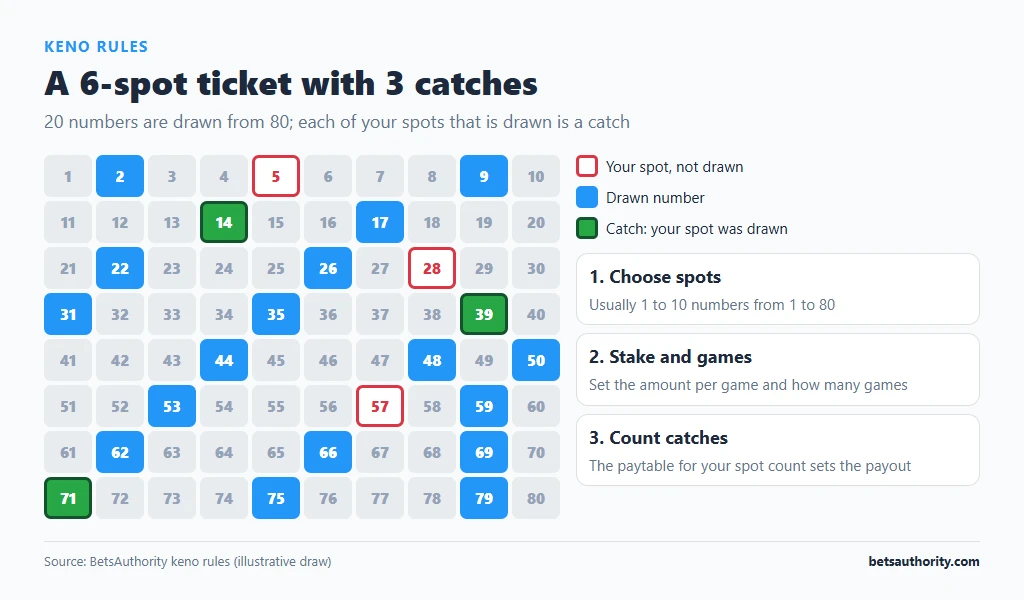
- Choose your spots. Mark between 1 and 10 numbers from 1 to 80 (many games allow up to 15 or 20). Each number you pick is a “spot”. A ticket with 6 numbers is a “6-spot” ticket.
- Choose your stake. Set the amount per game.
- Choose how many games. Many keno games let you play the same ticket for several consecutive draws (multi-race or “consecutive games”).
- The draw. 20 numbers are drawn from 80, one at a time, by a random number generator online or a ball machine or RNG in venues.
- Count your catches. Each of your numbers that is drawn is a “catch”. The paytable for your number of spots shows what each number of catches pays.
How Keno Is Paid
Every spot count has its own paytable. The paytable shows the return for each number of catches, usually as a multiple of your stake. Some key features:
- With 1 to 3 spots, you usually need to catch all or almost all of them to be paid.
- With larger tickets (8, 9, 10 spots), small catches pay little or nothing, and the big payouts are for catching 7 or more.
- Some paytables pay for zero catches on large tickets (for example catching 0 of 10), because that result is relatively unlikely (4.58% for a 10-spot).
Example paytable (illustrative)
The table below is an example only, to show the format; real paytables differ by game and venue.
| 4-spot ticket | Catch 2 | Catch 3 | Catch 4 |
|---|---|---|---|
| Pays (x stake) | 1x | 5x | 100x |
| Probability | 21.26% | 4.32% | 0.31% |
| Contribution to return | 21.3% | 21.6% | 30.6% |
This example paytable returns 73.5% of stakes in the long run (a house edge of 26.5%). The method is explained on our keno odds page, where you can check any paytable yourself.
Terms You Will See
| Term | Meaning |
|---|---|
| Spot | A number you have chosen |
| Catch | One of your spots that was drawn |
| Paytable | The payout for each number of catches |
| Multi-race / consecutive | Playing one ticket for several games in a row |
| Way ticket | A ticket split into groups of numbers, each group played as its own bet |
| King number | A single number that joins every group on a way ticket |
| Heads or Tails | A side bet on whether more numbers come from 1–40 or 41–80 |
Heads or Tails
Some keno games include a separate bet on where the 20 drawn numbers fall:
- Heads wins if 11 or more of the 20 numbers are from 1 to 40.
- Tails wins if 11 or more are from 41 to 80.
- Evens wins if the split is exactly 10 and 10.
The probabilities are fixed by the draw: exactly 10/10 happens 20.32% of the time, and Heads and Tails each win 39.84%. The payout offered for each option, set by the operator, determines the house edge.
Way Tickets and King Tickets
A way ticket lets you combine groups. Example: three groups of 3 numbers can be played as three 6-spot combinations (each pair of groups) plus one 9-spot combination (all three groups), for four bets on one ticket. A king ticket adds a single number to every group. These tickets multiply the number of bets, so the total stake is the per-way stake times the number of ways. They do not change the odds of any single combination.
Online Keno vs Venue Keno
| Feature | Online RNG keno | Venue keno (pubs, clubs, casinos) |
|---|---|---|
| Numbers | Usually 1–80, 20 drawn; some variants use smaller grids | 1–80, 20 drawn |
| Draw speed | Instant, on demand | Scheduled draws a few minutes apart |
| Paytables | Set by the game provider; vary by title | Set by the operator and state rules |
| Spots | Typically 1–10, some up to 15 or 20 | Typically 1–10; some games offer larger tickets |
| RTP disclosure | Usually in the help screen | In the official game rules |
Some instant keno games, such as Spribe’s Keno, use a smaller grid with fewer numbers drawn, so their odds are not the same as 80-ball keno. Check the grid size and number of draws in the game rules before comparing paytables.
In Australia, keno is offered in pubs, clubs and casinos by state-licensed operators. Online keno from offshore casinos is a separate product with its own paytables. The legal status of online gambling in Australia is explained on our dedicated page.
Quick Tips Based on the Rules
- Read the paytable for your spot count. The house edge can differ a lot between a 4-spot and a 10-spot ticket in the same game.
- Count the total cost of multi-race and way tickets. 10 consecutive games at A$2 per way on a 4-way ticket is A$80.
- Ignore “hot” and “cold” number displays. Every draw is independent; see the gambler’s fallacy.
- Set a game count, not just a budget. Online keno can run several games per minute.
Casinos carrying instant keno titles, such as Spin Samurai, list them under instant or “turbo” games. For lottery-style alternatives, see our online bingo guide and scratch cards guide. The keno guide hub links all keno pages.
Frequently Asked Questions
20 numbers from 1 to 80 in standard keno. Some instant online versions use smaller grids and draw fewer numbers.
Most games allow 1 to 10 spots, some up to 15, 20 or 40. The best choice depends on the paytable: compare the return for each spot count rather than the size of the top prize.
A catch is one of your chosen numbers that appears among the 20 drawn. Your payout depends on how many catches you get relative to the number of spots you picked.
A side bet on whether more of the 20 drawn numbers fall in 1–40 (Heads) or 41–80 (Tails). An exact 10/10 split, called Evens, happens about 20.3% of the time.
Yes. Multi-race or consecutive-game options repeat your ticket for a set number of draws. The total cost is the stake per game times the number of games.
Keno paytables often carry higher house edges than table games. Play only if you are 18 or older; Gambling Help Online (1800 858 858) offers free, confidential support.