
Online Bingo Guide
Bingo is a number-draw game in which players mark numbers on cards as they are called, and the first to complete a required pattern wins. In Australia it is played in clubs and community venues (often called housie) under state rules. Online, it appears in two forms: bingo rooms, where players compete for a shared prize pool, and bingo-style casino games, such as live ball-draw shows, where you play against fixed payouts set by the game.
Bingo Formats
| Format | Numbers | Card layout | Typical prizes |
|---|---|---|---|
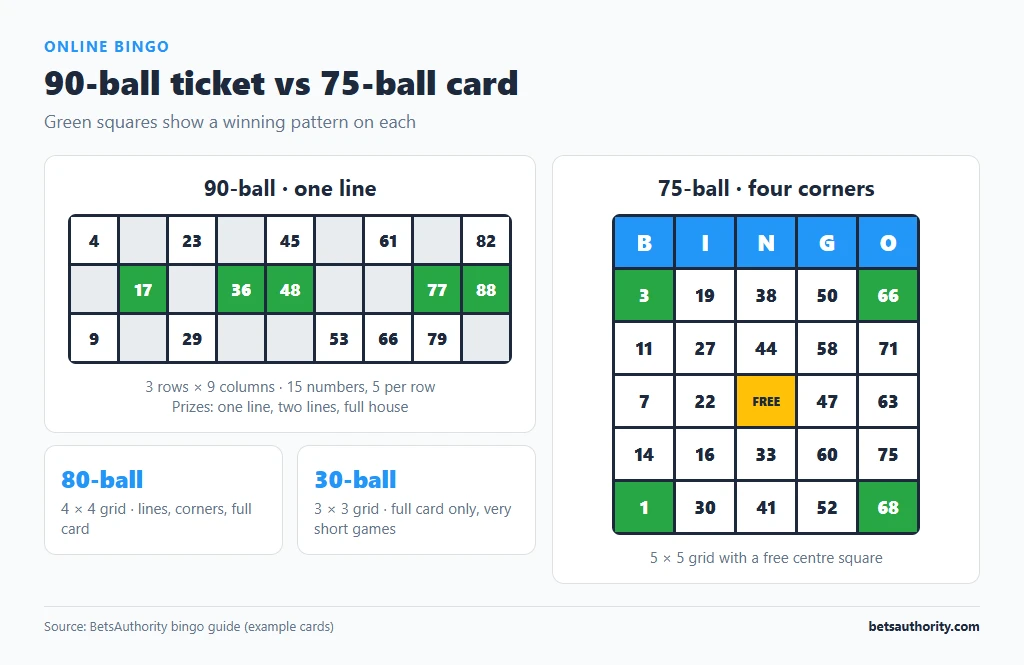
| 90-ball | 1–90 | 3 rows × 9 columns, 15 numbers per ticket (5 per row) | One line, two lines, full house |
| 75-ball | 1–75 | 5 × 5 grid with a free centre square; columns B (1–15), I (16–30), N (31–45), G (46–60), O (61–75) | Patterns such as a line, four corners, letters or a full card (“blackout”) |
| 80-ball | 1–80 | 4 × 4 grid | Lines, corners, full card |
| 30-ball (speed bingo) | 1–30 | 3 × 3 grid | Full card only; very short games |
90-ball tickets are usually sold in strips of six. A full strip contains all 90 numbers exactly once, so every number called marks one of your six tickets.
How a Bingo Room Works
- Buy cards for the next game before the draw starts. The price per card and the prize (fixed or a share of ticket sales) are shown in the room.
- Numbers are called by a random number generator, one at a time. Most online rooms mark your cards automatically (“auto-daub”).
- The first card to complete the pattern wins. If several cards complete it on the same number, the prize is usually split.
- Multi-stage games (one line, two lines, full house in 90-ball) pay a prize at each stage and continue until the full house.
Your Chance of Winning
In a room where all cards cost the same and each card has the same chance, your probability of winning a prize stage is close to your share of the cards in play.
| Your cards | Total cards in play | Approximate chance of winning a given prize |
|---|---|---|
| 6 | 60 | 10% |
| 6 | 300 | 2% |
| 24 | 300 | 8% |
| 6 | 1,200 | 0.5% |
Buying more cards raises your chance but also your cost by the same proportion, so it does not improve the return per dollar. Quieter rooms (fewer cards in play) give a higher chance of winning, but if the prize is a share of ticket sales, the prize is smaller too.
Return to player in rooms: when the prize pool is a fixed percentage of ticket sales, that percentage is the long-run return for the room as a whole. Rooms with guaranteed fixed prizes can pay out more than they take when few players join. Check the room rules for the prize structure.
Bingo-Style Live Casino Games
Casino lobbies also carry ball-draw games that use bingo cards but pay fixed multiples of your stake rather than a shared pool:
- Mega Ball (Evolution): you buy cards with numbers from 1 to 51, 20 balls are drawn, and lines are paid by a fixed paytable. A final Mega Ball can multiply the line wins on cards it completes.
- MONOPOLY Big Baller (Evolution): a ball-draw game with MONOPOLY-themed bonus rounds, separate from MONOPOLY Live.
In these games, other players do not affect your result: every card is paid according to the game’s paytable, and the RTP is stated in the help screen. Our live casino guide covers the wider range of Evolution game shows.
Where to Play
The casinos below accept Australian players and list Evolution, which supplies bingo-style live games such as Mega Ball. Dedicated multiplayer bingo rooms are less common at casinos that accept Australians; check the casino’s lobby for “bingo” before depositing.


Practical Points
- Check card price and prize structure in the room before buying: fixed prize, percentage of sales or progressive jackpot.
- Count the total cost. 24 cards at A$0.50 is A$12 per game; at 15 games per hour that is A$180 of tickets.
- Use auto-daub, so you cannot miss a winning number.
- Pre-buy carefully. Some rooms let you buy cards for future games; those purchases may not be refundable.
- Check bonus terms. Bingo is often excluded from casino bonus wagering or has its own bingo bonuses with separate rules; see wagering requirements.
- Set limits. Games run back to back; use deposit and session limits.
- Tax. Winnings of recreational players are generally not taxed in Australia; see gambling tax in Australia for the details.
Related Guides
Bingo shares its draw mechanics with keno, where you pick your own numbers against a fixed paytable, and its instant-result appeal with online scratch cards. For how chance and expected value work, read understanding casino odds. All game families are in the casino game guides.
Frequently Asked Questions
90-ball uses tickets of 3 rows and 9 columns with 15 numbers and pays for one line, two lines and a full house. 75-ball uses a 5 × 5 card with a free centre and pays for set patterns, such as lines, corners or a full card.
Your chance of winning is roughly your share of the cards in play. More cards or quieter rooms raise that share, but more cards also cost more, so the return per dollar does not improve.
Yes. Numbers are drawn by a random number generator in online rooms, and by physical ball machines in live studio games.
It uses bingo-style cards and a ball draw, but you are paid from a fixed paytable rather than competing with other players for a pool.
Gambling winnings of recreational players are generally not taxed in Australia. Our page on gambling tax explains when the position can differ.
Bingo is a game of chance. Play only if you are 18 or older; Gambling Help Online (1800 858 858) offers free, confidential support.