
Craps Rules
Craps is a dice game in which every bet is decided by the total of two six-sided dice. The table layout looks complicated, but a round follows one simple cycle: a come-out roll, possibly a point, then rolls until the point or a 7 appears. Once you know that cycle, every bet on the table is just a wager on how the cycle or the next roll will end.
The Dice: 36 Combinations
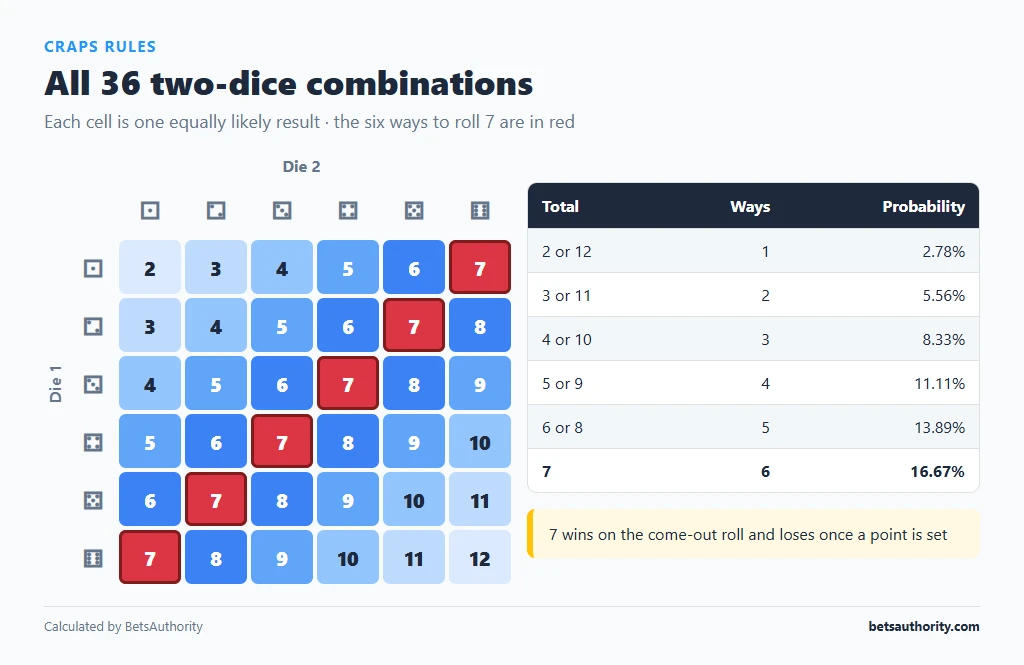
Two dice produce 36 equally likely combinations. All craps maths starts here.
| Total | Ways to roll | Probability | Odds against |
|---|---|---|---|
| 2 | 1 | 2.78% | 35 to 1 |
| 3 | 2 | 5.56% | 17 to 1 |
| 4 | 3 | 8.33% | 11 to 1 |
| 5 | 4 | 11.11% | 8 to 1 |
| 6 | 5 | 13.89% | 6.2 to 1 |
| 7 | 6 | 16.67% | 5 to 1 |
| 8 | 5 | 13.89% | 6.2 to 1 |
| 9 | 4 | 11.11% | 8 to 1 |
| 10 | 3 | 8.33% | 11 to 1 |
| 11 | 2 | 5.56% | 17 to 1 |
| 12 | 1 | 2.78% | 35 to 1 |
7 is the most common total and is central to the game: it wins on the come-out roll and loses once a point is set.
A Round Step by Step
1. The come-out roll
The round starts with a come-out roll. Before it, players make line bets: Pass Line (betting with the dice) or Don’t Pass (betting against them).
| Come-out result | Pass Line | Don’t Pass |
|---|---|---|
| 7 or 11 (“natural”) | Wins 1 to 1 | Loses |
| 2 or 3 (“craps”) | Loses | Wins 1 to 1 |
| 12 (“craps”) | Loses | Push (bar 12) |
| 4, 5, 6, 8, 9 or 10 | That number becomes the point | That number becomes the point |
The “bar 12” rule is what gives Don’t Pass its house edge; without it, Don’t Pass would favour the player. Some tables bar the 2 instead of the 12, which has the same effect.
2. The point phase
If a point is set, the dealer places a marker (the puck, turned to “ON”) on that number. The dice are rolled until either:
- the point is rolled again: Pass wins 1 to 1, Don’t Pass loses; or
- a 7 is rolled (“seven-out”): Pass loses, Don’t Pass wins 1 to 1.
All other totals during the point phase do not affect line bets. They only settle other bets on the table. After a point is made or a seven-out, the next roll is a new come-out roll.
3. Chance of winning a Pass Line bet
| Event | Probability |
|---|---|
| Win on the come-out (7 or 11) | 22.22% |
| Lose on the come-out (2, 3, 12) | 11.11% |
| Point set | 66.67% |
| Win overall (including points made) | 49.29% (244 in 495) |
The Pass Line wins 49.29% and loses 50.71%, a house edge of 1.41%.
Odds Bets
Once a point is set, Pass and Don’t Pass bettors can add an odds bet behind their line bet. It pays at true odds, so the house edge on the odds portion is zero.
| Point | Pass odds pay | Don’t Pass (lay) odds pay | Chance point is made |
|---|---|---|---|
| 4 or 10 | 2 to 1 | 1 to 2 | 33.3% |
| 5 or 9 | 3 to 2 | 2 to 3 | 40.0% |
| 6 or 8 | 6 to 5 | 5 to 6 | 45.5% |
Tables set a maximum odds multiple, such as “3-4-5x” (3x the line bet on 4/10, 4x on 5/9, 5x on 6/8) or a flat 2x to 100x. Live and RNG online games state their limit in the help screen.
Example: A$10 on the Pass Line, point is 6, you add A$50 odds (5x). If the 6 rolls before a 7, you win A$10 on the Pass Line and A$60 on the odds (6 to 5). If a 7 rolls first, you lose A$60.
Come and Don’t Come
Come and Don’t Come work exactly like Pass and Don’t Pass but can be placed after a point is set. The next roll acts as that bet’s own come-out roll: 7 or 11 wins a Come bet, 2, 3 or 12 loses, and any other number becomes that bet’s “come point”. You can have several come points working at once. The house edges are identical to Pass (1.41%) and Don’t Pass (1.36%).
Other Bets on the Layout
The rest of the table holds single-roll and multi-roll bets with higher house edges: place bets on individual numbers, the Field, Big 6/8, hardways and proposition bets such as Any 7. Their payouts and edges are covered in detail on our craps bets and odds page.
Table Roles and Etiquette
- Shooter: at a land-based table, players take turns rolling. The shooter keeps the dice until a seven-out.
- Stickman and dealers: the stickman moves the dice and calls the result; dealers pay and collect.
- Hitting the back wall: in live tables the dice must hit the far wall for a valid roll.
- “Seven” at the table: players avoid saying it out of superstition. It has no effect on the dice.
Craps Online: Live and RNG
| Version | How dice are rolled | Notes |
|---|---|---|
| Live dealer craps (e.g. Evolution Craps) | Physical dice rolled in a studio and streamed | No player shooter; streamed results, timed betting window |
| First-person / RNG craps | Random number generator | Faster rolls, often lower table minimums |
| Land-based table | Human shooter | Dice-setting myths apply here; no edge has been demonstrated |
Online versions use the same core rules, but bet menus, odds limits and the bar number differ by game. Check the help screen for the payout of each bet before playing.
Our craps strategy guide shows which bets keep the house edge lowest and how much each costs per 100 rolls. For Evolution’s full studio range, see Evolution live games. Casinos with Evolution lobbies include Cosmobet and MORI WIN. The hub craps guide and the wider casino game guides section list related pages. For a general introduction to probability, see understanding casino odds.
Frequently Asked Questions
A 7 or 11 wins for the Pass Line, a 2, 3 or 12 loses, and any other total (4, 5, 6, 8, 9, 10) becomes the point.
A 7 rolled after a point has been set. Pass Line and Come bets with points lose, Don’t Pass bets win, and the round ends.
1.41%. The Pass Line wins 244 out of every 495 decisions on average (49.29%).
Barring the 12 gives the house its edge on Don’t Pass. Without it, Don’t Pass would win more often than it loses.
No. It pays at true odds (2 to 1 on 4/10, 3 to 2 on 5/9, 6 to 5 on 6/8), so the house edge on the odds portion is zero.
Craps carries a house edge on every bet except the odds. Play only if you are 18 or older; Gambling Help Online (1800 858 858) offers free, confidential support.