
Texas Hold’em Rules
Texas Hold’em is the most widely played poker game. Each player gets two private cards, five community cards are dealt to the middle, and the best five-card hand from those seven wins, unless everyone else folds first. This page covers the rules of the player-versus-player game and explains how the banked casino versions differ.
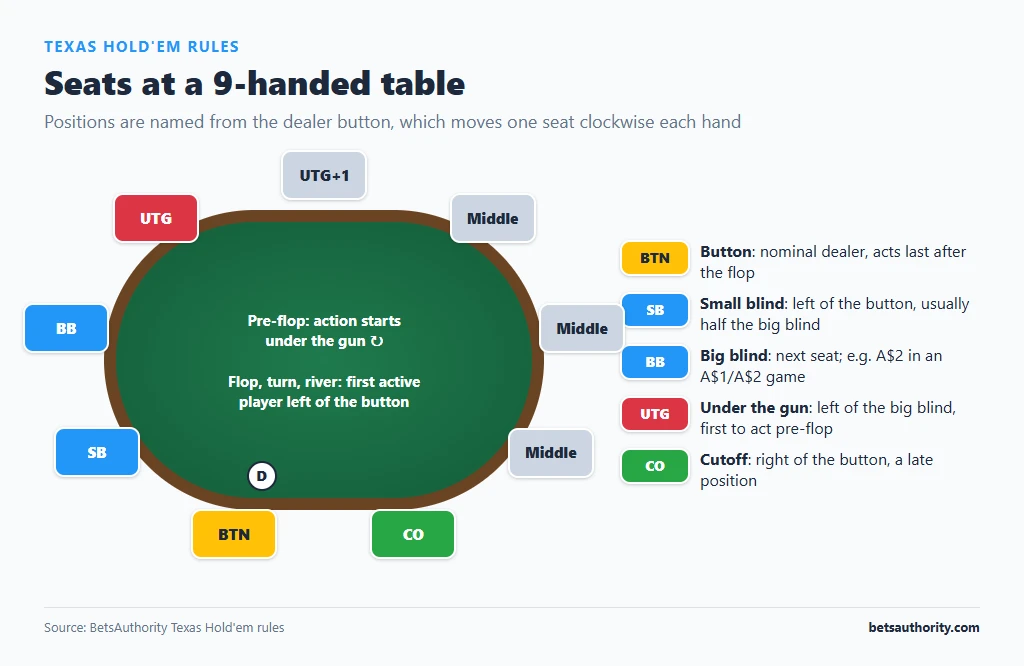
Setup: Seats, Button and Blinds
- A table seats 2 to 10 players. One 52-card deck is used, shuffled before every hand.
- The dealer button marks the nominal dealer and moves one seat clockwise after each hand.
- The player to the left of the button posts the small blind; the next player posts the big blind. Blinds are forced bets that start the pot. The small blind is usually half the big blind.
- Stakes are named after the blinds: an A$1/A$2 game has a A$1 small blind and A$2 big blind. Some games also use an ante, a small forced bet from every player.
The Four Betting Rounds
| Round | Cards dealt | Who acts first |
|---|---|---|
| Pre-flop | 2 hole cards to each player | Player to the left of the big blind (“under the gun”) |
| Flop | 3 community cards | First active player to the left of the button |
| Turn | 1 community card (4th) | First active player to the left of the button |
| River | 1 community card (5th) | First active player to the left of the button |
Before the flop, turn and river, the top card of the deck is usually “burned” (discarded face down).
Actions available
- Fold: give up the hand and any claim to the pot.
- Check: pass the action without betting. Only possible if nobody has bet in the current round.
- Bet: put chips in when nobody has bet yet in the round.
- Call: match the current bet.
- Raise: increase the current bet. Other players must then call the new amount, re-raise or fold.
A round ends when every remaining player has put in the same amount (or is all-in) and everyone has had a chance to act. Pre-flop, the big blind has the “option”: if everyone only calls, the big blind may check or raise.
Betting Structures
| Structure | Bet sizes | Minimum raise | Maximum bet |
|---|---|---|---|
| No-limit | Any amount from the big blind up | The size of the previous bet or raise in that round | Your whole stack |
| Pot-limit | Any amount from the big blind up | The size of the previous bet or raise | The size of the pot after you call |
| Fixed-limit | Small bet pre-flop and flop, big bet (2x) on turn and river | Fixed increment | Fixed; usually 1 bet plus 3 or 4 raises per round |
Minimum raise example (no-limit A$1/A$2): the first player raises to A$6 (a raise of A$4). The next player who wants to re-raise must make it at least A$10 (another A$4 on top).
All-In and Side Pots
In no-limit and pot-limit games you can never be forced out of a hand for lack of chips. If you go all-in for less than the current bet, you can only win from each other player as much as you put in. Extra bets between the remaining players go into a side pot.
Example: Player A is all-in for A$50. Players B and C each put in A$200. The main pot is A$150 (A$50 from each), and all three can win it. The side pot is A$300 (the extra A$150 from B and C), which only B or C can win. If A has the best hand, A takes A$150, and the better of B and C takes A$300.
Showdown
If two or more players remain after the river betting round, the hands are revealed.
- The last player to bet or raise on the river shows first. If there was no river bet, the first active player to the left of the button shows first.
- Each player makes the best five-card hand from their two hole cards and the five community cards. You may use both, one or none of your hole cards.
- Hands are compared by the standard poker hand rankings. Suits do not break ties; equal hands split the pot.
- Odd chips from a split pot go to the first player to the left of the button in most cardrooms.
Playing the board: if the five community cards make your best hand (for example, a straight on the board), you can still win a share of the pot, but so can every other remaining player who cannot beat it.
Common Rule Questions
- String bets: in live games, a bet must be put out in one motion or announced verbally. Moving chips forward in stages can be ruled a call.
- Showing one card: if you show a card to one player, house rules often require you to show it to everyone.
- Out-of-turn action: acting before your turn can be binding if the action in front of you does not change.
- Exposed cards: if the dealer exposes a hole card during the deal, it is usually replaced after the deal is complete.
- Rake: cardrooms charge a percentage of each pot (often 2.5% to 10% up to a cap) or a time fee. This is how the house earns from player-versus-player poker.
Hold’em Played Against the Casino
Online casinos mostly offer banked versions where you play against the dealer, not other players:
| Feature | Texas Hold’em (player vs player) | Casino Hold’em (banked) |
|---|---|---|
| Opponents | Other players | The dealer only |
| House earns from | Rake from each pot | House edge (2.16% on standard paytable) |
| Betting rounds | Four, with bluffing | One decision: call 2x Ante or fold |
| Bluffing | Central to the game | Not possible |
| Dealer qualifier | None | Pair of 4s |
| Bonus payouts | None | Ante paytable up to 100 to 1 |
Hold’em-style games also include Texas Hold’em Bonus Poker and Ultimate Texas Hold’em at some casinos; their rules and paytables are set out in each game’s help screen. Casinos running live dealer Hold’em tables are compared in our live dealer casino list.
Real-Money Online Poker and Australian Law
Under the Interactive Gambling Act 2001, it is illegal to provide or advertise real-money online poker to people in Australia, and after the 2017 amendments several large international poker sites withdrew from the Australian market. ACMA frames the offence around providers and promoters; in 2026 the Federal Court imposed A$24.24 million in penalties on providers and promoters of prohibited online poker services. Banked casino poker games online fall under the same prohibition on online casino services, which is why they are only offered to Australians by offshore operators; read our page on offshore casinos before you play. Live poker remains legal in Australian land-based casinos and in licensed venue tournaments under state law.
If you are new to the game, the next step is poker strategy basics: starting hands, position and pot odds. The casino poker guide lists every poker format we cover.
Frequently Asked Questions
Two private hole cards. Five community cards are shared, and you make the best five-card hand from all seven.
No. Your best five-card hand can use two, one or none of your hole cards.
At least the size of the previous bet or raise in the same round. If the big blind is A$2 and someone raises to A$6, the next raise must be to at least A$10.
The pot is split equally. Suits never break ties, and only the best five cards count.
It is illegal for operators to provide or advertise real-money online poker to people in Australia under the Interactive Gambling Act 2001. ACMA enforcement targets providers and promoters, and offshore sites offer no Australian consumer protection.
Poker for money is gambling. Play only if you are 18 or older; Gambling Help Online (1800 858 858) is available 24/7.