
Poker Strategy Basics
Poker strategy rests on a few measurable ideas: which hands to play, where you sit relative to the button, how often your draws complete, and whether the price of a call is right. This page covers those fundamentals for Texas Hold’em with exact numbers. The rules themselves are on our Texas Hold’em rules page.
Starting Hands by the Numbers
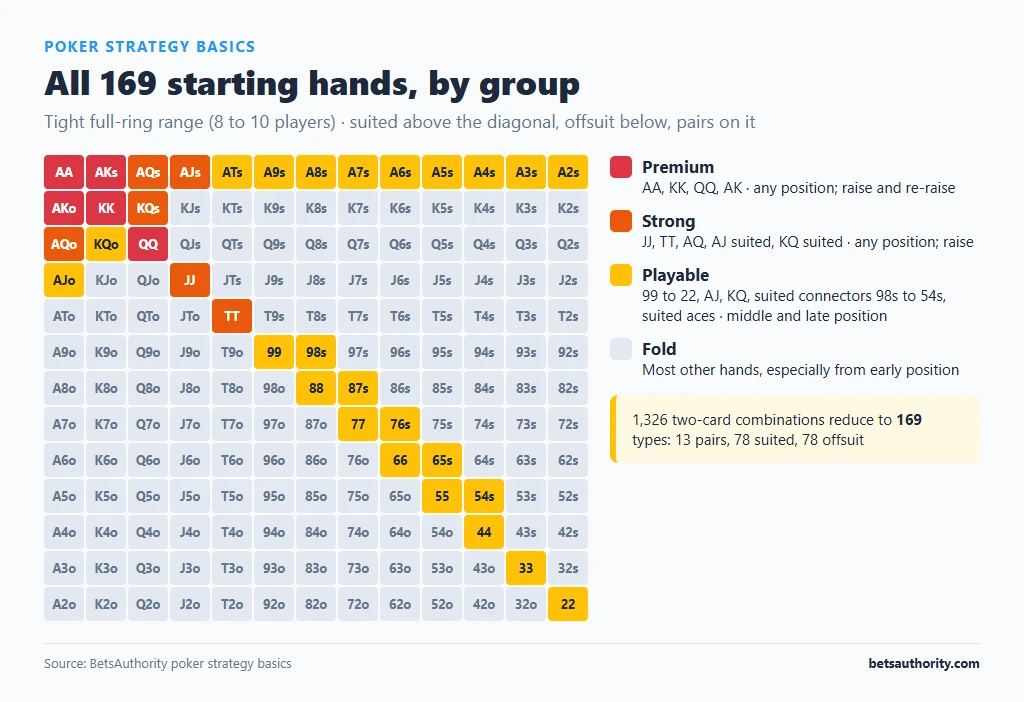
There are 1,326 possible two-card starting hands, which reduce to 169 distinct types (13 pairs, 78 suited and 78 offsuit combinations of ranks).
| Starting hand type | Combinations | Probability per hand | Roughly once every |
|---|---|---|---|
| A specific pair (e.g. AA) | 6 | 0.45% | 221 hands |
| Any pocket pair | 78 | 5.9% | 17 hands |
| AK (suited or offsuit) | 16 | 1.2% | 83 hands |
| Any suited hand | 312 | 23.5% | 4.3 hands |
| Any two cards containing an ace | 198 | 14.9% | 6.7 hands |
A simple starting-hand framework
For a full-ring table (8 to 10 players), a tight starting range is the most reliable base for beginners:
| Group | Hands | Play from |
|---|---|---|
| Premium | AA, KK, QQ, AK | Any position; raise and re-raise |
| Strong | JJ, TT, AQ, AJ suited, KQ suited | Any position; raise |
| Playable | 99 to 22, AJ, KQ, suited connectors 98s to 54s, suited aces | Middle and late position, or for a call when the pot is not raised |
| Fold | Most other hands | Early position especially |
Over time players widen their range in late position and tighten it in early position. The reason is the next topic.
Position
Position means where you act relative to other players after the flop. The player on the button acts last on the flop, turn and river, and so sees what everyone else does before deciding.
- Early position (first two or three seats left of the big blind): you act first on every later street, so play only strong hands.
- Middle position: add more pairs and suited broadway cards.
- Late position (cutoff and button): widest range; you can raise more hands to take the blinds and play pots with information.
- Blinds: you already have money in, but you act first after the flop, which makes them the hardest seats to play profitably.
Outs and the Rule of 2 and 4
An out is an unseen card that improves your hand to what you expect is the best hand. After the flop there are 47 unseen cards (52 minus your 2 and the 3 on board); after the turn there are 46.
| Draw | Outs | Hit on the turn | Hit on the river (from turn) | Hit by the river (from flop) |
|---|---|---|---|---|
| Flush draw | 9 | 19.1% | 19.6% | 35.0% |
| Open-ended straight draw | 8 | 17.0% | 17.4% | 31.5% |
| Two overcards | 6 | 12.8% | 13.0% | 24.1% |
| Gutshot straight draw | 4 | 8.5% | 8.7% | 16.5% |
| Pocket pair to a set | 2 | 4.3% | 4.3% | 8.4% |
| Flush draw + open-ended | 15 | 31.9% | 32.6% | 54.1% |
Rule of 2 and 4: multiply your outs by 4 on the flop (two cards to come) or by 2 on the turn (one card to come) for a quick estimate. Nine outs on the flop: 9 × 4 = 36%, against the exact 35.0%. The estimate overstates large draws: 15 outs × 4 = 60% versus the exact 54.1%.
Before the flop, a pocket pair flops a set or better about 11.8% of the time (roughly 1 in 8.5). This is why small pairs are best played in pots where you can win a large amount when you hit.
Pot Odds
Pot odds compare the cost of a call with the size of the pot you could win.
Formula: required equity = amount to call ÷ (pot after your call).
Example: the pot is A$30. Your opponent bets A$10, making it A$40. You must call A$10 to win A$40, and the pot after your call is A$50. Required equity = 10 ÷ 50 = 20%. With a flush draw on the turn (9 outs, 19.6%), the call is very close to break-even; on the flop with two cards to come (35.0%) and no further bets, it is clearly profitable.
| Bet size (relative to pot) | Equity needed to call |
|---|---|
| 1/4 pot | 16.7% |
| 1/3 pot | 20.0% |
| 1/2 pot | 25.0% |
| 2/3 pot | 28.6% |
| Full pot | 33.3% |
| 2x pot | 40.0% |
Implied odds add money you expect to win on later streets if you hit. They justify some calls slightly below the required equity, but only when your opponent has chips left and will pay you off.
Common All-In Matchups
Pre-flop equities with all five board cards to come:
| Matchup | Approximate equity |
|---|---|
| AA vs KK | 82% / 18% |
| Pair vs two higher cards (e.g. 22 vs AK offsuit) | About 52% / 48% |
| Pair vs one higher card (e.g. QQ vs AK offsuit) | About 57% / 43% |
| Dominated hand (AK vs AQ) | About 74% / 26% |
| Higher pair vs lower pair (e.g. JJ vs 77) | About 81% / 19% |
The “coin flip” (pair against two overcards) explains why tournament results vary so much: even a correct all-in loses close to half the time.
Five Habits That Matter Most
- Play fewer hands from early position. Most beginner losses come from weak hands played out of position.
- Bet and raise more than you call. Betting gives you two ways to win: your opponent folds, or you have the best hand at showdown.
- Count outs and compare with pot odds before calling a draw.
- Avoid dominated hands. A-9 offsuit against a raise from an early-position player often runs into A-K, A-Q or A-J.
- Do not chase losses by moving up stakes. Results over a few hundred hands are mostly variance.
Bankroll Guidelines
Poker results swing widely even for winning players. Common guidelines are 20 to 30 buy-ins for cash games and 50 to 100 buy-ins for multi-table tournaments, with more if you are still learning. If you play at A$50 buy-in tables, that is A$1,000 to A$1,500 set aside for cash games alone. Our bankroll management guide covers loss limits in detail.
Applying This to Casino Poker Games
In banked games there is no bluffing and no opponents’ ranges, so strategy reduces to a fixed rule set:
- Casino Hold’em: call 2x the Ante about 82% of the time; fold only the weakest no-pair, no-draw hands.
- Three Card Poker: play Q-6-4 or better.
- Caribbean Stud: raise with a pair or better, fold below A-K, and follow the A-K rules.
Those games keep a fixed house edge however well you play. For why systems and streak-reading do not change that, read our page on the gambler’s fallacy. Return to the casino poker guide for every poker format we cover.
Frequently Asked Questions
Pocket aces, kings, queens and ace-king are the strongest. Aces are dealt once every 221 hands on average.
Multiply your outs by 4 after the flop or by 2 after the turn to estimate your chance of hitting. Nine outs on the flop gives about 36%, close to the exact 35.0%.
Divide the amount you must call by the total pot after your call. Calling A$10 into a final pot of A$50 needs 20% equity.
Acting last lets you see what opponents do before you decide, so you can bet, check or fold with more information. Players in late position can profitably play more hands.
About 11.8% of the time, or roughly 1 in 8.5 flops.
Poker involves risk and variance even for skilled players. Play only if you are 18 or older; Gambling Help Online (1800 858 858) provides free support.