
Caribbean Stud Poker
Caribbean Stud Poker is a five-card stud game played against the dealer. There is no draw and no community cards: you see your five cards and one of the dealer’s, then decide to raise or fold. It is available as a live dealer game (Evolution runs a Caribbean Stud table) and as an RNG table game from several studios.
How a Round Works
- Place an Ante. Some versions also offer an optional progressive jackpot side bet.
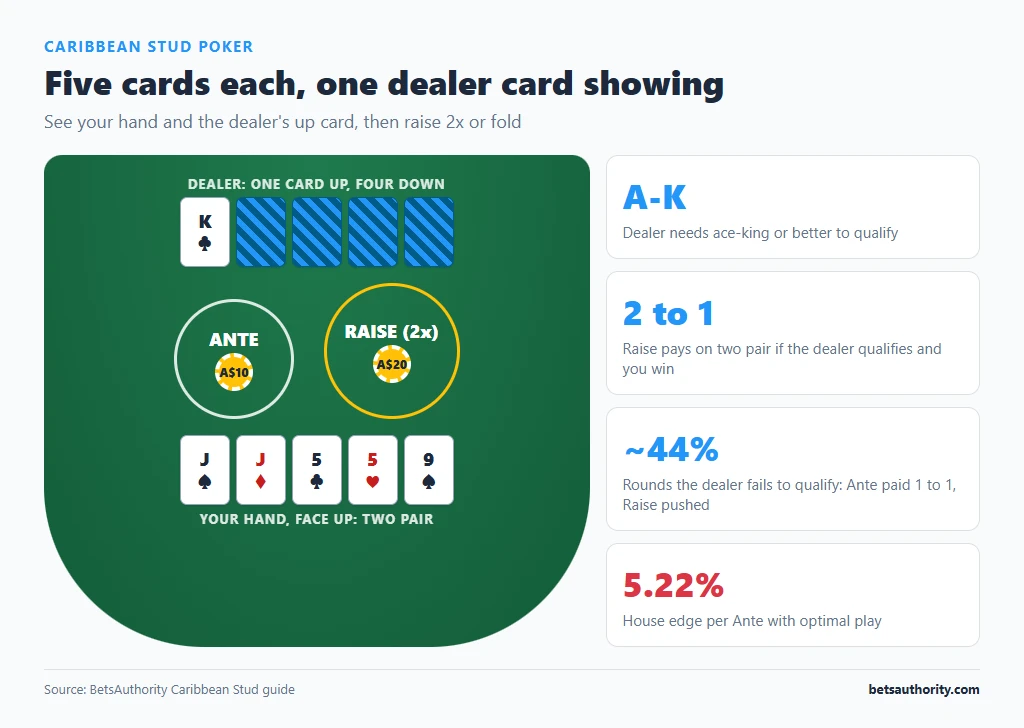
- You receive five cards face up. The dealer receives five cards with one face up.
- Either Fold (lose the Ante) or Raise by placing a bet of exactly 2x the Ante.
- The dealer reveals the remaining four cards.
- The dealer needs ace-king or better to qualify. Hands are compared using standard poker hand rankings.
Settlement
| Outcome | Ante | Raise |
|---|---|---|
| Dealer does not qualify (below A-K) | Pays 1 to 1 | Push |
| Dealer qualifies, you win | Pays 1 to 1 | Paid per the paytable below |
| Dealer qualifies, dealer wins | Loses | Loses |
| Tie | Push | Push |
Raise paytable
| Your hand | Raise pays |
|---|---|
| Royal flush | 100 to 1 |
| Straight flush | 50 to 1 |
| Four of a kind | 20 to 1 |
| Full house | 7 to 1 |
| Flush | 5 to 1 |
| Straight | 4 to 1 |
| Three of a kind | 3 to 1 |
| Two pair | 2 to 1 |
| One pair or A-K | 1 to 1 |
Some versions cap the total payout on the Raise per round. On a large stake, a royal flush can be limited by the cap rather than paid at 100 to 1, so read the maximum payout in the help screen if you bet high.
Worked examples
- Two pair, dealer qualifies: A$10 Ante, A$20 Raise. You hold J-J-5-5-9; the dealer has K-K-8-4-2. You win A$10 on the Ante and A$40 on the Raise (2 to 1), A$50 profit.
- Strong hand, dealer does not qualify: same bets, you hold a flush, the dealer has Q-J-9-6-3. The Ante pays A$10 and the Raise is returned. The flush earns nothing extra because the dealer did not qualify.
- Fold: you hold Q-10-8-5-3 with no pair. Folding loses A$10. Raising would risk A$20 more on a hand that cannot beat any qualifying dealer hand.
The second example is the game’s main source of house edge. The dealer fails to qualify about 44% of the time, and on those rounds your raise earns nothing however good your hand is.
House Edge
With the paytable above and optimal strategy:
| Measure | Value |
|---|---|
| House edge (per Ante) | 5.22% |
| Element of risk (per total amount bet) | 2.56% |
| Hands raised under optimal strategy | 52.2% |
| Standard deviation (per Ante) | 2.24 units |
5.22% is more than twice the house edge of Casino Hold’em (2.16%) and above Three Card Poker (3.37%). Per A$100 of Antes you should expect to lose about A$5.22 on average.
Optimal Raise-or-Fold Strategy
Most decisions are simple:
- Always raise with a pair or better.
- Always fold with less than ace-king (no pair, highest two cards not A and K).
- Ace-king hands need the rules below.
Raising with ace-king
With A-K and no pair, raise if any one of these is true:
- The dealer’s up card is a 2 through Q and matches the rank of one of your cards.
- The dealer’s up card is an ace or king and you also hold a queen or a jack.
- The dealer’s up card does not match any of your cards, you hold a queen, and the dealer’s up card is lower than your fourth-highest card.
Otherwise fold the A-K hand. This simplified rule set has a house edge of 5.225%, only 0.001 percentage points above the computer-optimal play.
Examples with ace-king
| Your hand | Dealer up card | Decision | Rule |
|---|---|---|---|
| A-K-9-6-3 | 9 | Raise | Up card matches one of your cards (rule 1) |
| A-K-J-7-4 | K | Raise | Up card is A or K and you hold a jack (rule 2) |
| A-K-Q-8-5 | 6 | Raise | Holding Q; 6 is lower than your fourth card (8) (rule 3) |
| A-K-Q-6-4 | 8 | Fold | 8 is not lower than your fourth card (6) |
| A-K-10-7-2 | 5 | Fold | No match, no queen |
Why matching matters: if the dealer’s up card pairs one of your cards, the dealer has one fewer card of that rank available to make a pair, which lowers the dealer’s chance of beating your hand.
The Progressive Jackpot Side Bet
Land-based and some online versions offer a fixed-price side bet (often A$1 or the local equivalent) that pays on a flush or better in your own hand, with the royal flush paying all or part of a progressive jackpot. The paytable and meter differ by venue. Across common land-based versions the average house edge is over 25%, and it falls only when the jackpot meter is very high. Treat it as a lottery-style add-on.
Strategy Mistakes to Avoid
- Raising every hand. This costs much more than the 5.22% optimal edge because you add 2 units to hands that rarely win.
- Folding pairs. Even a pair of 2s should be raised: it collects the Ante whenever the dealer fails to qualify and beats every qualifying ace-king hand.
- Assuming a strong hand is guaranteed a bonus. The Raise paytable only applies when the dealer qualifies.
- Using a betting progression. Systems such as Martingale do not change the house edge; see betting systems.
Live Caribbean Stud
At a live table, the raise decision has a time limit, so learn the ace-king rules before you sit down. Evolution’s live poker range, which includes Caribbean Stud, Casino Hold’em and 3 Card Poker, is carried by most casinos with an Evolution lobby, such as Cosmobet; our live dealer casinos list shows others. For an overview of live studio games, see the live casino guide. Other poker games are covered in the casino poker guide.
Frequently Asked Questions
Ace-king or better. If the dealer has less, your Ante wins 1 to 1 and your Raise is returned.
5.22% of the Ante with optimal strategy and the standard paytable. Measured against all money bet, the element of risk is 2.56%.
Yes. Every pair, including 2s, should be raised.
Raise if the dealer’s up card matches one of your cards (2 to Q), if the up card is an A or K and you hold a Q or J, or if you hold a queen and the dealer’s unmatched up card is lower than your fourth-highest card. Otherwise fold.
On standard paytables it has a house edge above 25%, far higher than the main game. It only improves when the jackpot is unusually large.
Caribbean Stud has a built-in house edge on every hand. Play only if you are 18 or older; Gambling Help Online (1800 858 858) offers free, confidential help.