
Poker Hand Rankings
Every poker game sold in an online casino, from Texas Hold’em to video poker, uses the same ten-step ladder of hands. The order is not arbitrary: a hand ranks higher because it is harder to make. This page lists the ten hands, the exact number of ways each can be dealt, how ties are broken, and the few games that change the order.
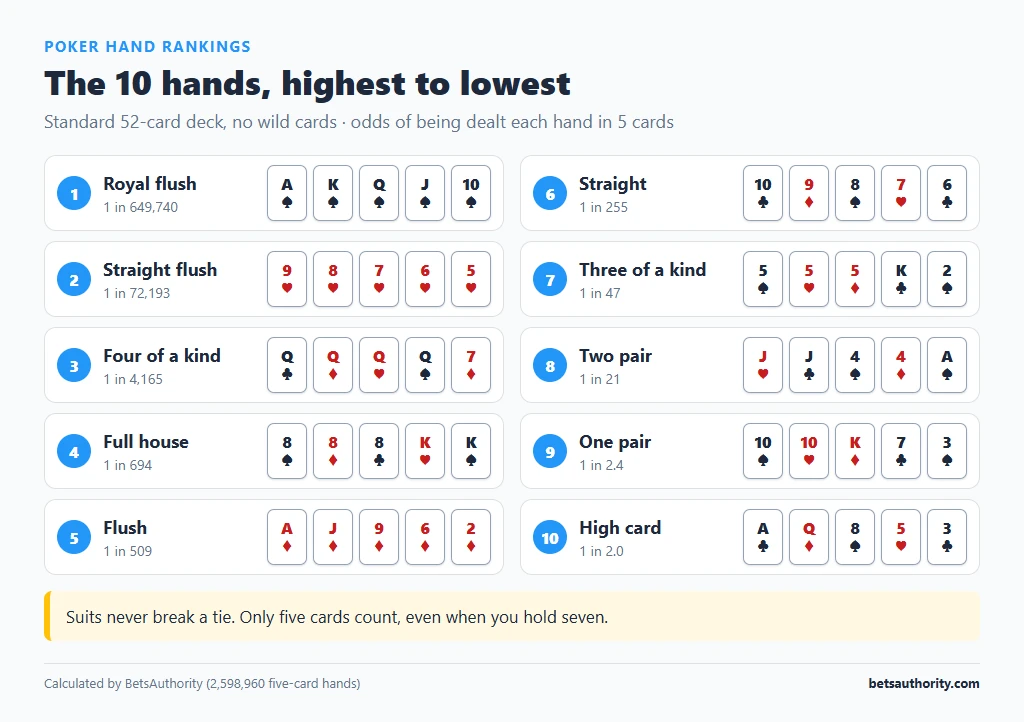
The 10 Poker Hands, Highest to Lowest
The table uses a standard 52-card deck with no wild cards. “Combinations” is the number of distinct five-card hands of that type out of 2,598,960 possible five-card hands.
| Rank | Hand | Example | Combinations | Odds (5 cards) |
|---|---|---|---|---|
| 1 | Royal flush | A♠ K♠ Q♠ J♠ 10♠ | 4 | 1 in 649,740 |
| 2 | Straight flush | 9♥ 8♥ 7♥ 6♥ 5♥ | 36 | 1 in 72,193 |
| 3 | Four of a kind | Q♣ Q♦ Q♥ Q♠ 7♦ | 624 | 1 in 4,165 |
| 4 | Full house | 8♠ 8♦ 8♣ K♥ K♠ | 3,744 | 1 in 694 |
| 5 | Flush | A♦ J♦ 9♦ 6♦ 2♦ | 5,108 | 1 in 509 |
| 6 | Straight | 10♣ 9♦ 8♠ 7♥ 6♣ | 10,200 | 1 in 255 |
| 7 | Three of a kind | 5♠ 5♥ 5♦ K♣ 2♠ | 54,912 | 1 in 47 |
| 8 | Two pair | J♥ J♣ 4♠ 4♦ A♠ | 123,552 | 1 in 21 |
| 9 | One pair | 10♠ 10♥ K♦ 7♣ 3♠ | 1,098,240 | 1 in 2.4 |
| 10 | High card | A♣ Q♦ 8♠ 5♥ 3♣ | 1,302,540 | 1 in 2.0 |
What each hand requires
- Royal flush: A-K-Q-J-10 of one suit. It is the highest straight flush and gets its own name because many paytables pay it separately.
- Straight flush: five consecutive ranks in one suit. The lowest is 5-4-3-2-A.
- Four of a kind (quads): four cards of one rank plus any fifth card (the kicker).
- Full house: three of one rank plus two of another. It is described by the trips first: 8-8-8-K-K is “eights full of kings”.
- Flush: five cards of one suit that are not consecutive.
- Straight: five consecutive ranks in mixed suits. The ace can be high (A-K-Q-J-10) or low (5-4-3-2-A), but straights do not wrap around: Q-K-A-2-3 is not a straight.
- Three of a kind (trips or a set): three cards of one rank and two unrelated cards.
- Two pair: two cards of one rank, two of another, and a kicker.
- One pair: two cards of one rank and three unrelated cards.
- High card: none of the above. The hand is named after its top card, for example “ace high”.
How Ties Are Broken
When two players hold the same type of hand, the cards decide it in a fixed order. Suits never break a tie in standard poker: a spade flush and a heart flush of the same ranks split the pot.
- Straights and straight flushes: the highest card wins. 9-8-7-6-5 beats 8-7-6-5-4. The wheel (5-4-3-2-A) is the lowest straight because the ace counts as 1.
- Four of a kind: the higher quad rank wins; if the board gives both players the same quads (possible in Hold’em), the kicker decides.
- Full house: compare the three-card part first, then the pair. 9-9-9-2-2 beats 8-8-8-A-A.
- Flush and high card: compare the highest card, then the second-highest, and so on down to the fifth card.
- Three of a kind: rank of the trips, then the two kickers in order.
- Two pair: the higher pair first, then the lower pair, then the kicker. K-K-3-3-2 beats Q-Q-J-J-A.
- One pair: rank of the pair, then the three kickers in order.
If all five cards are equal in rank, the hand is a tie and the pot is split. Only five cards ever count. In Hold’em a sixth or seventh card cannot break a tie, which is why two players can split with different hole cards.
Odds When You Get Seven Cards
In Texas Hold’em, Casino Hold’em and Caribbean-style games with community cards, you make the best five-card hand from seven cards (two hole cards plus five on the board). With more cards to choose from, the strong hands become far more common. Of the 133,784,560 possible seven-card sets:
| Best hand from 7 cards | Combinations | Probability |
|---|---|---|
| Royal flush | 4,324 | 0.0032% |
| Straight flush (not royal) | 37,260 | 0.028% |
| Four of a kind | 224,848 | 0.168% |
| Full house | 3,473,184 | 2.60% |
| Flush | 4,047,644 | 3.03% |
| Straight | 6,180,020 | 4.62% |
| Three of a kind | 6,461,620 | 4.83% |
| Two pair | 31,433,400 | 23.5% |
| One pair | 58,627,800 | 43.8% |
| High card | 23,294,460 | 17.4% |
Two points stand out. First, with seven cards you finish with at least a pair 82.6% of the time, so a single pair is a weak holding at a full Hold’em table. Second, high card (17.4%) is less likely than one pair or two pair, which is the opposite of the five-card table.
Games That Change the Order
The standard ladder applies in most games, but several casino variants adjust it. Check the paytable before you play, because the payouts follow the game’s own ranking.
| Game | Change to the standard ranking | Why |
|---|---|---|
| Three Card Poker | Straight beats flush; three of a kind beats straight | With 3 cards, a straight (720 combinations) is rarer than a flush (1,096) |
| Deuces Wild video poker | Adds five of a kind (e.g. 7-7-7-7 plus a deuce) and splits royal flushes into “natural” and “wild” | The four 2s are wild, so new hands become possible |
| Joker Poker | Adds five of a kind using the joker | 53-card deck with one wild card |
| Short Deck (6+) Hold’em | Flush beats full house; in many rule sets three of a kind beats straight | Removing 2s to 5s makes flushes rarer |
| Lowball (2-7, A-5) | Lowest hand wins | Reverse objective; A-5 ignores straights and flushes |
In Caribbean Stud and Casino Hold’em the standard ranking applies, but the dealer must reach a minimum hand to “qualify” (ace-king for Caribbean Stud, a pair of fours for Casino Hold’em). That qualifier is a separate rule, not a change in hand values.
Common Ranking Mistakes
- Counting suits as tie-breakers. In standard rules, no suit outranks another.
- Claiming a wrap-around straight. K-A-2-3-4 is ace high, not a straight.
- Playing the board without noticing. If the five community cards make a straight and you cannot improve it, every remaining player has the same hand and the pot is split.
- Misreading a flush in Hold’em. You need five cards of one suit among your seven. Four suited board cards and no matching hole card is not a flush.
- Overvaluing two pair on a paired board. On a board of 8-8-K-5-2, a player holding K-Q has kings and eights with a queen kicker; a player with A-K has the same two pair with an ace kicker and wins.
Using the Rankings in Casino Games
In player-versus-player poker you only need to beat the other hands at the table. In banked casino poker the ranking also sets the payout. Two examples:
- In Jacks or Better the full-pay table returns 9 units for a full house and 6 for a flush. A table that pays only 8 and 5 cuts the long-run return from 99.54% to 97.30% with optimal play.
- In Caribbean Stud the raise bet pays 100 to 1 for a royal flush and 1 to 1 for a pair, so knowing the rank of your hand tells you exactly what you can win before the dealer reveals.
If you are new to poker, learn the ladder first, then read our poker strategy basics for starting hands and pot odds. For the probability concepts behind these numbers, see how casino odds work. Live dealer poker tables come mainly from Evolution; our list of casinos carrying Evolution games shows where Australians can find them. The full casino poker guide lists every game we cover, and the wider game guides section covers blackjack, roulette and live games.
Frequently Asked Questions
Yes. In standard five-card rankings a flush beats a straight because there are 5,108 flushes and 10,200 straights among the 2,598,960 possible hands. The exception is Three Card Poker, where a straight beats a flush.
None. Standard poker rules give all four suits equal value, so identical hands in different suits split the pot. Some home games and promotions rank suits for draws, but casino poker games do not.
Yes. It is called the wheel and is the lowest possible straight because the ace counts as 1. A straight cannot wrap around, so Q-K-A-2-3 is not a straight.
The kicker, the fifth card, decides. If the kickers are also the same rank, the pot is split.
In five-card poker it is 1 in 649,740. In Hold’em with seven cards to choose from, it is about 1 in 30,940. In optimal Jacks or Better video poker with draws, it lands roughly once every 40,000 hands.
Poker is gambling: only play if you are 18 or older and within limits you set in advance. Free, confidential support is available 24/7 from Gambling Help Online on 1800 858 858.