
The Gambler’s Fallacy: Why “Due” Wins Don’t Exist
The gambler’s fallacy is the belief that a random outcome becomes more likely because it hasn’t happened for a while, or less likely because it just happened. “Black has come up eight times, red is due.” “This pokie hasn’t paid a bonus in 300 spins, it must be close.” In games where each round is independent, these beliefs are wrong, and acting on them usually means betting more at exactly the wrong moment. This page in our casino tips section shows the probabilities behind it.
Independent Events: The Core Idea
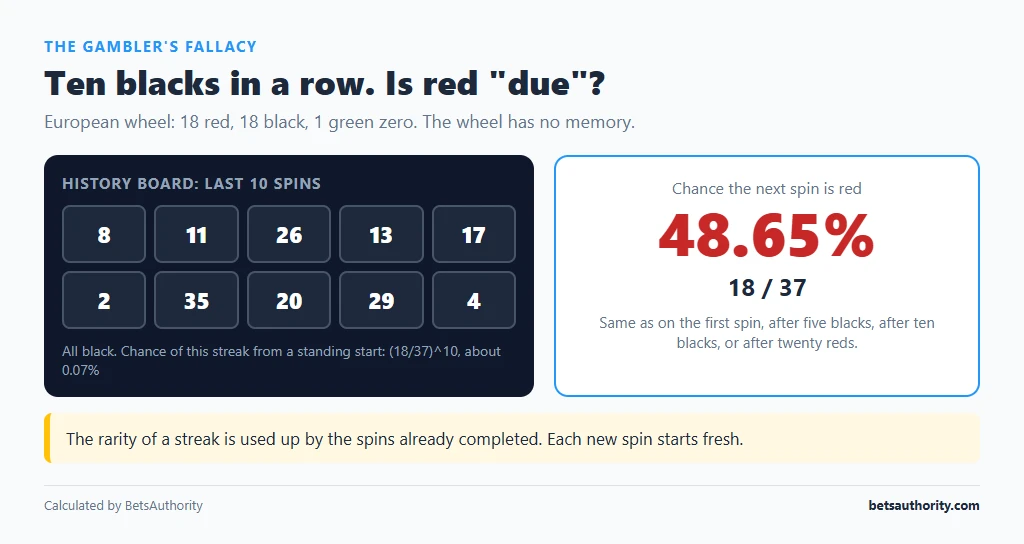
A roulette wheel has no memory. The ball does not know which pockets it landed in before. On a European wheel, every spin has 18 red pockets, 18 black and one green zero, so the chance of red is always 18/37 = 48.65%, no matter what the history board says.
| What just happened | Chance the next spin is red (European wheel) |
|---|---|
| Nothing (first spin) | 48.65% |
| Five blacks in a row | 48.65% |
| Ten blacks in a row | 48.65% |
| Twenty reds in a row | 48.65% |
The same applies to online pokies, RNG card games and dice games. Each spin’s result is generated by a random number generator at the moment you press the button, independently of the previous spin. Our RNG explainer covers how that works.
Why the Fallacy Feels Right
Two true facts get mixed up:
- Long streaks are rare before they start. The chance of ten blacks in a row from a standing start is (18/37)^10, about 0.07%.
- Once nine blacks have happened, the tenth spin is still 48.65% black. The rarity of the streak was used up by the nine spins already completed.
The brain treats a sequence as something that must “look random”, with reds and blacks mixed. Real random sequences contain more streaks than people expect. In 100 spins of a European wheel, a run of at least five of the same colour is very likely to appear somewhere.
The Law of Large Numbers Doesn’t “Correct” Streaks
People sometimes defend the fallacy with the law of large numbers: over many spins, red should come up about 48.65% of the time, so a shortage must be made up. The law is true, but it works by dilution, not correction. If black leads by 10 after 100 spins, that 10-spin gap stays (on average) as you keep playing; it just becomes a smaller percentage of a growing total. After 10,000 spins, a 10-spin gap is 0.1%. Nothing pushes red to “catch up”.
The Monte Carlo Streak of 1913
The fallacy is sometimes called the Monte Carlo fallacy after a well-known night at the Monte Carlo Casino in August 1913, when black came up 26 times in a row. Players reportedly bet heavily on red as the streak grew, expecting it to end. The probability of 26 blacks in a row on a single-zero wheel is (18/37)^26, roughly 1 in 137 million. That was the probability before the first spin. At any point during the streak, the next spin was still 18/37 black.
The Fallacy on Pokies
On pokies the fallacy usually sounds like “it’s due a bonus”. If a game’s free spins trigger on average once every 200 spins, that is an average across millions of spins, not a schedule. After 400 dry spins the chance of triggering on the next spin is still about 1 in 200. Switching to a “hot” machine, or staying on a “cold” one because it is due, makes no difference to the odds. Our pokies myths page covers related beliefs such as time-of-day payouts.
The Reverse: The Hot-Hand Belief
The mirror image is betting that a streak will continue: “red is hot, keep betting red”. This is equally unsupported in independent games. A pokie that just paid a big win is not more or less likely to pay again. A dealer on a “good run” has no influence over an automatic shuffler or an RNG.
Where Results Are Not Independent
Not every game is independent, and it matters to know the exceptions:
- Blackjack from a shoe. Cards already dealt are removed until the reshuffle, so the remaining composition changes. This is what card counting exploits. Online RNG blackjack typically reshuffles every hand and many live tables use continuous shufflers or cut the shoe early, which removes the effect. See card counting.
- Progressive jackpots. The jackpot amount grows over time, but the chance of hitting it per spin stays fixed by the game’s maths.
- Must-drop-by jackpots. Some jackpots must pay before a stated cap. As the pot approaches the cap the drop becomes more likely, which is a genuine, published rule, not a hunch.
How the Fallacy Costs Money
The cost is rarely the individual bet, which has the same house edge either way. The damage comes from what the belief makes people do:
- Raising stakes because a win “must be coming”, which raises the total wagered and the expected loss.
- Playing longer than planned to stay with a machine that is “about to pay”.
- Chasing losses with a Martingale-style doubling on the theory that a streak must break.
Practical Checks
- If you hear yourself say “due”, “overdue”, “hot” or “cold”, stop and reset your plan.
- Ignore history boards at live roulette. They are display features, not information.
- Decide stake size before the session, based on your bankroll plan, not on recent results.
- Set a time and loss limit in advance; the limit-setting guide shows the tools casinos provide.
Frequently Asked Questions
It is the mistaken belief that past random results change the odds of the next one, for example that red is more likely after a run of blacks.
No. On a European wheel the chance of red is 18/37, or 48.65%, on every spin regardless of previous results.
No. Each spin is generated independently, so the trigger chance is the same on every spin, however long it has been since the last feature.
Results converge in percentage terms because a growing number of spins dilutes any early imbalance. Nothing actively corrects a streak.
Shoe-dealt blackjack and baccarat change composition as cards are dealt, until the reshuffle. Must-drop-by jackpots also become more likely to drop as they approach their published cap.
Gambling should be entertainment for adults 18+. If you find yourself chasing losses, Gambling Help Online offers free support 24/7 on 1800 858 858.