
10 Common Roulette Mistakes and Their Real Cost
Roulette has no in-game decisions, so mistakes happen before the spin: choosing the wrong wheel, the wrong bets, the wrong stake size or the wrong reasons to keep playing. Some cost a fixed percentage of every bet; others cost nothing in expectation but expose a bankroll to swings it cannot survive. This list puts a number on each one where possible. The background is in our roulette guide.
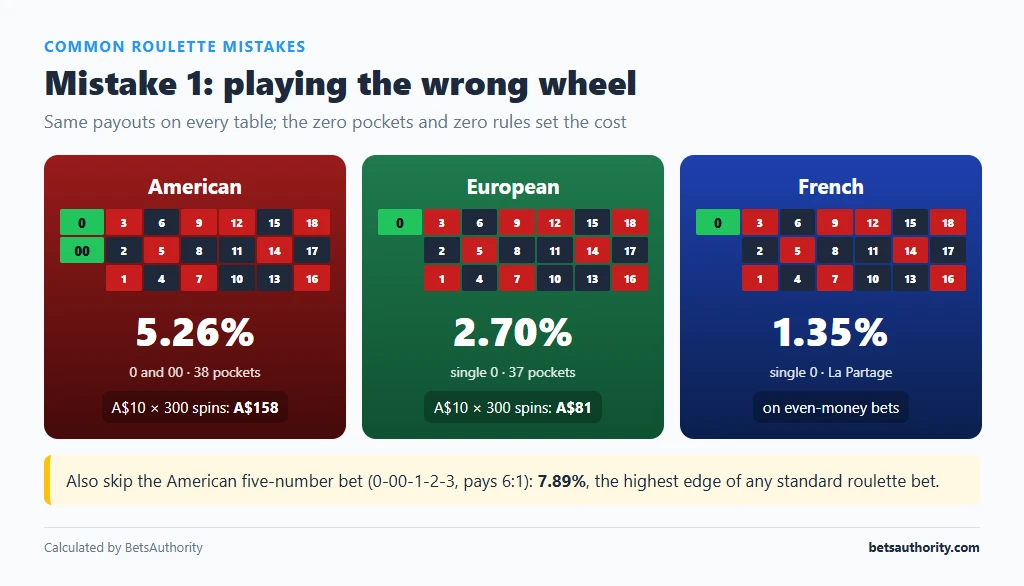
1. Playing a Double-Zero Wheel
The American wheel has 38 pockets and the same payouts as the 37-pocket European wheel. House edge: 5.26% instead of 2.70%.
| A$10 × 300 spins | European | American |
|---|---|---|
| Expected loss | A$81 | A$158 |
Fix: check the top of the layout for 00 and choose single-zero tables. See European vs American roulette.
2. Using the Five-Number Bet
On American tables, the bet on 0-00-1-2-3 pays 6:1 with a 7.89% house edge, the highest of any standard roulette bet. On A$10 it costs about A$0.79 per spin on average versus A$0.27 for any European bet.
3. Ignoring La Partage Tables
Even-money bets on French tables with La Partage cost 1.35% instead of 2.70%. A player who only bets red/black and plays 1,000 spins at A$10 saves about A$135 in expected loss by choosing such a table. See La Partage and En Prison.
4. Believing in “Due” Numbers
| Belief | Fact |
|---|---|
| “Red has come up 8 times, black is due” | The next spin is 18/37 black, 18/37 red, 1/37 zero, regardless of history |
| “17 hasn’t hit in 100 spins, so it will soon” | 17 still has a 1/37 chance; a 100-spin gap happens about 6.5% of the time for any chosen number |
| “Hot numbers keep hitting” | Short-term clusters are normal randomness |
Hot and cold panels in online games are display features, not predictors. See gambler’s fallacy.
5. Expecting a System to Beat the Edge
Martingale, Fibonacci, D’Alembert, Labouchère and similar systems change stake sizes, not probabilities. The expected loss stays 2.70% of everything staked on a single-zero wheel. The Martingale in particular produces long runs of small wins and occasional losses of hundreds of dollars when a losing streak reaches the table limit: with a A$5 base and A$500 limit, a seven-loss streak (about 1 in 106 sequences) costs A$635. See the Martingale page and roulette strategies.
6. Chasing Losses
Increasing stakes to win back a loss raises the amount at risk exactly when the session budget is already reduced. Every additional dollar staked carries the same 2.70% expected loss, so chasing increases the expected loss for the session and the chance of losing the whole budget. If this is happening repeatedly, see signs of problem gambling.
7. Stakes Too Large for the Budget
A session budget of A$100 with A$20 even-money bets covers only five losing bets. Five losses in a row on red have a probability of (19/37)^5 = 3.57% for any given run of five spins, and over a few hundred spins such a run is likely to occur at least once. With A$2 bets the same budget covers 50 net losing units. Common practice is 1%–2% of the session budget per spin. Our bankroll management guide covers the method.
8. Playing Fast Formats Without Adjusting
Expected loss scales with the number of spins. At A$10 per spin and 2.70% edge:
| Format | Assumed spins per hour | Expected loss per hour |
|---|---|---|
| Standard live table | 40 | A$10.80 |
| Speed / auto live | 80 | A$21.60 |
| RNG with quick spin | 200 | A$54.00 |
Fix: reduce stake on fast formats, or set a time limit. Casino tools for this are covered in reality checks.
9. Using Roulette to Clear a Bonus Without Reading the Terms
Many bonus terms count roulette at 0%–10% towards wagering, and some prohibit covering most of the table (for example red and black together, or more than 24 numbers) as “low-risk betting”. Breaking these rules can void winnings. Read game weighting and the max bet rule before using bonus funds on roulette.
10. Paying for Prediction Software or “Signals”
No legitimate software can predict independent spins of a certified RNG or a monitored studio wheel. Products sold as roulette predictors, bots or “signal” channels are a common scam pattern. Our guide to spotting scam casinos lists related warning signs.
Smaller Errors on Live and Multiplier Tables
- Assuming standard payouts on multiplier games. In Lightning Roulette a straight-up pays 29:1 unless the number is struck, not 35:1. A$10 straight-up wins return A$300 instead of A$360. See Lightning Roulette.
- Using “Repeat” and “Double” buttons without checking the total. Two taps of Double turn a A$10 layout into A$40.
- Late bets. Bets entered after the timer closes are rejected; on speed tables the window is short, so complex layouts often go unplaced.
- Not checking table maximums before starting any progression. Straight-up maximums are often much lower than outside-bet maximums.
Checklist
- Single-zero wheel; French table with La Partage for even-money bets.
- No five-number bet.
- Flat stakes of 1%–2% of the session budget.
- Session time limit, especially on speed and RNG formats.
- Bonus terms read before playing roulette with bonus funds.
- Stop point set in the casino’s limit tools.
Frequently Asked Questions
Playing an American double-zero wheel when a European one is available. It almost doubles the house edge from 2.70% to 5.26% with identical payouts.
No. Each spin is independent; past results do not change the next one.
Not in cost terms: straight-ups have the same 2.70% edge as other bets on a single-zero wheel. They have much higher variance, so stakes should be smaller.
No. They change the pattern of results but the expected loss remains 2.70% of all stakes on a single-zero wheel.
A common guideline is 1%–2% of the session budget, so that normal losing streaks do not end the session early.
18+ only. Gambling Help Online is available on 1800 858 858 for free, confidential support.