
Martingale Roulette Strategy: The Numbers Behind It
The Martingale is the most widely used roulette system: bet on an even-money outcome such as red, double the stake after every loss, and go back to the base stake after a win. Each completed sequence ends with a profit of one base unit. The system feels safe because most sequences end quickly, but its maths is simple to check, and it shows that the occasional large loss cancels all the small wins and more. This page works through the numbers for a single-zero wheel. It is part of our roulette guide; the general version across games is in the Martingale system explained.
The Stake Table
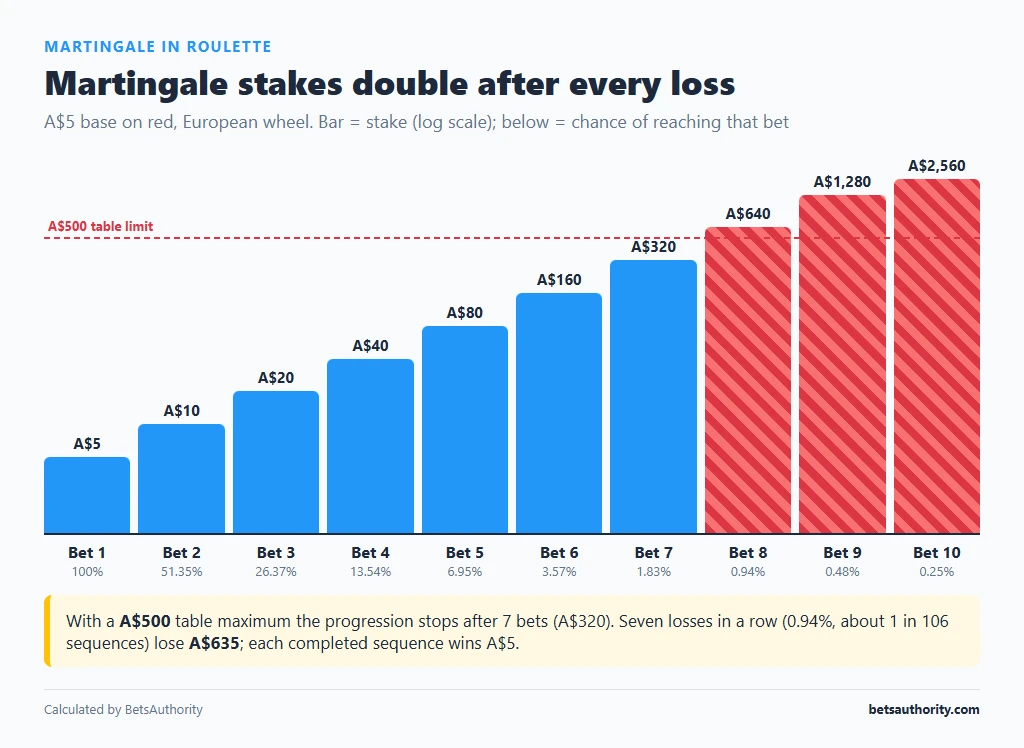
Base stake A$5 on red, European wheel.
| Bet number | Stake | Total lost if this bet loses | Profit if this bet wins | Probability of reaching this bet |
|---|---|---|---|---|
| 1 | A$5 | A$5 | +A$5 | 100% |
| 2 | A$10 | A$15 | +A$5 | 51.35% |
| 3 | A$20 | A$35 | +A$5 | 26.37% |
| 4 | A$40 | A$75 | +A$5 | 13.54% |
| 5 | A$80 | A$155 | +A$5 | 6.95% |
| 6 | A$160 | A$315 | +A$5 | 3.57% |
| 7 | A$320 | A$635 | +A$5 | 1.83% |
| 8 | A$640 | A$1,275 | +A$5 | 0.94% |
| 9 | A$1,280 | A$2,555 | +A$5 | 0.48% |
| 10 | A$2,560 | A$5,115 | +A$5 | 0.25% |
The probability of losing any single even-money spin on a European wheel is 19/37 = 51.35%, because zero also loses. “Probability of reaching this bet” is (19/37) raised to the number of previous losses.
Where the System Breaks: Table Limits and Bankroll
Every table has a maximum bet. With a A$5 minimum and a A$500 maximum on even-money bets, the progression can run only seven steps (A$5 to A$320); the next stake of A$640 is not allowed.
| Setup | Maximum losses in a row covered | Chance a sequence fails | Loss when it fails |
|---|---|---|---|
| A$5 base, A$500 limit (European) | 7 | 0.94% (about 1 in 106) | A$635 |
| A$5 base, A$500 limit (American) | 7 | 1.12% (about 1 in 89) | A$635 |
| A$1 base, A$1,000 limit (European) | 10 | 0.13% (about 1 in 784) | A$1,023 |
Failure is rare per sequence, but sequences are short (about two spins on average), so they add up quickly. Over 100 sequences with the first setup (roughly 200 spins), the chance of at least one failure is about 61%.
The Expected Value Per Sequence
For the A$5 base / A$500 limit European setup:
- Wins A$5 with probability 99.06%
- Loses A$635 with probability 0.94%
- Expected value = 0.9906 × A$5 − 0.0094 × A$635 = about −A$1.03 per sequence
The average amount staked per sequence is about A$37.97, and −A$1.03 is 2.70% of that, exactly the house edge. The system has redistributed results into many small wins and rare large losses without changing the total expected loss. On an American wheel, the same arithmetic gives 5.26%.
A Typical Session in Numbers
Suppose you start with A$1,000, use A$5 base stakes, and stop after 50 completed sequences or one failure.
- If no sequence fails (about 62% chance over 50 sequences): you finish +A$250.
- If one fails: you have won A$5 for each completed sequence before it, minus A$635. A failure on sequence 20 leaves you at about −A$540.
The session often ends up, and when it ends down, the loss is two to three times as large as the typical win. Averaged over every possible session, the result equals 2.70% of total stakes.
Why Doubling Cannot Beat a Negative Edge
Every individual bet in the sequence has an expected value of −2.70% of its stake. A sequence is just a series of such bets, so its expected value is −2.70% of the total staked in it, whatever the stake sizes. Raising stakes after losses puts more money on the table exactly when the sequence is longest, which is why the rare failures are so large. With unlimited money and no table limit the system would always end one unit ahead, but no player or table meets those conditions. This is a standard result in probability theory: no betting system made of negative-expectation bets can produce a positive expectation.
Variations
| Variation | Change | Effect |
|---|---|---|
| Grand Martingale | Double plus one unit after each loss | Larger profit per sequence, faster growth toward the limit |
| Mini Martingale | Stop after a set number of losses (e.g. 4) | More frequent small failures, smaller maximum loss |
| Martingale on dozens | Stakes raised after each loss so a 2:1 win recovers all losses plus one unit | Lower success rate per spin (32.43%), losses grow faster |
| Reverse Martingale (Paroli) | Double after wins | Limits losses per sequence; see roulette strategies |
None of them changes the 2.70% edge on a single-zero wheel.
Practical Problems Online
- Table limits. Maximum bets on even-money outside bets at online and live tables are often set per casino; check the limits panel before relying on any progression.
- Bonus terms. Many casinos list the Martingale or “low-risk betting patterns” (such as covering red and black together) as prohibited while a bonus is active. Breaking that rule can void bonus winnings. See the max bet rule and bonus red flags.
- Bet speed. Auto and speed roulette produce more sequences per hour, which brings the inevitable failure sooner.
- Gambler’s fallacy. “Red is due after six blacks” is false: the next spin is still 18/37. See gambler’s fallacy.
If You Still Use It
- Use a single-zero wheel; a French table with La Partage lowers the edge on even-money bets to 1.35%.
- Decide the maximum steps in advance and treat a failure as the session’s end.
- Size the base stake so that a full failure is within the session budget, not the whole bankroll.
- Use the casino’s loss and session limits (setting limits).
Frequently Asked Questions
It produces frequent small wins but rare large losses. Over time those losses equal 2.70% of everything staked on a single-zero wheel, the same as flat betting.
Any number. Seven in a row happen about once every 106 sequences on a European wheel, and ten in a row about once every 784.
The table maximum and your bankroll. With a A$5 base and A$500 limit, you can cover only seven losses before the next stake exceeds the limit.
Not in normal play, but many bonus terms prohibit it or similar low-risk patterns while bonus funds are active.
The house edge on even-money bets is lower (1.35% with La Partage), so the expected loss is smaller, but the risk of a large loss from a long losing streak remains.
18+ only. If you are chasing losses, Gambling Help Online can help: 1800 858 858.