
Time Management for Casino Play: Session Length, Breaks and Reality Checks
Online casinos have no clocks, no closing time and no walk to the car park. Pokies run a spin every few seconds, and a balance on screen feels less like money than cash in hand. Time is therefore the limit most often broken. Managing it is also the simplest way to control cost, because expected loss grows with every hour played. This page sets out a practical system. It is part of our casino tips and strategy section.
Time Is Money: The Hourly Cost Table
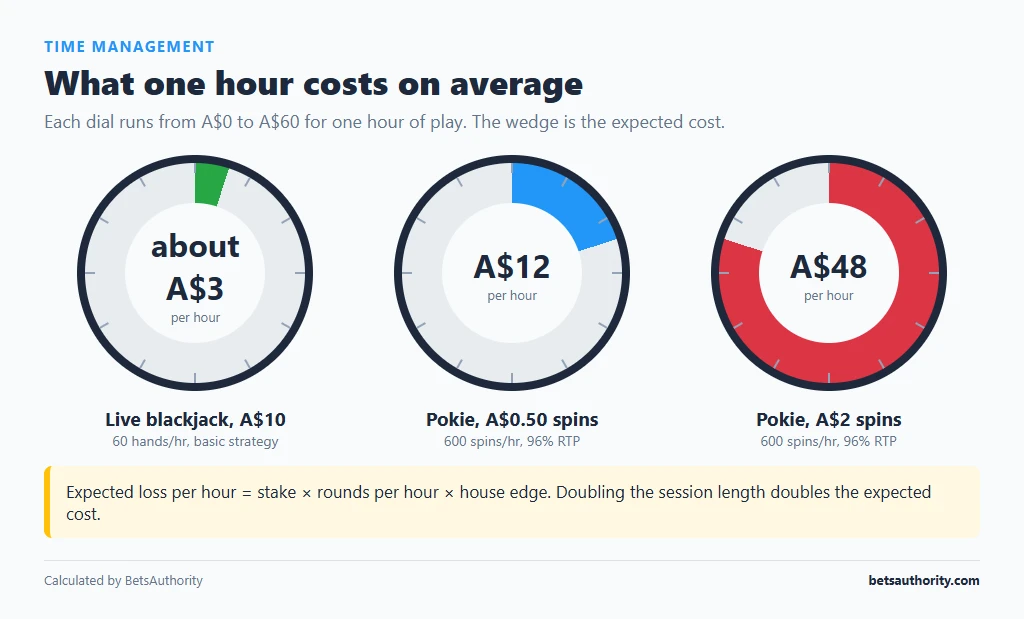
Expected loss per hour = stake x rounds per hour x house edge. Typical figures:
| Activity | Rounds per hour (approx.) | Expected cost per hour |
|---|---|---|
| Pokie, A$0.50 spins, 96% RTP, normal speed | 600 | A$12 |
| Same pokie with Turbo | 1,000 | A$20 |
| Pokie, A$2 spins, 96% RTP | 600 | A$48 |
| Live blackjack, A$10, basic strategy | 60 | about A$3 |
| Live European roulette, A$5 | 40 | A$5.40 |
| Crash game, A$1 bets, 3% edge | 400 | A$12 |
A two-hour pokie session at A$2 a spin has an expected cost of about A$96 before variance. Doubling the session length doubles the expected cost; there is no way to “make it back” with more time.
Plan Each Session Before It Starts
- Pick the window. A fixed start and end time, for example 8:00 to 8:45 pm. Avoid open-ended sessions late at night.
- Set the budget for that window. Use the session bankroll from your bankroll plan.
- Set an alarm on your phone for the end time, and a second one 10 minutes earlier as a warning.
- Set the casino’s reality check to the shortest interval available (often 15 to 30 minutes). It shows time played and net result.
- Decide the stop rules: end time reached, budget gone, or win point reached. Whichever comes first ends the session.
Reality Checks and Session Limits
Most casinos offer some of these tools in account settings, under names such as “Responsible Gaming”, “Limits” or “Safer Gambling”:
| Tool | What it does | Suggested setting |
|---|---|---|
| Reality check | Pop-up after a set interval showing time and net result | Every 15 to 30 minutes |
| Session limit | Logs you out after a set time | 45 to 90 minutes |
| Deposit limit | Caps deposits per day/week/month | Your monthly budget |
| Loss limit | Caps net losses over a period | Your session bankroll per day |
| Cooling-off | Locks the account for a short period (e.g. 24 hours to 6 weeks) | Use after any session that ran over |
Increases to limits usually take effect only after a delay, often 24 hours or more, while decreases apply immediately. That delay is deliberate. See reality checks and cooling-off periods.
Break Rules That Work
- Stand up every 20 to 30 minutes. Even a short break interrupts the rhythm of continuous play.
- Close the tab, not just the game. A lobby full of thumbnails restarts sessions.
- Never start a new session to recover the last one. Same-day repeat sessions after a loss are a common sign of chasing.
- Do not gamble when tired, after alcohol, or when upset. Judgement on stakes and stopping points is the first thing affected.
Features That Speed Up Play
Several game features increase rounds per hour without changing the house edge, which raises the hourly cost:
- Turbo / Quick Spin: shortens animations. Turn it off.
- Autoplay: removes the decision between spins. If you use it, set a spin count and a loss limit.
- Feature buys: compress hundreds of spins of cost into one click. See bonus buys.
- Multiple tables or games at once: doubles the hourly turnover.
Promotions Set on Overseas Clocks
Offshore casinos usually time promotions, tournaments and bonus deadlines in UTC or Central European Time. RocketPlay’s Friday reload, for example, runs on Friday UTC, which is 10 or 11 am Friday to 10 or 11 am Saturday on the east coast depending on daylight saving. Deadlines that fall overnight in Australia push play into late hours. Convert promotion times to local time before you plan a session, and skip any offer that only fits outside your planned window.
Weekly Time Budget
Many people find a weekly time cap easier to keep than a daily one. A simple template:
| Item | Example |
|---|---|
| Sessions per week | 2 |
| Length per session | 45 minutes |
| Days | Friday and Sunday evenings |
| Weekly time total | 90 minutes |
| Expected cost at A$0.50 pokies | About A$18 |
Record the actual time in your session log. If actual time exceeds the plan two weeks in a row, cut the session count, not just the length. The tracking guide includes a log template.
Signs a Session Has Run Too Long
- You did not notice the reality check pop-ups, or dismissed several.
- You played past the alarm “to finish the bonus” or “until the next feature”.
- You deposited again during the session.
- You are playing at hours you would not normally be awake.
Any of these is a cue to use a cooling-off period. If they keep happening, the signs of problem gambling page and help services list are the next step.
Frequently Asked Questions
Many players use sessions of 30 to 60 minutes with a fixed end time. Shorter sessions keep the expected cost and the risk of chasing losses lower.
A pop-up that appears at set intervals showing how long you have been playing and your net result, so you can decide whether to continue.
No. Expected loss grows with every round played. More time means more total wagered and a larger expected loss.
No, but it increases spins per hour, which increases the hourly cost at the same stake.
Set a casino session limit that logs you out, use a cooling-off period, and reduce the number of sessions per week. Gambling Help Online can also help.
Set time limits before you start, not during a session. Gambling is for adults 18+; Gambling Help Online is on 1800 858 858, 24/7.