
Provably Fair Games: How Seeds and Hashes Prove a Result
Provably fair is a method used mainly by crypto casinos and crash-game studios that lets you check, after the fact, that a game result was fixed before you bet and was not changed afterwards. Instead of trusting a lab certificate, you recompute the result yourself from published inputs. It is common in crash games, dice, Plinko, Mines, Keno variants and some in-house card games. This guide sits in our casino tips and strategy section.
The Four Ingredients
| Input | Who controls it | Purpose |
|---|---|---|
| Server seed | Casino | A secret random string. You see only its SHA-256 hash until you rotate it. |
| Server seed hash | Shown to you in advance | A commitment: the casino cannot change the seed later without the hash no longer matching. |
| Client seed | You (or your browser) | Your input, so the casino cannot pre-select results knowing every input. |
| Nonce | Counter | Increases by one with every bet, so each round uses a different input. |
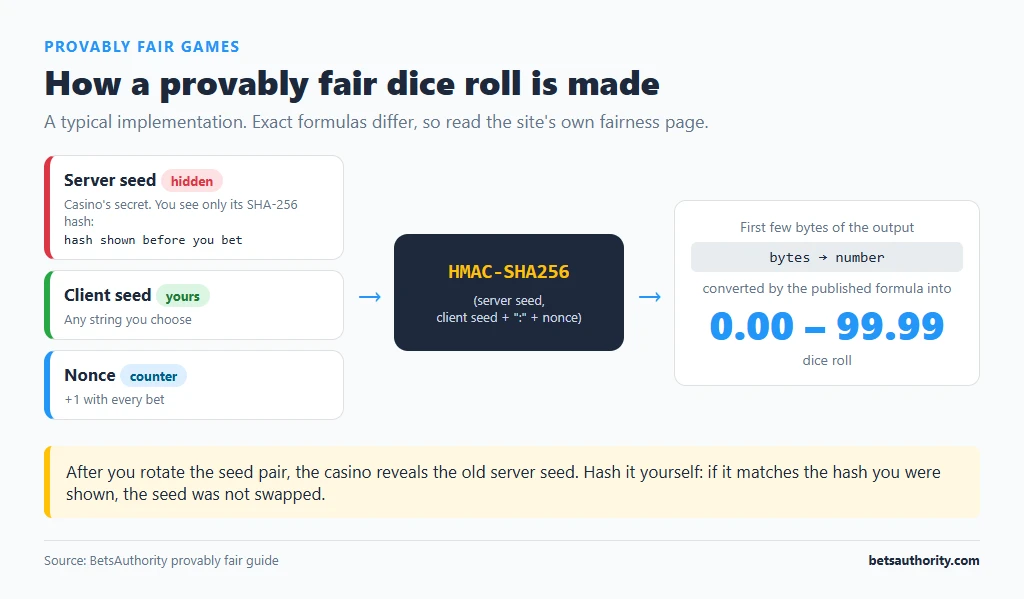
A typical implementation computes HMAC-SHA256(server seed, client seed + “:” + nonce), takes the first few bytes of the output and converts them into a number. That number becomes the dice roll, crash point or Plinko path according to a published formula. Exact formulas differ between casinos and studios, so always read the site’s own fairness page.
Why the Hash Is the Key
SHA-256 is a one-way function. Given a hash, you cannot work out the seed, and it is practically impossible to find a second seed with the same hash. When the casino shows you the hash before you bet, it has committed to one server seed. When it later reveals the seed, you hash it yourself. If the hash matches what you were shown, the seed was not swapped mid-session.
How to Verify a Round: 5 Steps
- Before betting, open the fairness or seed settings. Copy the server seed hash and set your own client seed (any string you choose, such as a random word and number).
- Play and note the nonce of any round you want to check. Most bet histories show it.
- Rotate the seed pair. The casino reveals the old server seed and issues a new hash for future bets.
- Hash the revealed seed with any independent SHA-256 tool and compare it to the hash you copied in step 1.
- Recompute the result using the casino’s published formula, either with their verifier or, more convincingly, an independent script or third-party verifier. The output must match the result in your history.
If step 4 or 5 fails, screenshot everything and contact support; then stop depositing until it is explained.
Shared-Seed Games Such as Crash
Multiplayer crash games need one result for everyone. Some use a pre-generated chain of hashes, where each round’s seed is the hash of the next, published in reverse order, so all future crash points are committed in advance. Spribe’s Aviator combines the server seed with client seeds from the first players to bet in each round. Either way, the principle is the same: the inputs are fixed before the round and can be checked afterwards. More on crash mechanics in how crash games work.
What Provably Fair Does Not Guarantee
- A low house edge. The formula itself contains the edge. A dice game paying 1.98x on a 50% chance has a 1% edge; another site might pay 1.96x (2% edge). Both are provably fair. Read the payout table.
- Payouts. It proves the round result, not that the casino will process your withdrawal. Licensing and complaint history still matter; see withdrawing winnings.
- Verification by default. The protection only exists if someone checks. Spot-checking a handful of rounds after each seed rotation is enough to catch tampering.
- Every game in the lobby. Third-party pokies and live tables at crypto casinos use standard certified RNGs or physical equipment, not provably fair seeds. See our RNG explainer.
Typical House Edges on Provably Fair Games
| Game type | Typical house edge range | How to read it |
|---|---|---|
| Dice | 1% to 2% | Payout x win chance; 1.98 x 50% = 99% RTP |
| Crash | 1% to 3% | Stated RTP in game rules (Aviator: 97%) |
| Plinko | About 1% to 3%, varies by risk setting and rows | Game rules or fairness page |
| Mines | About 1% to 3% | Multiplier table vs true odds |
These edges are low compared with pokies, but crash and dice games run very fast. A 1% edge on 1,000 bets an hour at A$2 each is an expected A$20 an hour, close to a 96% RTP pokie at the same pace. See house edge explained for the formula.
Checklist for Provably Fair Sites
- The fairness page publishes the exact formula, not just the word “provably fair”.
- You can set your own client seed and rotate the server seed at any time.
- Bet history shows the nonce and seed pair for each round.
- The casino has a stated licence and a track record of paying; our crypto casino comparison lists sites we have reviewed.
Frequently Asked Questions
It is a cryptographic method that lets you verify each game result was determined by inputs committed before your bet, using a hashed server seed, your client seed and a nonce.
It cannot change a verified round without the hash failing to match. It can still offer a high house edge or refuse withdrawals, which provably fair does not address.
No. Spot-checking several rounds after each seed rotation is enough, because any tampering would show up as a mismatch.
Spribe states that Aviator uses a provably fair system that combines a server seed with client seeds from the first players in each round. Its stated RTP is 97%.
Usually not. Third-party pokies use the provider’s certified RNG. Provably fair mostly applies to in-house crash, dice, Plinko and Mines games.
Fast crypto games can consume a balance quickly. Play only if you are 18+, and call Gambling Help Online on 1800 858 858 for confidential support.