


Chicken Road Review

Chicken Road is not a classic online slot, and that is the first thing worth saying clearly. It sits much closer to the instant-game and crash-style side of the casino market than to reels, paylines, and ordinary free spins. The whole point is simple: guide the chicken forward, let the multiplier rise, and decide whether to cash out before the run ends. That structure makes the game feel more direct than a slot because the player is not only watching an outcome happen. The player is also deciding when enough value is enough.
That one design choice changes the mood of the session. Chicken Road creates tension from timing rather than from symbol combinations. There is no long list of paylines to memorize and no giant feature tree to decode. Instead, the pressure comes from choosing whether to keep pushing for a better multiplier or lock the result before the chicken gets burned. For players who enjoy simple rules but still want genuine risk, that is exactly why Chicken Road has found an audience so quickly.
Game Overview
Chicken Road is commonly listed as an InOut Games release from 2024. Public game sheets and official-style promotional materials usually describe it as an instant or crash-style casino game built around progressive multipliers, several difficulty settings, and a strong emphasis on user choice. That already separates it from most slot pages. When reviewing Chicken Road, the main question is not how the reels behave. The real question is how the risk curve behaves as the run continues.
Publicly available game information often lists a top RTP of up to 98%, although some difficulty modes and casino integrations may show different effective values. Volatility is generally described as high, which fits the format because one extra decision can dramatically change the final result. Maximum win figures also vary across public listings, but the most common promotional cap is up to $20,000 or an equivalent top multiplier under the highest difficulty modes. Because this is an operator-configured instant game rather than a fixed classic slot, players should always check the in-game information panel before treating any one number as universal.
| Parameter | Details |
|---|---|
| Game | Chicken Road |
| Provider | InOut Games |
| Game type | Instant / crash-style casino game |
| Layout | Progressive path format rather than reels |
| Pay system | Manual cash-out multiplier model |
| RTP | Up to 98% depending on mode and operator |
| Volatility | High |
| Maximum win | Commonly listed up to $20,000 |
| Main features | Difficulty modes, rising multipliers, manual cash-out, demo play |
How Chicken Road Actually Works
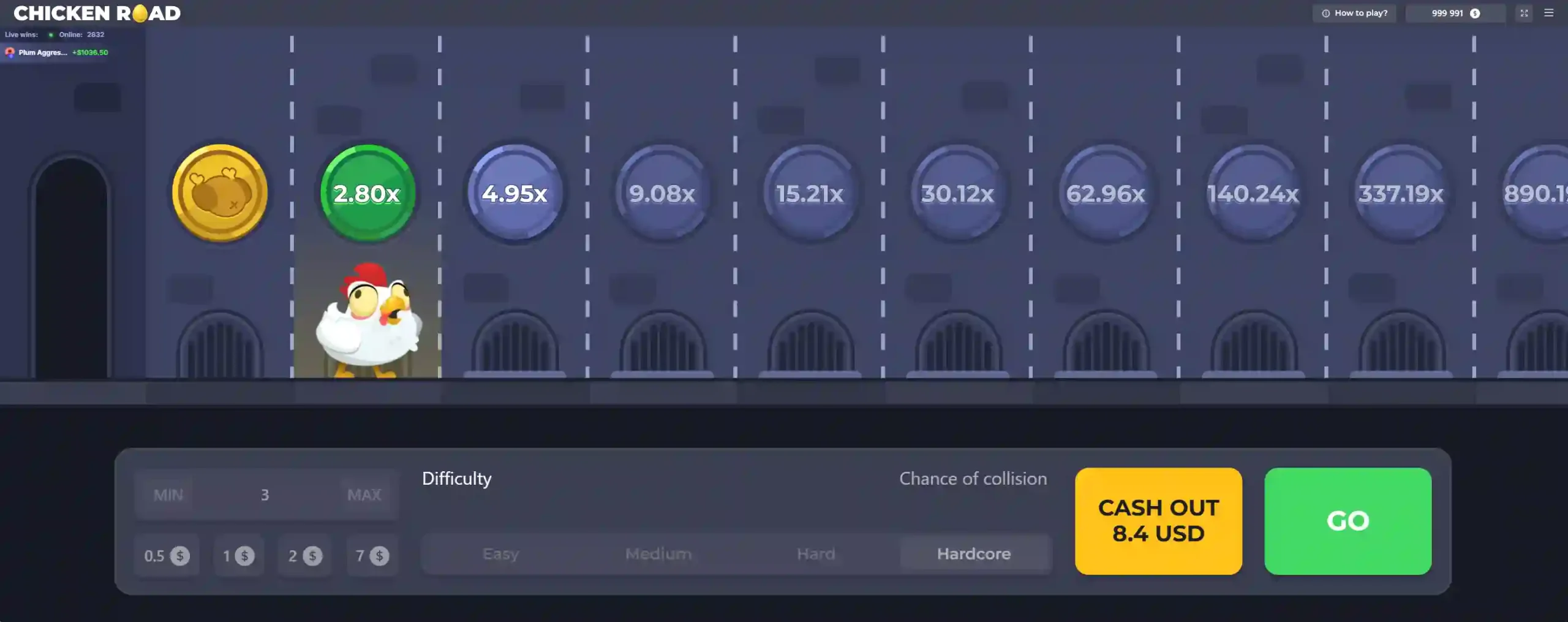
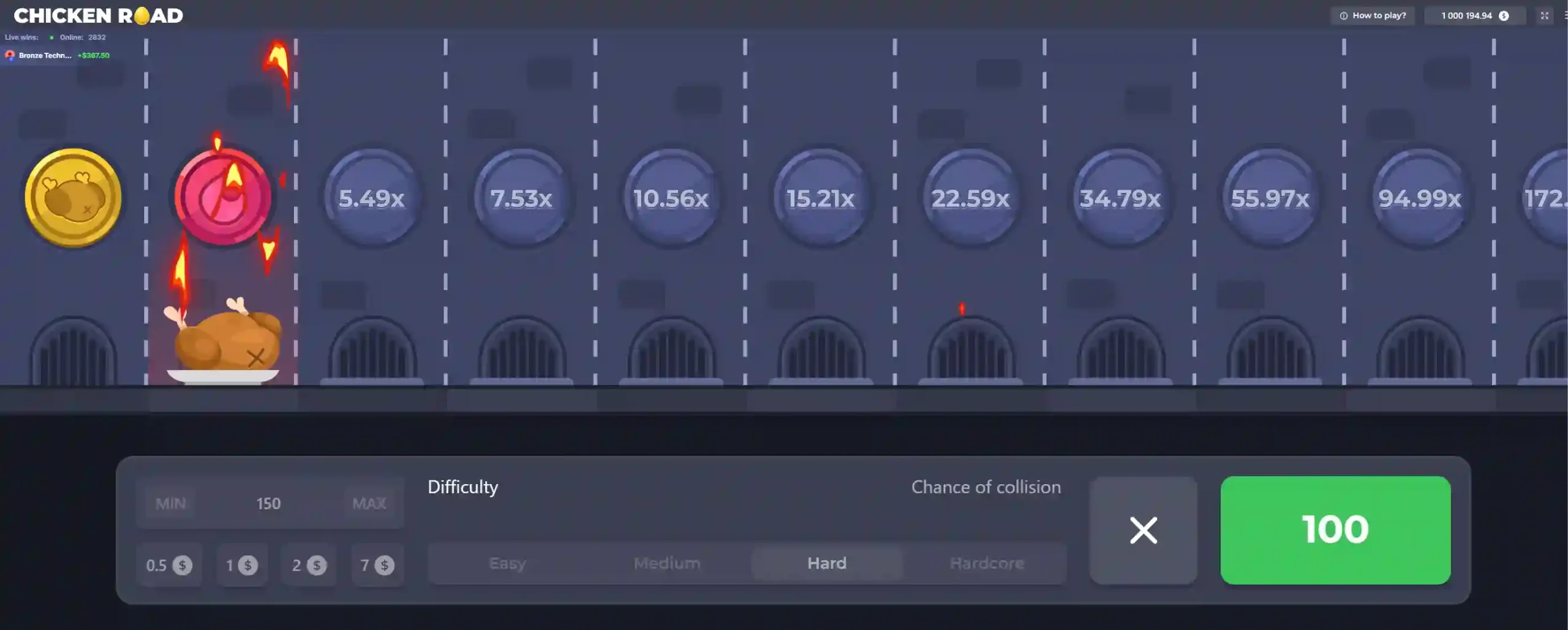
The rules are easy to explain, which is one reason the game converts well with casual players. You place a bet, start the round, and watch the chicken move forward along a dangerous path. With each successful step, the multiplier increases. At any point before failure, you can cash out and secure the current return. If you stay in too long and the chicken hits a trap, the round ends and the stake is lost. That is the entire loop, but the simplicity is deceptive because every decision after the first step becomes a judgment about risk tolerance.
Unlike a reel slot, the game does not hide its tension inside symbol mathematics. Chicken Road makes the danger obvious. You can see the multiplier rising, and you know that a better payout always requires more exposure. This transparency is a big part of the appeal. Many casino players enjoy the feeling that they are making an active choice rather than waiting for a slot to decide everything on their behalf. Chicken Road taps directly into that preference.
The result is a faster emotional cycle than ordinary slots usually provide. In a line slot, the spin is the decision. In Chicken Road, the spin is only the beginning. The real decision is whether to stop now or keep going. That makes the game feel closer to a trading decision or a controlled crash experience than to a standard slot round. For some players that is a huge positive. For others, it creates too much tension too quickly. Either way, the game knows exactly what it is trying to do.



Difficulty Modes and Risk Structure
One of the more interesting design choices in Chicken Road is the use of multiple difficulty settings. Public descriptions commonly refer to levels such as Easy, Medium, Hard, and Hardcore. The practical meaning is clear even when the exact mathematical profile varies by operator. Lower modes usually offer a gentler path with smaller top-end multipliers, while harder modes compress the safety margin and increase the upside if the player keeps going.
This difficulty structure matters because it gives the player more control than a standard crash graph does. Instead of only choosing when to cash out, you also choose what kind of risk environment you want to enter before the round starts. That makes Chicken Road more adaptable. A cautious player can stay on lighter settings and treat the game as a controlled multiplier grinder. An aggressive player can choose the harsher modes and accept the fact that many rounds may end abruptly in exchange for access to much larger returns.
It also makes the game easier to position strategically. On easier settings, Chicken Road behaves more like a discipline game where consistent early exits matter. On tougher settings, it becomes much more psychological because the temptation to chase a dramatic multiplier becomes stronger. That dual identity gives the game more depth than it first appears to have. The rules are simple, but the experience changes significantly once difficulty is added to the decision tree.
Why RTP and Volatility Need Extra Context Here
When people see a quoted RTP of 98%, they often assume the game is automatically generous. That is too simplistic. In Chicken Road, RTP only makes sense together with difficulty selection, cash-out behavior, and operator configuration. A player who always chases long risky runs may experience the game very differently from one who repeatedly takes modest multipliers. The theoretical return does not remove the importance of decision quality.
Volatility works the same way. Chicken Road is commonly described as high volatility because the difference between a safe exit and a failed push can be huge. Still, this is not volatility in the same sense as a slot with bonus buys and giant scatter triggers. It is a more immediate form of volatility. The player sees the risk expanding in real time and chooses whether to stay exposed. That makes losses feel more self-directed and wins feel more intentional.
This is one reason the game appeals to players who say they want more control in casino sessions. Chicken Road does not guarantee better outcomes just because it offers a decision, but it does make the decision visible. For many users, that makes the game easier to engage with than a complicated slot with ten layers of bonus logic and uncertain timing.
Chicken Road Demo Play vs Real Money Play
Chicken Road demo play is especially useful because the main lesson of the game is not just understanding rules. It is understanding your own behavior. Demo mode shows very quickly whether you are the kind of player who cashes out early and protects small gains or the kind who always wants one more step. That self-knowledge matters more here than in most slot demos because the game is built around temptation management.
Real money play adds pressure to those same decisions. Once the stake matters, every extra step feels more expensive and every early exit can feel too conservative. That is why Chicken Road works best when the player enters with a fixed session plan. Decide your average exit zone before the round begins. Decide whether you are using low-risk or high-risk difficulty. Decide how many failed runs you are willing to absorb before stopping. Without that structure, the game can become too emotional very quickly.
Casino choice also matters. Since Chicken Road is often offered through modern crypto-friendly and instant-game-focused operators, players should still check licensing, banking speed, support quality, and visible game information before depositing. The format may feel lightweight, but the operator conditions still shape the real-money experience in the same way they do for slots and table games.
How to Approach Chicken Road Strategically
The strongest practical advice for Chicken Road is to treat it as a decision game, not as a luck machine with a funny chicken theme. If you enter every round with no exit plan, the multiplier will usually end up making the decision for you. That is how players turn a simple instant game into an expensive chase. The better approach is to define a realistic zone where you are usually willing to cash out and then deviate from it only deliberately.
This does not mean you should always leave early. That would flatten the entire point of the game. It means you should understand why you are staying. Are you in a higher-risk mode because you intentionally want a bigger swing? Are you already ahead and willing to push more aggressively? Or are you simply reacting emotionally because the multiplier is rising and you do not want to miss out? Chicken Road becomes much more manageable once you separate those motives.
Players who enjoy the game most usually do one of two things well. They either play it like a disciplined ladder, banking smaller multipliers regularly, or they use clearly defined high-risk sessions where larger failures are already budgeted for. Problems start when someone tries to mix those two identities without noticing. That is when the game feels unfair, even though it is often just exposing weak bankroll discipline.
Pros and Cons
Pros
- The rules are simple enough for beginners, but the cash-out timing still creates real tension.
- Difficulty modes give players more control over session style than a standard instant game usually offers.
- Manual cash-out makes the experience feel more active than ordinary slot spinning.
- Publicly listed RTP can be very competitive when the top version is available.
- Works well in demo mode because it teaches player behavior, not just game rules.
Cons
- It is not a traditional slot, so players expecting reels, bonus symbols, and free spins may be disappointed.
- The game becomes emotionally expensive very quickly if you chase one extra step too often.
- Public figures such as RTP and max win can vary by operator and mode, so you need to verify them in-game.
- High-risk modes can burn a bankroll faster than the simple visuals might suggest.
- Not ideal for players who prefer passive casino play and do not want repeated timing decisions.
Final Verdict
Chicken Road works because it understands that simplicity can still create serious pressure. The game does not need reels, scatters, or a long bonus ladder to stay engaging. Its strength is that every round asks a clean and uncomfortable question: do you take the current multiplier or do you believe the next step is worth the risk? That directness gives the game a different kind of replay value from most slots.
For players who enjoy instant games, crash-style formats, and visible decision-making, Chicken Road is a strong fit. For players who want traditional slot structure, it is better understood as a neighboring casino product rather than a substitute. Either way, it is better to review it honestly as a cash-out game than to force it into the shape of a classic slot page. On its own terms, Chicken Road is easy to understand, easy to enter, and harder to master than it first appears.